

Last month, a contractor sent us a video from a hotel facade test in the Netherlands.
The DMX LED neon flex sample had worked perfectly on the bench. But on the building, the last sections flickered, two zones copied the same color, and the white channel did not respond at all.
The neon flex was not the real problem. The control plan was.
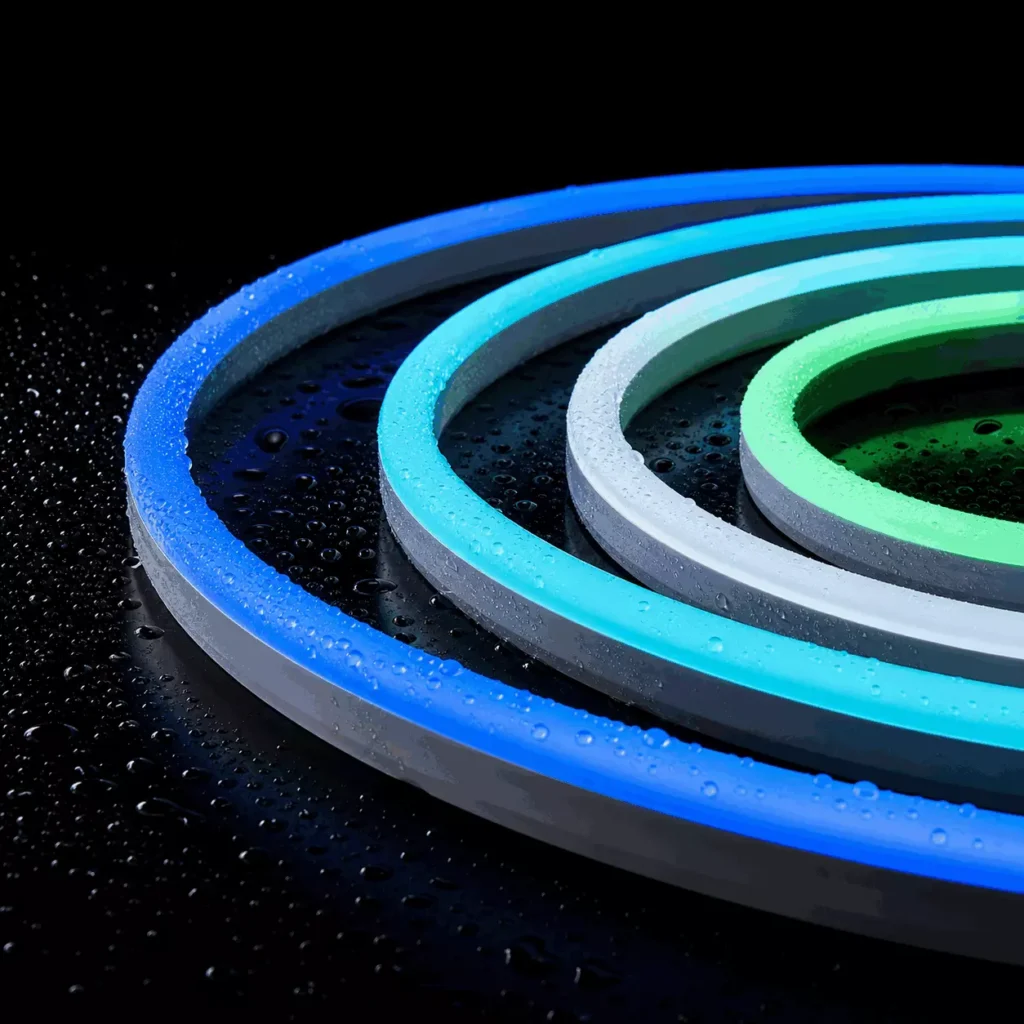
Table of Contents
The project had RGBW pixel sections, a single DMX universe that was already overloaded, one wrong decoder type, and no clear power injection plan. By the time the installer found the root cause — every reel had shipped with the factory-default start address 001, so every section was fighting over the same 512 channels — the strips were already mounted high on the facade. The re-installation cost the contractor a full day and a very uncomfortable client conversation.
We hear a version of this story at least once a month at NPHIS. And almost every time, the failure is not the LED chip, not the silicone, not the power supply. It is a control planning mistake made before a single meter of strip was installed.
That is why we wrote this guide from the factory side. If you are buying DMX LED neon flex for facades, stages, clubs, hotels, bridges, or entertainment venues, the product specification is only half of the job. The control architecture must be right before production starts.
What Is DMX LED Neon Flex?
The Product in Plain Language
DMX LED neon flex is a flexible silicone linear light that can be controlled through the DMX512 protocol for dimming, color, zone control, or pixel-level effects.
A static neon flex turns on as one continuous line. A standard RGB neon flex can change color by zone. A DMX RGBW or pixel neon flex can be individually addressed, mapped, synchronized, and programmed as part of a larger lighting show.
For B2B projects, the value is not only color. The value is control.
A hotel can run warm white on weekdays and brand colors during events. A shopping mall can change scenes for holidays. A stage designer can sync neon outlines with a console in real time.
What Makes It Different From Normal Neon Flex
Three things separate DMX neon flex from a standard silicone strip:
1. The silicone housing — integral co-extruded silicone, IP67 or IP68 rated, UV-resistant, anti-yellowing. This is the same material used in all NPHIS outdoor neon flex products.
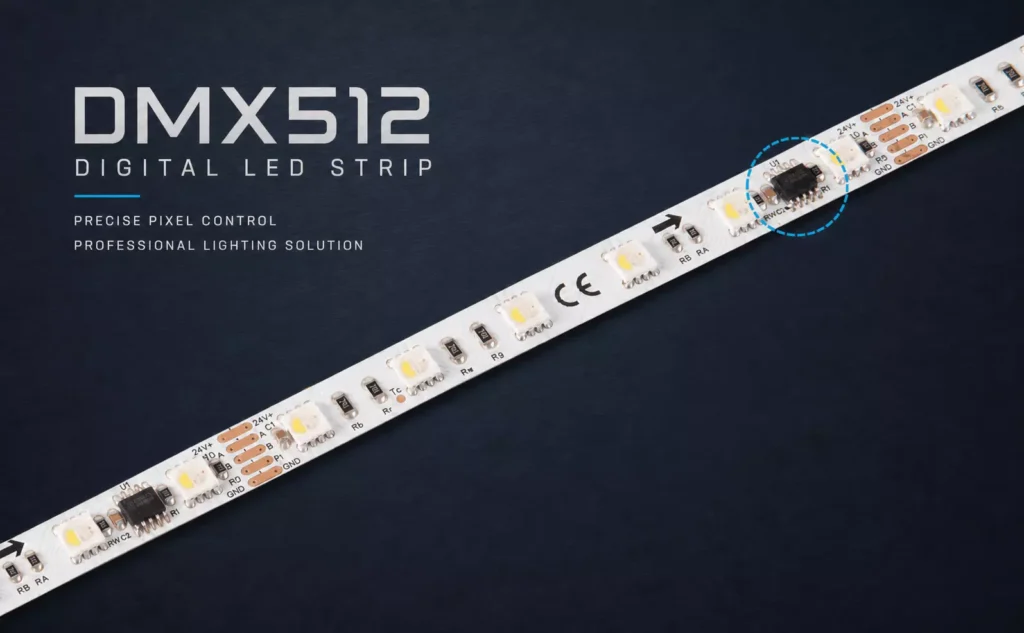
2. The LED and IC layer — SMD LEDs (typically 5050 RGBW or 3535 RGBW) mounted on a flexible PCB, with a built-in addressable IC that reads DMX512 data directly.
3. The control input — a DMX512 data signal carried over a shielded RS-485 cable, decoded by the IC inside each section. Without the signal, the strip does nothing. Without a correctly addressed strip, the signal goes nowhere useful.
For the full range of NPHIS silicone neon flex options including side bend, top bend, RGB, RGBW, pixel, and DMX configurations, see the NPHIS Silicone LED Neon Flex collection.
How DMX LED Neon Flex Control Works
The Full System Path
Most buyers focus on the strip. The strip is the last component in a chain that starts at the controller.
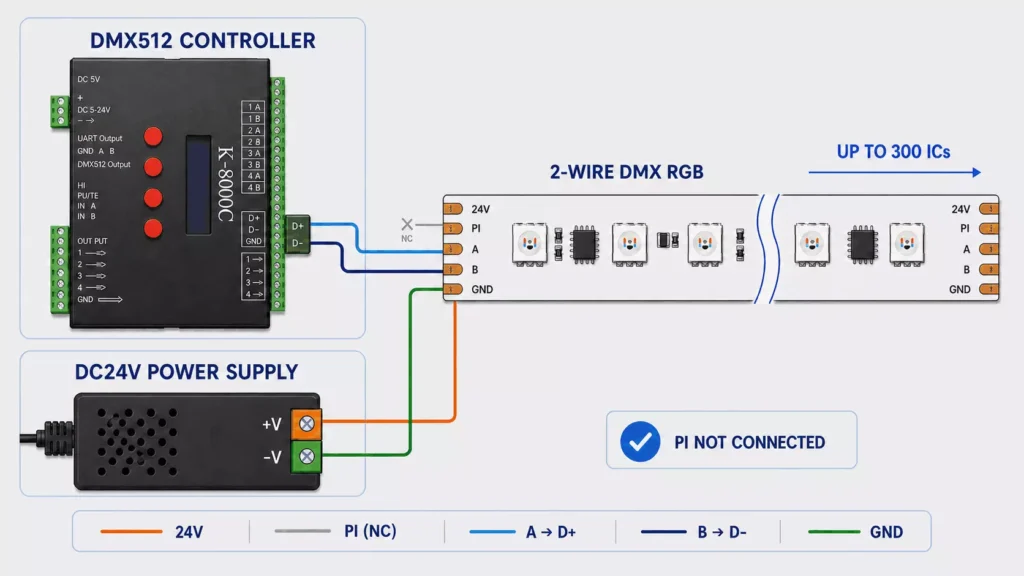
Here is the complete signal path for a professional DMX neon flex installation:
Lighting Console / Media Server / Standalone Controller
↓
Art-Net or sACN Node (for large multi-universe projects)
↓
DMX Decoder or DMX Pixel IC (built into the strip)
↓
Constant-Voltage Power Supply (24V recommended)
↓
DMX LED Neon Flex
Each step in this chain must match the next. A mismatch at any point — wrong decoder type, wrong protocol, wrong voltage — causes the failure, not the strip itself.
DMX512: The Protocol Basics
DMX512 is a serial communication protocol based on the EIA-485 (RS-485) electrical standard. The “512” refers to the number of data channels in one universe.
Think of it as a 512-lane highway. Every lane carries a value between 0 and 255. Your controller broadcasts all 512 lanes simultaneously, up to 44 times per second. Every fixture on the line reads only the lanes it has been assigned.
As Microchip’s DMX-512 protocol reference describes, the protocol runs at 250,000 bps over a differential RS-485 pair — which gives it excellent noise immunity over long cable runs.
Addressing: The Most Overlooked Step
Each controllable section on the strip has a unique start address in the DMX universe. The controller sends 512 channels of data continuously. Each section “listens” only to its assigned channel block.
For RGBW neon flex, set addresses in increments of 4:
- Section 1 → Address 001 (channels 1–4: R, G, B, W)
- Section 2 → Address 005 (channels 5–8: R, G, B, W)
- Section 3 → Address 009 (channels 9–12: R, G, B, W)
If two sections share the same start address, they mirror each other. That is exactly what happened in the hotel facade story above.
Build your address map in a spreadsheet before installation. Share it with the factory. We can pre-set addresses on every reel before shipment.
Art-Net and sACN: When You Need More Than One Universe
For large facade or entertainment projects, one DMX universe is rarely enough.
Art-Net and sACN (streaming ACN) carry multiple DMX universes over standard Ethernet. ETC’s control protocols documentation covers how professional consoles like ETC Eos handle Art-Net and sACN distribution across large installations.
For a hotel facade or bridge with hundreds of pixel groups, plan for Art-Net or sACN from the start — not after you discover one universe is not enough.
DMX vs SPI vs PWM: Which Control Method Do You Need?
This is the question we get most from new importers and facade contractors. The wrong choice here creates a quote mistake that costs real money.
| Control Method | Signal Type | Max Cable Run | Pixel Control | Outdoor Suitability | Best For | Main Risk If Misused |
|---|---|---|---|---|---|---|
| PWM | Analog 0–10V / PWM | 50–100 m | ❌ Whole zone only | ⭐⭐⭐ Moderate | Simple dimming, single-color zones, low-cost projects | No pixel-level control. Wrong choice for addressable IC strips. |
| SPI (WS2812 / SK6812) | Single-ended TTL | 5–10 m (needs booster) | ✅ Per-pixel | ⭐⭐ Poor outdoors | Short indoor pixel effects, signs, retail features, DIY | Sensitive to distance, grounding, and signal quality on outdoor runs. |
| DMX512 | Balanced RS-485 differential | 300 m (with termination) | ✅ Per-pixel / per-zone | ⭐⭐⭐⭐⭐ Excellent | Facades, stages, clubs, hotels, bridges, professional show control | Needs universe and address planning. Poor wiring causes flicker or lost data. |
| Art-Net / sACN | Ethernet (UDP) | 100 m per segment (Ethernet) | ✅ Multi-universe | ⭐⭐⭐⭐⭐ Excellent | Large multi-universe projects, media servers, professional AV integration | Needs integrator-level network planning and compatible nodes. |
The Honest Recommendation
Use DMX when the project is outdoors, over 20 meters, or needs to integrate with a professional AV or lighting console.
SPI works well for short indoor pixel art, retail features, or custom microcontroller projects. But on a 200-meter facade with 6 cable runs in separate conduits, SPI becomes a grounding and signal-integrity nightmare.
PWM is enough when you just need to dim a single color zone. Do not over-engineer a simple hospitality accent light.
The decision should come from the project scale, cable route, controller ecosystem, and maintenance plan — not from a product title alone.
For a deeper technical breakdown of decoder types and why a standard PWM decoder will destroy an addressable pixel strip, read our article: DMX Pixel Decoder vs Standard DMX Decoder.
Where DMX LED Neon Flex Works Best
DMX LED neon flex is not necessary for every order. If a buyer only needs one warm-white line around a small storefront, standard silicone neon flex is simpler and more cost-effective.
DMX becomes valuable when the light must move, respond, synchronize, or change scenes across a larger space.
| Application | Recommended DMX Neon Direction | Key Buyer Notes |
|---|---|---|
| Building Facade | IP67/IP68 silicone RGBW or pixel DMX neon flex | Confirm run length, cable route, power room location, and maintenance access before ordering. |
| Hotel Exterior | Warm white plus RGBW DMX scenes | Keep daily scenes elegant. Save strong colors for events and holidays. |
| Shopping Mall | RGBW or pixel DMX facade lighting | Plan seasonal content and multi-zone control before production starts. |
| Stage / Concert | High-refresh addressable neon with DMX or Art-Net integration | Match console, decoder, and pixel protocol before shipping. Confirm refresh rate. |
| Club / Bar | RGBW DMX neon flex with scene presets | Use zones for bar counter, ceiling, wall, entrance, and VIP areas separately. |
| Bridge / Public Space | Weatherproof DMX linear neon with stable signal planning | Prioritize waterproof connectors, surge protection, and long-term serviceability. |
| Theme Park | Pixel DMX neon flex with media server integration | High-cycle operation. Specify IP68 and UV-stable silicone. Plan for easy section replacement. |
For outdoor facade basics — IP rating, silicone material, bending direction, and connector sealing — read our dedicated guide: Outdoor LED Neon Flex for Building Facade Lighting. We will not repeat those topics here.
DMX LED Neon Flex Wiring Architecture
A reliable DMX neon flex installation separates the control signal from the power design. Treating both as one simple cable run is how most projects develop flicker, voltage drop, and painful maintenance calls.
The Correct Signal Path
Lighting Console / Media Server
↓ (XLR or Ethernet cable)
Art-Net / sACN Node (for multi-universe projects)
↓ (Shielded DMX cable, 110Ω impedance)
DMX Decoder or built-in DMX IC in neon flex
↓ (Power + data to strip)
Section 1 (Address 001) → Section 2 (Address 005) → ... → 120Ω Terminator
Four Wiring Rules That Prevent Most Failures
Rule 1 — Always daisy-chain, never star-wire. Controller → Fixture 1 → Fixture 2 → Fixture 3 → Terminator. Star topology creates impedance mismatches and signal reflections. If you need to split to multiple runs, use an opto-isolated DMX splitter — not a passive Y-cable.
Rule 2 — Always terminate. A 120Ω resistor at the end of every DMX chain is not optional. Without it, signal reflections cause flickering, especially on runs over 50 meters. Use a pre-made XLR termination plug or solder a 120Ω resistor between Pin 2 and Pin 3.
Rule 3 — Keep power and signal in separate conduits. Switching noise from LED power supplies induces interference into DMX signal cable. Route DMX cables in separate conduit, or maintain at least 100mm separation from power cables.
Rule 4 — Maintain a common ground. Keep a stable ground reference between controller, decoder, power supply, and strip. Ground loops cause flickering and can damage ICs over time. For power injection points, connect to the same power supply — or supplies sharing a common ground.
Use the Right DMX Cable
Always use dedicated DMX cable with 110Ω characteristic impedance. Do not use standard microphone cable — it has 75Ω impedance and causes reflections on longer runs. For outdoor installations, use UV-rated shielded cable with IP-rated XLR connectors.
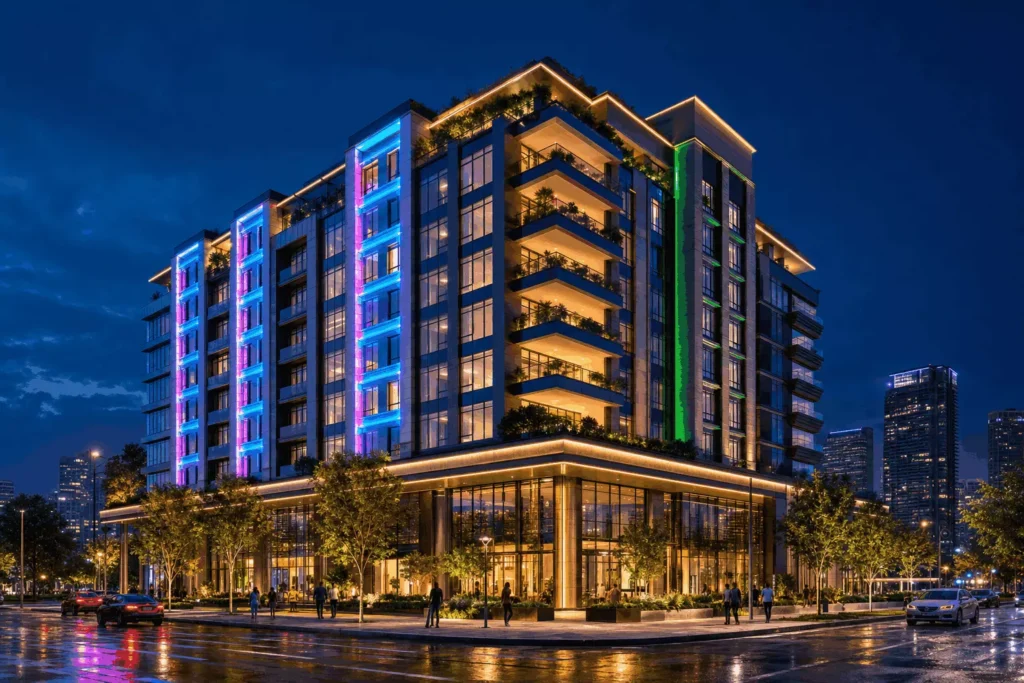
DMX Universe Calculator for RGB and RGBW Neon Flex
This is the calculation every project manager must complete before ordering. Get it wrong, and you either run out of channels mid-project or over-specify hardware you do not need.
The Core Formula
One DMX universe = 512 channels Channels needed = Pixels × Channels per pixel Universes needed = Total channels ÷ 512 (round up)
| Pixel / Segment Type | Channels per Pixel | Max Pixels per Universe | Channels Used | Planning Note |
|---|---|---|---|---|
| Single Color Dimming | 1 | 512 segments | 512 | For simple dimming zones only. Not for color effects. |
| RGB Neon Flex | 3 | 170 pixels | 510 (2 spare) | Good for pure color effects. No dedicated white channel. |
| RGBW Neon Flex | 4 | 128 pixels | 512 | Best for facades needing real white plus full color. Most common for hotels and commercial. |
| RGB + CCT (Tunable White) | 5 | 102 pixels | 510 | Use only when tunable white is truly required. Adds universe count quickly. |
Worked Example: Hotel Facade, 300 RGBW Pixel Groups
- Total pixels: 300
- Channels per pixel (RGBW): 4
- Total channels needed: 300 × 4 = 1,200 channels
- Universes needed: 1,200 ÷ 512 = 2.34 → round up to 3 universes
- Recommended: plan for 4 universes to allow grouping flexibility and future expansion
For a project of this scale, you need a controller or software that supports at least 4 Art-Net or sACN universes — and a network switch capable of handling the data throughput.
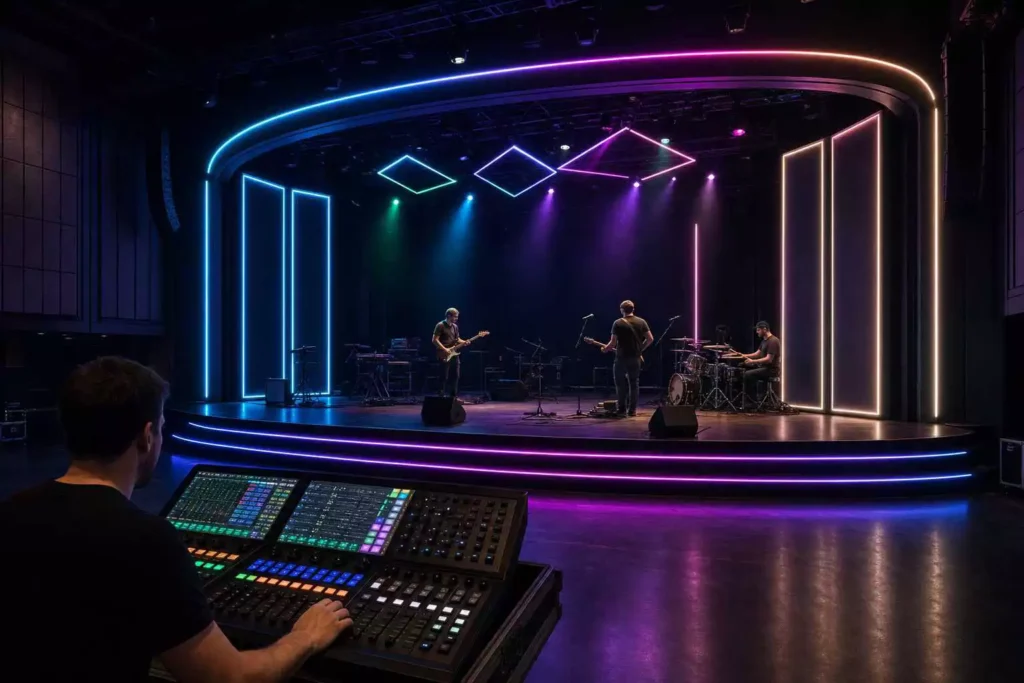
Power Injection and Voltage Drop Planning
DMX controls the signal. Power controls brightness stability. A perfect DMX address map cannot fix a long 24V run with visible color shift at the far end.
Why Voltage Drop Matters on Facades
At 24V, a 10-meter run of NPHIS RGBW neon flex at 18 W/m draws approximately 7.5 A at full white output. Feed that from one end only, and by meter 8, the voltage at the strip has dropped enough to shift the white point — the far end looks warmer than the near end.
On a facade where color uniformity is the whole point, this is unacceptable.
The 5% Rule
Keep voltage drop below 5% of nominal voltage. For 24V, that means no more than 1.2V drop across any run.
Voltage Drop (V) = Current (A) × Wire Resistance (Ω)
For practical use, inject power every 5–10 meters on full-load RGBW runs.
Power Supply Sizing Guide
Always add 20–25% headroom to your PSU capacity. Never run a power supply at 100% load — it shortens its life and causes thermal shutdown in warm climates.
| Run Length | Load (18 W/m RGBW) | Current at 24V | Min PSU (with 25% headroom) | Recommended Wire | Injection Strategy |
|---|---|---|---|---|---|
| 5 m | 90 W | 3.75 A | 120 W | 18 AWG | Single end feed |
| 10 m | 180 W | 7.5 A | 240 W | 14 AWG | Single end or both ends |
| 20 m | 360 W | 15 A | 2 × 240 W | 12 AWG | Inject at mid-point |
| 30 m | 540 W | 22.5 A | 3 × 240 W | 12 AWG | Inject every 10 m |
For waterproof material and connector details for outdoor power runs, read our guide: IP67 Silicone LED Neon Flex for Outdoor Commercial Lighting.
Common DMX Neon Flex Failures and How to Diagnose Them
When buyers send us a failure video, we do not start by blaming the strip. We first ask what changed between the sample test and the site installation.
In 14 years of supplying DMX neon flex, these are the failures we see most often:
| Symptom | Most Likely Cause | Field Check |
|---|---|---|
| Random flickering | Floating ground, bad DMX cable, signal reflection, interference, or water-damaged connector | Bond grounds, check DMX cable quality (110Ω), add termination resistor, separate power and data conduits |
| Last section stays dark | Universe overloaded, address map wrong, voltage drop, or missing power injection | Check total channel count vs universe capacity, measure voltage at far end, verify address map |
| Colors are swapped (R shows as G, etc.) | Wrong wiring order or decoder channel order mismatch | Test R/G/B/W channels one by one at 100% before sealing connectors |
| Every section mirrors the same color | Duplicate DMX start addresses on all sections | Assign and document unique addresses for each controllable segment. Pre-set at factory if possible. |
| No response at all | Wrong decoder type, protocol mismatch, or no shared ground | Confirm strip type: PWM RGBW, SPI pixel, or DMX pixel. A standard PWM decoder cannot drive a DMX pixel strip. |
| Color shifts toward end of run | Voltage drop — insufficient power injection or undersized wire | Measure voltage at strip far end. Add mid-run power injection. Upgrade wire gauge. |
| Works on bench, fails outdoors | Water ingress at cable exit points or cut ends | Re-seal with silicone gel. Use IP68 cable glands. Check end caps for compression seal integrity. |
The “Ghost Pixel” Problem
One failure mode that trips up even experienced installers: ghost pixels — random sections firing colors with no console command.
This happens when a DMX cable picks up electrical noise from nearby HVAC motors, switching PSUs, or fluorescent ballasts. The strip interprets the noise as a valid DMX signal.
The fix is always the same: use shielded DMX cable, ground the shield at the controller end only (not both ends — that creates a ground loop), and route away from noise sources.
A good supplier should help you check these risks before the order ships. That is why NPHIS asks for drawings, control method, voltage, section length, cable route, and pixel requirement before giving a final project recommendation.
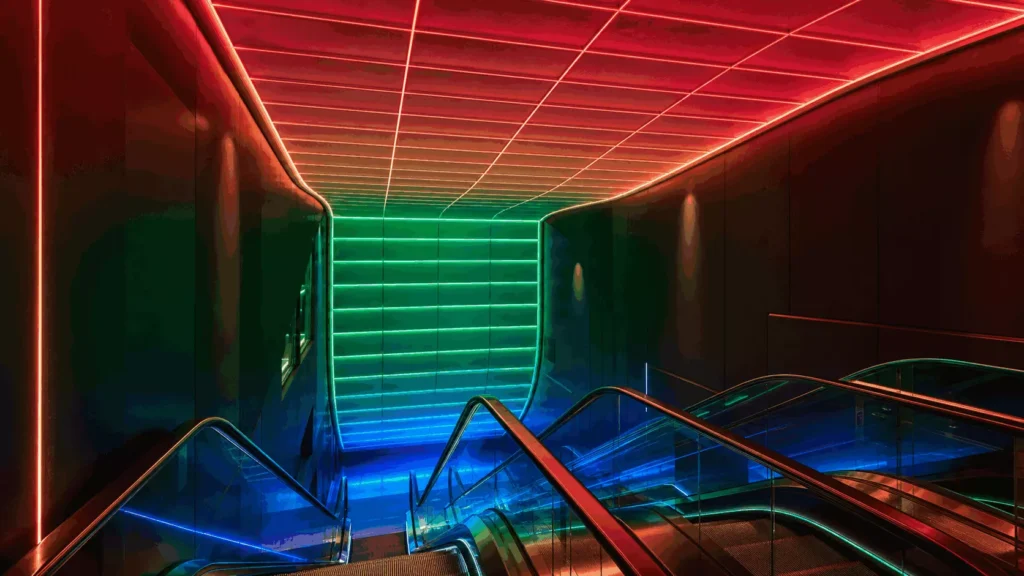
How to Choose the Right DMX LED Neon Flex: Buying Guide
The Weakest Question in a Neon Flex RFQ
“What is your price per meter?”
Price depends on structure, chip, color, control, IP rating, cable, accessories, and QC level. A better RFQ starts with a specification table.
| Spec | What to Confirm | Why It Matters |
|---|---|---|
| Profile | Top bend, side bend, 3D bend, 360° round, or custom | Must match the drawing and viewing direction. Wrong bend direction causes PCB stress and failure. |
| Control Protocol | PWM RGBW, DMX512, SPI, Art-Net/sACN system | Prevents decoder mismatch — the most common cause of "dead strip" failures. |
| Color | RGB, RGBW, dynamic white, single CCT, or custom | Affects channel count, white quality, and controller planning. |
| Voltage | 12V, 24V, 36V, 48V, or project-specific | Affects voltage drop, power layout, and PSU selection. |
| IP Rating | IP65, IP67, IP68 — plus connector and end-cap details | Outdoor failure often starts at cut ends and cable joints, not the strip itself. |
| Pixel Pitch | Pixels per meter or segment length | Controls animation resolution and DMX universe count. Match to viewing distance. |
| Accessories | Mounting channel, clips, end caps, waterproof connectors | Determines installation quality and long-term serviceability. |
| Certification | CE, RoHS, UL, ETL, TÜV on request | Required for EU/US import, project submittals, and market compliance. |
Profile Selection: Don’t Guess
For facade projects with compound curves or wave shapes, the bend direction is as critical as the IP rating. A top-bend strip forced into a horizontal curve will stress the PCB until it fails.
For profile selection guidance, read:
- Side Bend Silicone LED Neon Flex — for horizontal curves, logos, and letter outlines
- 3D Bend Silicone Neon Flex — for compound curves and complex architectural surfaces
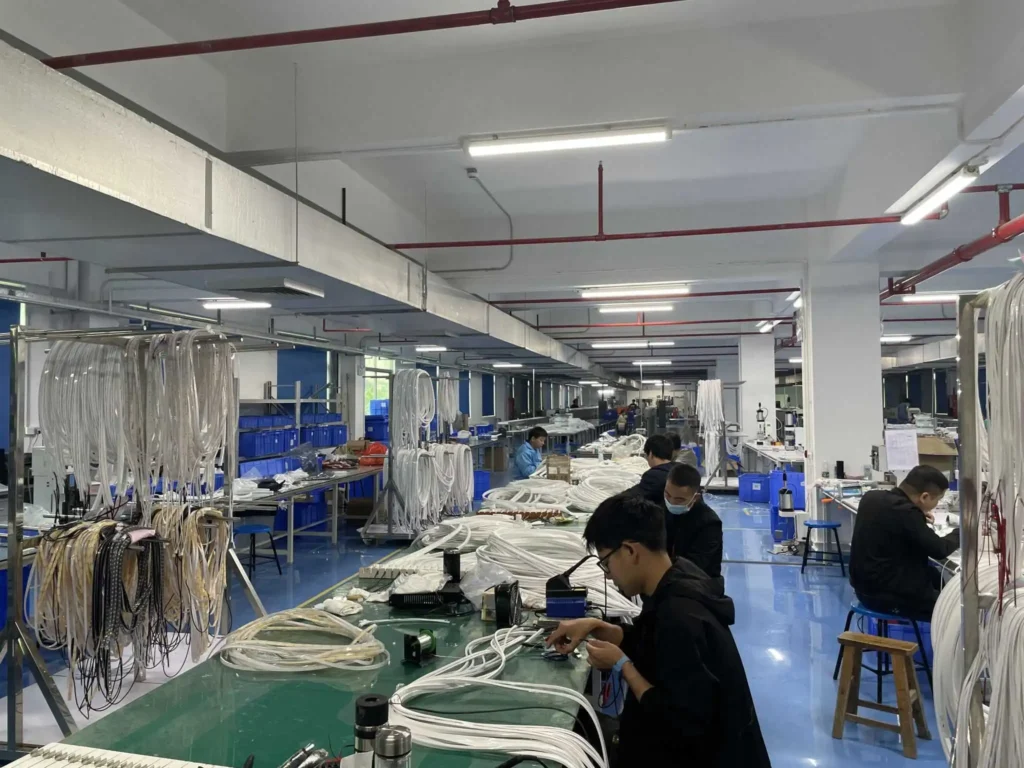
NPHIS Manufacturing: What Happens Before Your Order Ships
We get asked this a lot: “How do I know the strips I receive match the samples?”
Here is what every batch goes through at our factory before it leaves:
Our 6-Step QC Process
Step 1 — SMT and Soldering Inspection Every PCB goes through automated optical inspection (AOI) after SMT placement. LED and IC placement, solder joint quality, and PCB condition are verified at the machine level.
Step 2 — Silicone Extrusion Check We confirm smooth, dot-free output, profile dimensions, surface finish, and diffuser consistency. Any batch with surface bubbles or dimension deviation is pulled before aging.
Step 3 — Electrical Aging Test Finished reels run at rated voltage for 24 hours in our aging room. Early-life failures (infant mortality) are caught here — not at your job site.
Step 4 — DMX Control Test Each reel is connected to a test controller. We run a full RGBW cycle and verify that every pixel responds correctly to its assigned address. For pre-addressed orders, we verify the address map against your spreadsheet.
Step 5 — Waterproof Verification For IP67/IP68 products, we perform water immersion tests per IEC 60529 on sample units from each batch. Joints, end caps, and cable entries are all tested.
Step 6 — Final Visual and Packing Check Every reel is visually inspected for silicone surface quality and cable seal integrity. Labels confirm voltage, control type, batch number, cutting direction, and accessory set.
We document every step. Batch QC reports are available for orders over 500 meters as standard.
Before You Send an RFQ to NPHIS
If you send only a total meter length, we can give a rough price. If you send the details below, we can help prevent mistakes before production starts.
| Category | What to Provide | Example |
|---|---|---|
| Project Drawing | Facade or stage drawing with marked light lines | PDF or DWG with section lengths labeled |
| Environment | Indoor or outdoor, rain/UV/coastal/high-temperature exposure | Outdoor, coastal, UAE climate |
| Total Length | Total meters and individual section lengths | 620 m total, 5 m sections |
| Color | Single CCT, RGB, RGBW, dynamic white, or pixel effects | RGBW, 4000K white channel |
| Control System | DMX console, standalone controller, Art-Net, sACN, Madrix, xLights, or unknown | Madrix 5, Art-Net output |
| Pixel Pitch | Pixels per meter or animation resolution requirement | 10 pixels/m (100mm pitch) |
| Voltage | Preferred voltage and power room location | 24V DC, PSU room every 20 m |
| IP Rating | Waterproof requirement | IP68 integral extrusion |
| Certifications | Target market and required compliance marks | CE, RoHS, IP68 test report for EU |
| Delivery | Target date, port, packaging requirement | FOB Shanghai, by Sep 15, OEM box |
NPHIS supports custom silicone neon flex options including profile, voltage, RGB/RGBW, DMX512 control, accessories, packaging, and project-specific cut lengths. Full product details: NPHIS Silicone Neon Flex Product Page.
FAQs
❓️ What is DMX LED neon flex?
DMX LED neon flex is flexible silicone LED neon that can be controlled through DMX512 for dimming, color, zone, or pixel effects. It uses a built-in addressable IC to receive DMX512 signals over a standard RS-485 cable. It is used in facades, stages, clubs, hotels, bridges, and commercial lighting projects where dynamic, programmable lighting is required.
❓️ How many RGB pixels can one DMX universe control?
One DMX universe has 512 channels. RGB uses 3 channels per pixel, so one universe can control 170 RGB pixels with 2 channels left unused.
❓️ How many RGBW pixels can one DMX universe control?
RGBW uses 4 channels per pixel, so one DMX universe can control 128 RGBW pixels. Larger projects need multiple universes distributed through Art-Net or sACN nodes.
❓️ Is DMX better than SPI for facade lighting?
For large facade and entertainment projects, DMX is usually better. It supports cable runs up to 300 meters, integrates with professional lighting consoles, and has excellent noise immunity outdoors. SPI can be excellent for shorter pixel effects but is sensitive to distance, grounding, and signal quality on larger outdoor runs.
❓️ Why does DMX neon flex flicker?
Common causes include poor grounding, wrong decoder type, overloaded universe, signal reflection from missing termination resistor, low-quality DMX cable, water-damaged connector, or voltage drop at the far end of a long run.
❓️ Can DMX LED neon flex be used outdoors?
Yes. Choose outdoor-rated silicone housing with IP67 or IP68 integral extrusion, sealed end caps, waterproof connectors, and a serviceable power and control layout. Avoid secondary-coated (dip-coated) products for outdoor use — only integral silicone extrusion reliably maintains IP68 over years of outdoor exposure.
❓️ Do I need a separate DMX decoder for NPHIS DMX neon flex?
It depends on the product. NPHIS DMX512 RGBW pixel neon flex has the addressable IC built directly into the strip — no external decoder per strip is needed. However, you still need a DMX controller or software console to generate and send the DMX512 universe data, and a DMX interface (USB-to-DMX or Art-Net/sACN node) to bridge software to the physical cable.
❓️ How far can a DMX signal travel without a repeater?
The DMX512 standard (EIA-485) supports cable runs up to 300 meters (approximately 1,000 feet) without a repeater, provided you use 110Ω impedance DMX cable and a 120Ω termination plug at the end. For runs beyond 300 m, insert an opto-isolated DMX repeater/splitter to regenerate the signal.
❓️ Should I choose RGB or RGBW DMX neon flex?
Choose RGBW when the project needs better white light quality, soft pastel colors, hotel facade scenes, or daily architectural lighting. The dedicated white channel produces a much cleaner, more natural white than mixing R+G+B. Choose RGB for pure color effects where white quality is not critical — it uses fewer DMX channels per pixel and is simpler to program.
❓️ What information should I send before ordering DMX neon flex?
Send: project drawing with light line locations, total length and section lengths, indoor or outdoor environment, color type (RGB/RGBW), voltage preference, control system (DMX console, Art-Net, etc.), pixel pitch, IP rating requirement, power room location, cable route, and certification requirements. The more detail you provide, the faster we can confirm specs and prevent mistakes before production
Ready to Plan Your DMX Neon Flex Project?
Planning a facade, stage, hotel, mall, bridge, or entertainment lighting project with DMX LED neon flex?
Send NPHIS your drawing, control method, voltage, color requirement, total length, pixel pitch, and installation environment. Our engineers will review your control plan, power layout, and neon flex specification — before production starts, not after something goes wrong on site.
👉 Get a Free Sample + Technical Quote →
👉 Browse the Full NPHIS Silicone LED Neon Flex Range →
Have a specific project? Send us your meter count, pixel pitch, IP rating, and target delivery date. We will come back with a full technical proposal within 24 hours.
References and Authority Sources
- Microchip Technology — DMX-512 Protocol Reference: onlinedocs.microchip.com — Technical reference for DMX512 protocol structure, 512-channel universe, and 250,000 bps data rate.
- ETC (Electronic Theatre Controls) — Entertainment Control Networks: etcconnect.com — Industry-standard reference for DMX, Art-Net, and sACN in professional lighting systems.
- ETC — Control Protocols: Art-Net and sACN: etcconnect.com — Protocol comparison and implementation guidance from a leading professional console manufacturer.
- U.S. Department of Energy — LED Basics: energy.gov — LED efficiency, lifespan, and solid-state lighting technology benchmarks.
- IEC 60529 — International standard for IP (Ingress Protection) ratings, governing waterproof testing methodology for LED products.
WHY I WRITE THIS
About my business
Our company’s main products include LED flexible light strips, rigid light strips, and linear light fixtures, all of which are manufactured in our own factory or in factories we have been cooperating with for many years.
Our services
Our products are primarily mid-to-high-end, exported to Europe and America. We accept OEM & ODM small-batch orders, and also provide sourcing services in China to help our international clients solve problems. Please contact us if you need our assistance with sourcing.
Contact Profile
Name Ted Lau
Brand Name NPHIS
Country China
Model B2B Wholesale only
Email ted@nphis-led.com
Related Posts
Explore essential insights on material durability, IP ratings, and installation for our Silicone LED Neon Flex. Designed for lighting professionals, this guide helps you make informed purchasing decisions for commercial and architectural applications.
Client Endorsements
Here,we proudly display the brands we have partnered with.






Request a free quote
If you have questions or suggestions,please leave us a message,we will reply you as soon as we can!