

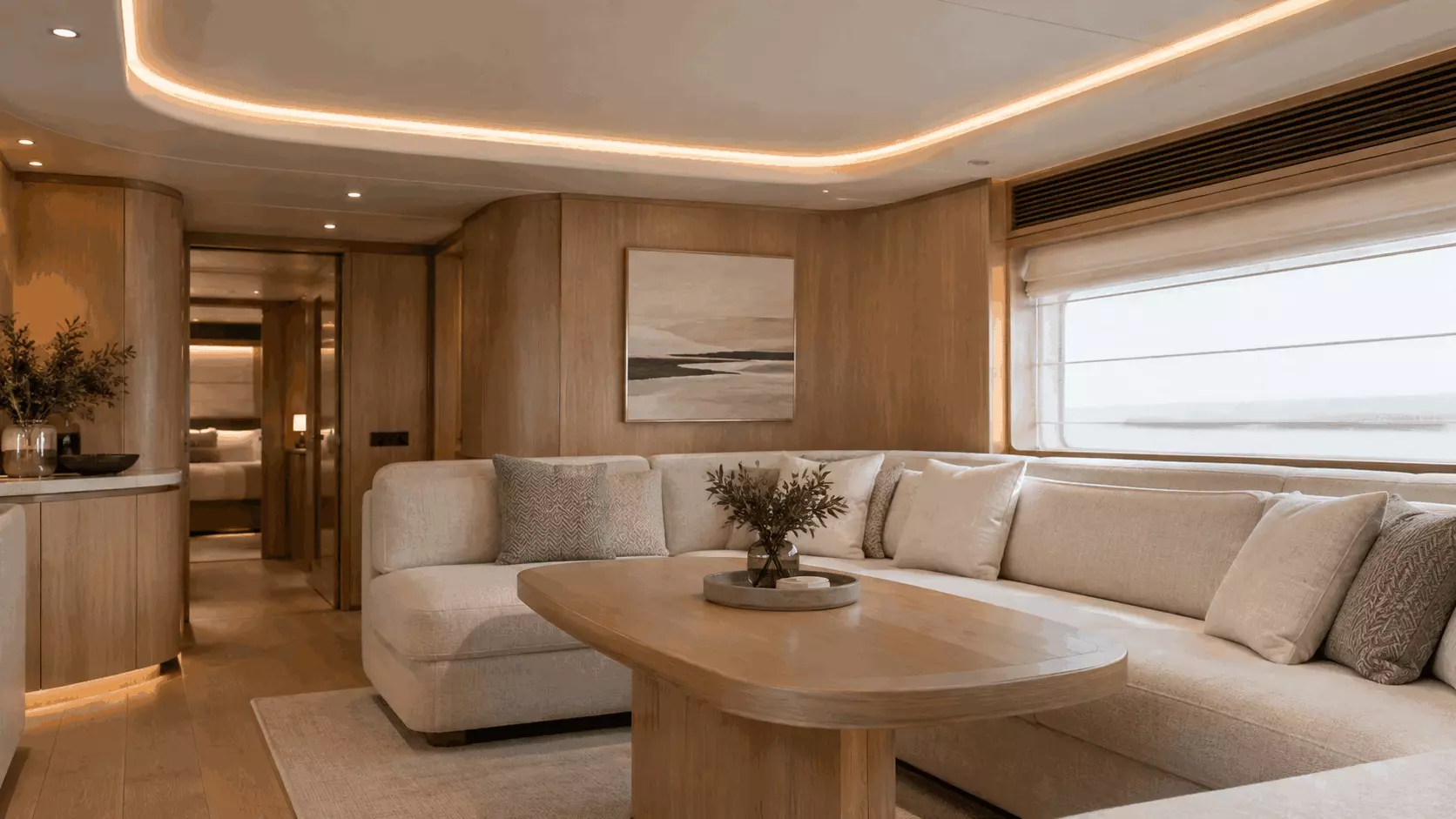
Last spring, a client in Dubai sent us photos that made our whole engineering team wince. His storefront neon signs — installed less than a year earlier — had turned a sickly yellow, and the housing had cracked open along the bends. He’d bought cheap PVC neon flex from a reseller, and one Gulf summer was enough to destroy it. This is the conversation we have almost weekly. As a factory that has been extruding LED neon for over a decade, we’ll tell you straight: the secret to outdoor survival isn’t the LED chip — it’s the material. That’s exactly why we steer every serious outdoor project toward IP67 silicone LED neon flex. In this guide, we’ll share what we see on our own factory floor and in our testing lab.
Table of Contents
Why Standard PVC Fails While IP67 Silicone LED Neon Flex Survives
We don’t say this to bash PVC — it has its place indoors and on a tight budget. But outdoors, the physics are simply against it. Two things kill PVC neon flex: ultraviolet light and temperature swings. Silicone shrugs off both.
The Anti-Yellowing Truth: UV Resistance in the Real World
Here’s what actually happens. PVC contains plasticizers to keep it soft. Under constant UV exposure, those plasticizers break down and migrate out. The result? The tube gets brittle, hairline cracks form, and that ugly yellow tint appears.
In our QC lab, we run samples through a UV testing chamber that simulates years of sun exposure. Food-grade silicone comes out clear. PVC comes out amber and stiff. That difference is why we build our anti-yellowing silicone LED strip range for any exterior job — and if you’re buying for outdoor signage, our UV resistant LED neon flex for outdoor signage guide shows how to verify that UV stability before you order.
A few real-world notes from our bench tests:
- Silicone stays optically clear after extended UV cycling — no yellow film over the LEDs.
- PVC loses flexibility first, then cracks at the bends where stress concentrates.
- A clear tube matters: yellowing shifts your color temperature and kills brand colors on signage.
If you want the deep-dive comparison, we wrote a full breakdown here: Silicone VS PVC LED Flexible Neon Lights
Surviving Extreme Temperatures: From Dubai Heat to Canadian Cold
Outdoor lighting doesn’t get a comfortable room temperature. A facade in Dubai can hit surface temps that soften PVC. A sign in Calgary can drop to -40°C, where PVC turns glass-brittle and snaps the moment wind flexes it.
Our UV resistant neon flex for exteriors is engineered for a working range of -40°C to +55°C without cracking, sagging, or melting. That’s the spec we test to before anything ships for an extreme weather outdoor LED neon installation.
| Property | Standard PVC Neon Flex | IP67 Silicone LED Neon Flex |
|---|---|---|
| UV / Anti-Yellowing | Yellows & cracks in 6–12 months | Stays clear for years |
| Temperature Range | ~ -20°C to 50°C | -40°C to +55°C |
| Flexibility in Cold | Becomes brittle | Stays soft & bendable |
| Best Use | Indoor / short-term | Outdoor commercial / long-term |
Real-World Applications in Outdoor Commercial Lighting
This is where the material choice pays off. Here are the three project types we supply most often.
Architectural Facade Lighting: Seamless Continuous Lines
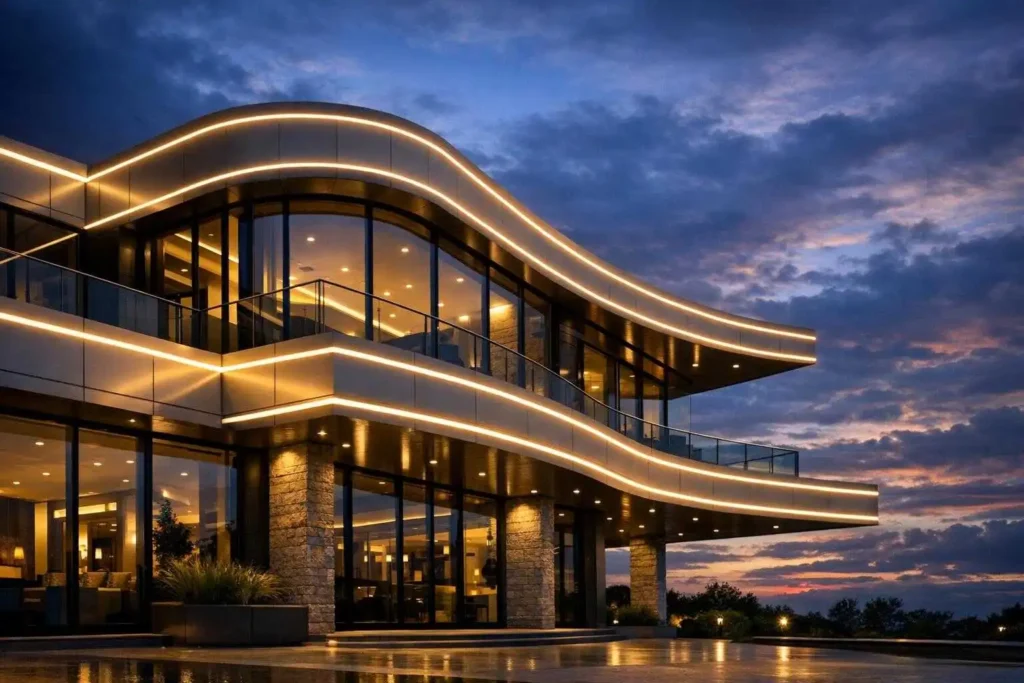
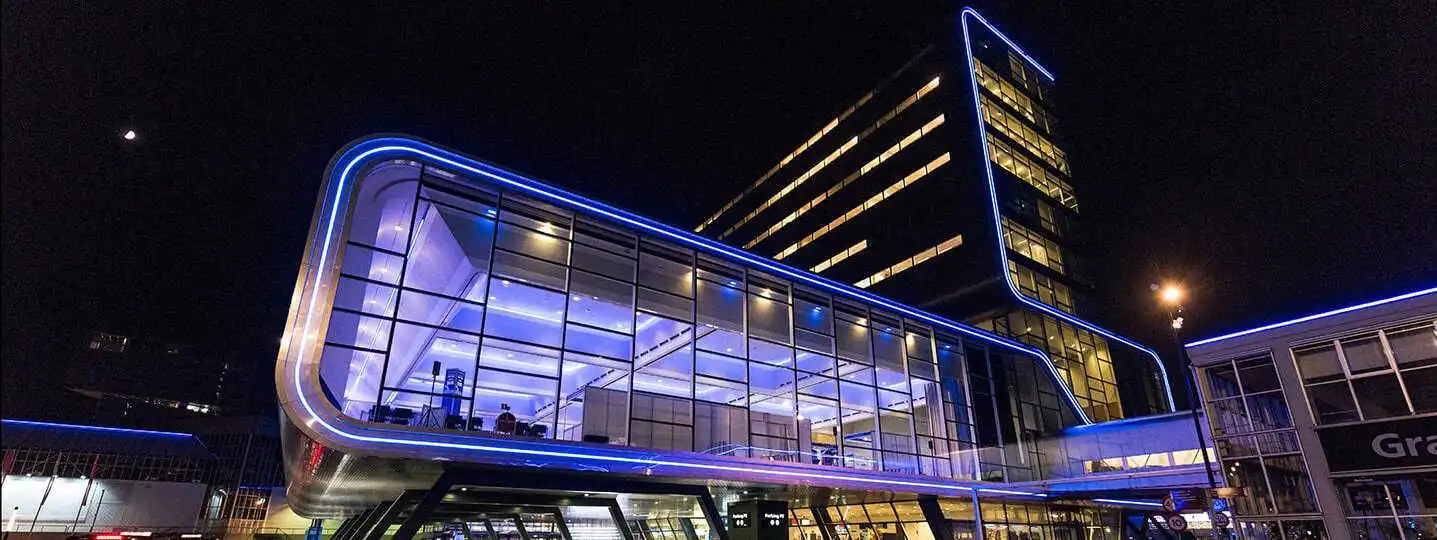
For architectural facade LED linear lighting, the look clients want is one unbroken line of light — no visible dots, no dark gaps. Our high-density builds give you that dot-free glow even up close.
Long runs matter here too. We engineer the copper and voltage so you can run continuous lengths along building edges without ugly seams every meter.
Custom Outdoor Signage for Retail & Hospitality
Logos are rarely straight lines. A good neon flex needs a tight bending radius to follow curves, loops, and script lettering. Our side-bend and top-bend profiles handle complex shapes without kinking or stressing the silicone.
We did a hotel entrance sign last year with three tight script curves — silicone bent clean, no whitening at the corners. That’s the difference a proper profile makes.
Landscape & Pathway Accents: Handling Moisture and Rain
Garden lighting lives in a wet world: heavy rain, irrigation sprinklers, morning dew, and ground splash. This is exactly the duty IP67 was designed for. The sealed silicone body means sprinkler spray and rain simply roll off, with no water creeping into the LEDs.
Behind the Scenes: How We Extrude IP67 Silicone Neon Flex
People assume all neon flex is built the same way. It isn’t — and how it’s made decides how long it lasts.
The Co-Extrusion Process Explained Simply
Cheap neon flex is often made as a hollow tube, then the LED strip is slid inside. That leaves an air gap. Air traps heat and gives moisture a path to travel.
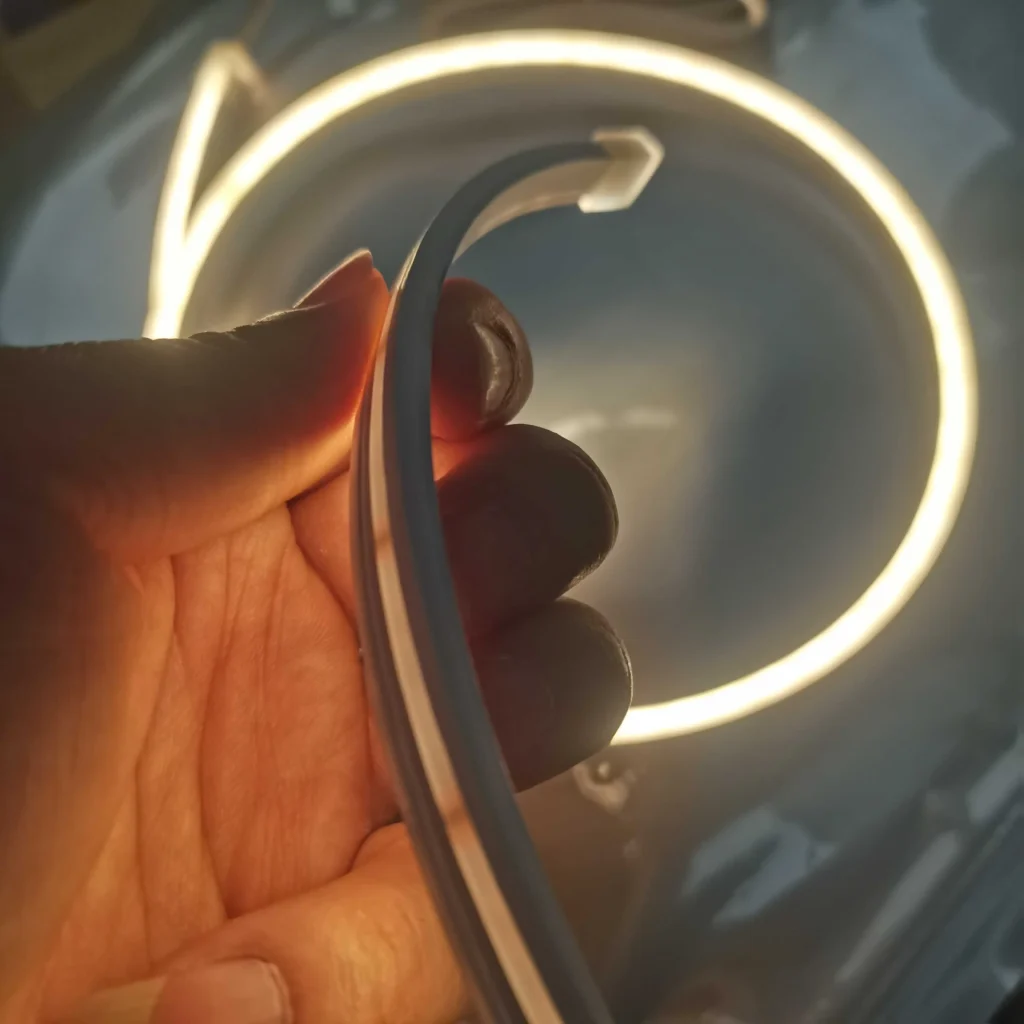
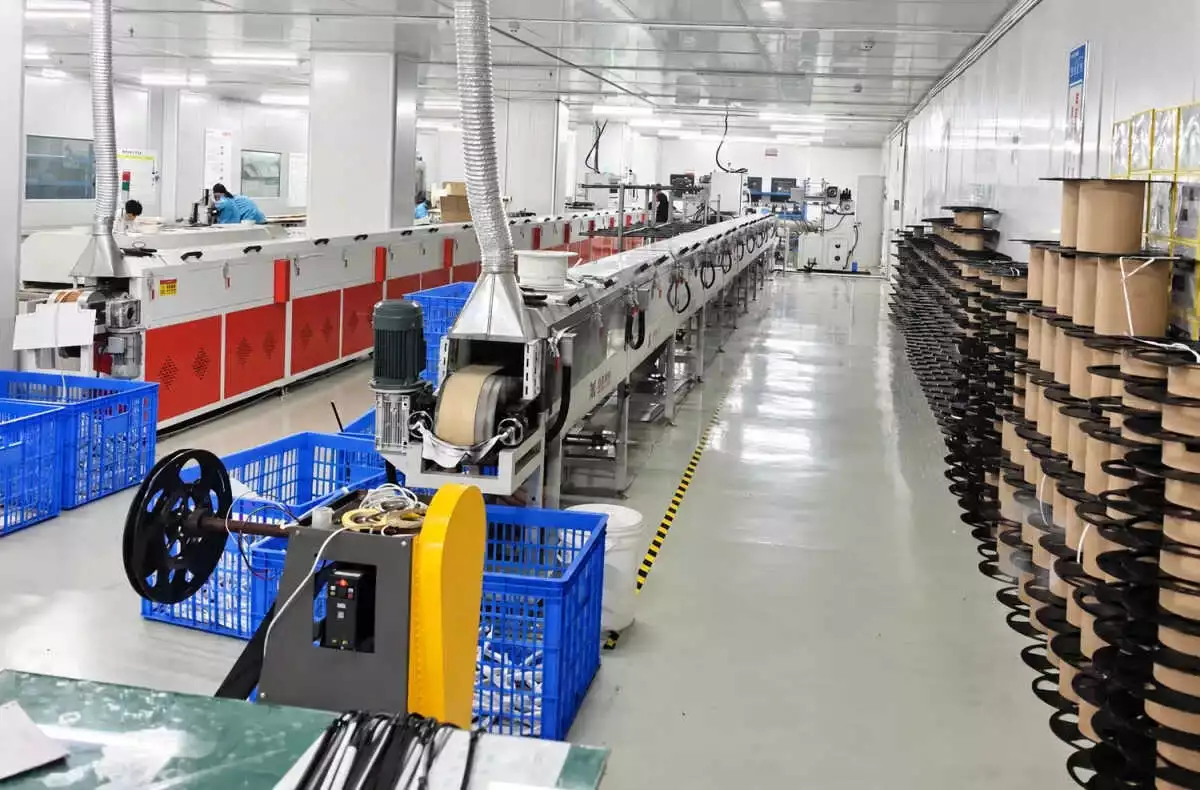
We use a co-extrusion process instead. The silicone is molded directly around the PCB in one continuous piece — it’s a one-piece body, not a sleeve. Two big wins:
- No water ingress channel — there’s no hollow gap for moisture to migrate through.
- Better heat dissipation — the silicone bonds to the strip and pulls heat away, so the LEDs run cooler and last longer.
What IP67 Actually Means in Our Testing Lab
Forget the dictionary definition. Here’s what IP67 means on our floor: before a custom outdoor order ships, we run a water submersion test. We drop sealed sections into a water tank, leave them, then pull them out and power them up. If a single section shows fogging or moisture inside, the batch goes back.
The rating itself is defined by the international IEC 60529 standard (you can verify it directly at the IEC IP ratings page). For most outdoor commercial jobs, IP67 is the sweet spot. If you’ll have full, permanent submersion, that’s an IP68 conversation — and we explain the difference here: IP67 vs IP68 LED Strip Waterproof Guide
Installation Pitfalls to Avoid for Commercial Projects
A great product still fails if it’s installed wrong. We’ve seen it, so here’s where projects go sideways.
Cutting and Sealing the Ends Correctly
We’ll be blunt: roughly 80% of the “your product leaked” complaints we investigate trace back to bad end-sealing, not the product.
- Always cut on the marked cut line, never mid-LED.
- Fill the silicone end cap with proper silicone glue before pushing it on — don’t dry-fit it.
- Seal the cable entry point too. Water loves to wick in along the wire.
Do this right and the IP67 rating actually holds in the field.
Choosing the Right Mounting Aluminum Profiles
Plastic clips are fine indoors. Outdoors, wind and thermal expansion will pop them loose over a season. For commercial facades we recommend serrated aluminum profiles — they grip the neon flex firmly, hold a clean line, and add heat dissipation on top.
Managing Voltage Drop in Long Runs
On long facade runs, single-end power causes the far end to look dim. Two fixes we build in:
- Dual-end powering — inject power from both ends to balance the run.
- Constant current ICs — keep brightness even from the first meter to the last.
For big projects, send us your run lengths and we’ll spec the powering for you.
Sourcing Directly from an LED Neon Flex Manufacturer
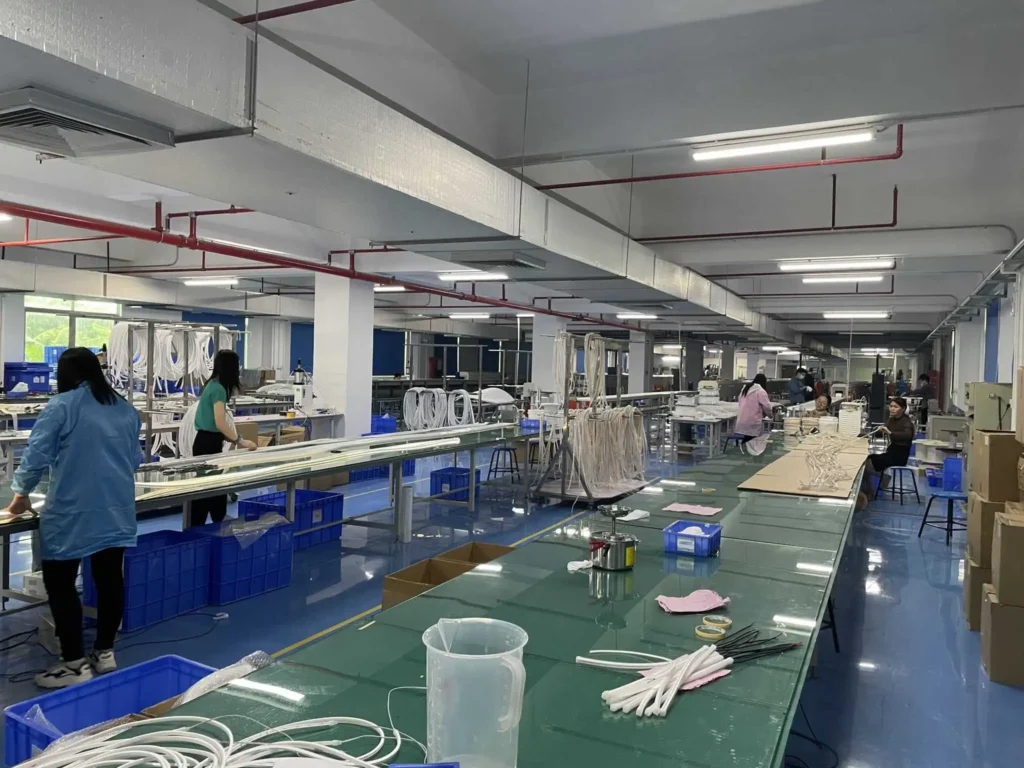
When you skip the trading company and buy factory direct custom LED neon, you get the engineer on the phone instead of a salesperson reading a brochure.
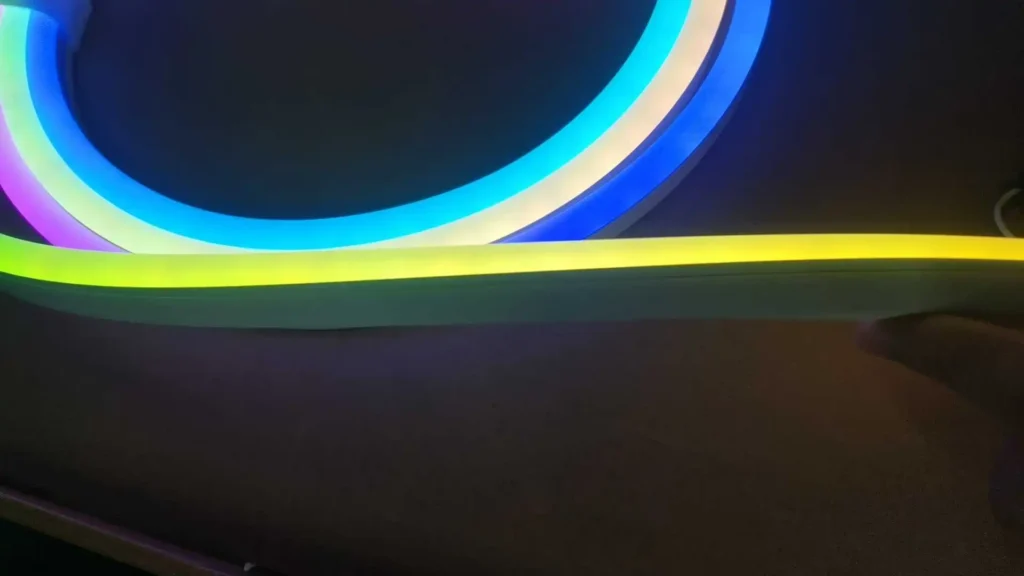
Customization Options (CCT, RGBW, DMX512)
Because we own our extrusion lines and SMT lines, almost everything is on the table:
- Single color CCT — 1800K to 6500K, plus custom Kelvin blends.
- RGBW — full color plus a dedicated white for clean pastels and true white.
- DMX512 pixel control — addressable chasing, gradients, and synced architectural shows.
We also handle non-standard profiles, custom reel lengths, and white-label packaging.
| Control Type | Best For |
|---|---|
| Single Color (CCT) | Facade outlines, signage, steady accent lines |
| RGBW | Retail branding, mood/scene changes, hospitality |
| DMX512 Pixel | Dynamic shows, animated facades, landmark projects |
Partner with Us for Your Next Project
If you’re scoping an outdoor commercial job and you’re tired of yellowing returns, let’s talk before you buy. Our IP67 silicone LED neon flex is built and water-tested for exactly these conditions.
👉 Send us your project specs — run lengths, color, control type — and our engineers will reply within 12 hours with a tailored quote. Contact Nphis-LED today.
FAQs
❓️ Is IP67 silicone LED neon flex truly safe for permanent outdoor use?
Yes, for rain, splash, and sprinkler exposure. The silicone body and sealed ends handle weather well. For continuous underwater use (pools, fountains), choose IP68.
❓️ How long does silicone neon flex last outdoors compared to PVC?
With quality silicone and correct installation, expect 50,000+ hours and several years of UV exposure without yellowing. Cheap PVC often degrades within 6–12 months in strong sun.
❓️ Why does my neon flex yellow even though it's "waterproof"?
Waterproofing and UV resistance are two different things. PVC can be sealed but still yellow under UV. Only proper anti-yellowing silicone resists discoloration outdoors.
❓️ Can it survive freezing winters?
Yes. Our silicone neon flex stays flexible from -40°C to +55°C, so it won’t crack in cold climates the way PVC does.
❓️ What IP67 testing do you actually perform before shipping?
We run water submersion tests on sealed sections, then power them to check for any internal fogging or moisture — per the IEC 60529 standard.
❓️ Where do most outdoor failures come from?
The cut ends. Around 80% of leaks we investigate are from poorly sealed end caps, not the flex itself. Always glue and seal both the end cap and the cable entry.
❓️ Can I run long continuous lengths on a building facade?
Yes, but plan for voltage drop. We recommend dual-end powering or constant-current ICs on long runs to keep brightness even.
❓️ Do you offer RGBW and DMX512 for dynamic facades?
Yes. We manufacture single color,RGB, RGBW, RGBWW and DMX512 addressable pixel neon flex in-house, with custom CCT and profiles.
❓️ What's the difference between IP67 and IP68 for my project?
IP67 = temporary immersion (rain, splash) — ideal for most outdoor commercial work. IP68 = continuous submersion. See our full IP67 vs IP68 guide linked above.
❓️ Can you white-label and customize for my brand?
Yes. As a factory-direct manufacturer we offer custom profiles, reel lengths, branded packaging, and spec sheets.
Sources & References
- IEC — Ingress Protection (IP) ratings, IEC 60529: https://www.iec.ch/ip-ratings
- Nphis-LED — Silicone VS PVC LED Flexible Neon Lights: https://nphis-led.com/industry-blogs/silicone-vs-pvc-led-flexible-neon-lights/
- Nphis-LED — IP67 vs IP68 LED Strip Waterproof Guide: https://nphis-led.com/industry-blogs/ip67-vs-ip68-led-strip-waterproof-guide/
WHY I WRITE THIS
About my business
Our company’s main products include LED flexible light strips, rigid light strips, and linear light fixtures, all of which are manufactured in our own factory or in factories we have been cooperating with for many years.
Our services
Our products are primarily mid-to-high-end, exported to Europe and America. We accept OEM & ODM small-batch orders, and also provide sourcing services in China to help our international clients solve problems. Please contact us if you need our assistance with sourcing.
Contact Profile
Name Ted Lau
Brand Name NPHIS
Country China
Model B2B Wholesale only
Email ted@nphis-led.com
Related Posts
Explore essential insights on material durability, IP ratings, and installation for our Silicone LED Neon Flex. Designed for lighting professionals, this guide helps you make informed purchasing decisions for commercial and architectural applications.
Request a free quote
If you have questions or suggestions,please leave us a message,we will reply you as soon as we can!