

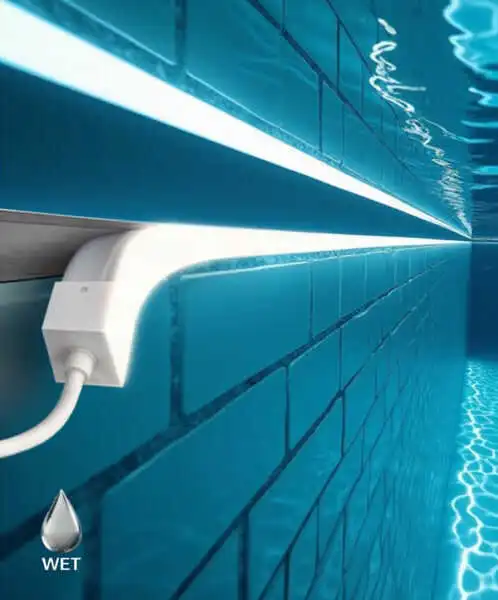
💡 Direct Answer & Executive Summary
Side bend silicone LED neon flex is a linear architectural luminaire housing a vertically oriented flexible printed circuit board (FPC) encapsulated within an optical-grade silicone extrusion. This internal vertical alignment enables lateral, horizontal curving parallel to the mounting surface without shearing LED solder pads or fracturing copper traces.
4 Critical Engineering Takeaways:
- Horizontal Bending Mechanics: Designed strictly for side-to-side sweeping arcs along ceilings, facades, and signage contours with minimum bend radii (RminRmin) down to 30mm–60mm.
- 20-Meter Single-Feed Runs: Specialized 24V constant-current models (0816, 1018, 1020, 1220) integrate heavy copper busbars to run 20 meters with less than 5% lumen deviation.
- Food-Grade Silicone Durability: Co-extruded liquid silicone rubber (LSR) resists UV yellowing, coastal salt spray, and thermal extremes from −40∘C−40∘C to +60∘C+60∘C.
- IP67/IP68 Field Integrity: Precision factory cut increments (35.71mm, 50mm, 71.43mm) pair with neutral RTV silicone potting for long-term outdoor waterproofing.

In the past year alone, our engineering desk reviewed over 40 project failure reports from commercial contractors in Europe and North America.
The culprit was almost always the same. Installers tried to force standard LED strips or top-bend neon sideways around curved ceiling coves. Within three months, thermal expansion caused the twisted copper traces to snap, leaving dark dead zones across multi-million-dollar hotel lobbies.
At NPHIS LED, we have spent over 12 years on the extrusion factory floor solving these exact mechanical mismatches. Today, I will walk you through the internal physics, material science, and electrical engineering behind side bend silicone neon—so your next curved lighting specification lasts for a decade, not a season.
Table of Contents

The Extrusion Floor Perspective: The Physics of Internal PCB Orientation
Why do standard LED tapes fail when bent laterally? It comes down to simple metallurgy and tensile stress.
Standard LED strips have a flat, horizontal circuit board. When you force that flat ribbon sideways around a curve, the outer edge stretches under extreme tension while the inner edge buckles. That lateral shear force rips SMD LED solder pads right off the copper foil.
How Vertical FPC Alignment Solves Lateral Stress
Side bend neon eliminates this failure by rotating the internal flexible printed circuit board (FPC) 90 degrees. Inside our silicone extrusion die, the PCB stands vertically—perpendicular to the mounting base.
When you curve the fixture left or right across a flat wall or ceiling, the PCB bends naturally along its thin, flexible spine. Zero shearing force hits the solder joints. Meanwhile, a specialized optical diffuser channel on top redirects the side-mounted LED light upward by 90 degrees for a spotless, dot-free glow.
Table 1: Engineering Mechanics — Side Bend vs. Top Bend Neon Flex
Depending on your architectural planes, selecting the wrong bending axis will ruin an installation. Often, complex facades require combining side-curving runs with top bend LED neon flex or even multi-axis 3D bend flexible neon.
| Metric | Side Bend Silicone Neon | Top Bend Silicone Neon | 3D Multi-Axis Neon |
|---|---|---|---|
| Primary Bending Plane | Horizontal (Left / Right parallel to surface) | Vertical (Up / Down perpendicular to surface) | Omni-directional (Simultaneous X, Y, Z axes) |
| Internal FPC Placement | Vertical (Perpendicular to mounting base) | Horizontal (Flat / Parallel to mounting base) | Helical / Corrugated center-axis FPC |
| Typical Min. Bend Radius (R_min) | 30mm – 60mm (Profile dependent) | 50mm – 80mm (Profile dependent) | 60mm – 100mm (All directions) |
| Primary Architectural Application | Organic ceiling coves, facade contours, signage | Straight wall grazers, vaulted arches, decks | Spiral columns, sculptural art, wavy facades |
| Critical Failure Risk if Misused | Solder pad delamination if forced vertically | Copper trace fracture if twisted sideways | Lumen hotspot shift if over-twisted axially |

Silicone Co-Extrusion vs. Secondary Assembly: Why Chemical Purity Dictates Exterior Lifespan
Last summer, a resort developer in Dubai contacted us after their outdoor promenade lighting turned brittle and amber-yellow in just 14 months. Their previous supplier had sold them low-cost PVC neon disguised as silicone.
The Chemistry of PVC Failure vs. Optical-Grade LSR
PVC relies on liquid plasticizers to stay flexible. Under intense solar UV radiation and high ambient heat, those plasticizers migrate to the surface and evaporate.
Once plasticizers outgas, PVC shrinks, yellows, and cracks at temperatures below 0∘C0∘C. By contrast, NPHIS uses 100% optical-grade Liquid Silicone Rubber (LSR) with strong silicone (Si-O-SiSi-O-Si) molecular bonds. For a deeper dive into polymer testing, read our breakdown on silicone vs PVC material durability.
Factory QC Breakdown: Salt-Spray & Dew Point Protection
Cheap “secondary assembly” neon pulls a bare LED strip through a pre-made hollow tube. That leaves an internal air gap. When outdoor temperatures drop at night, humid air inside that hollow tube hits its dew point, condensing liquid water directly onto live LED chips.
Our solid one-step silicone co-extrusion vulcanizes the dual-color silicone jacket directly around the FPC at 180∘C180∘C, leaving zero air pockets. Every batch undergoes rigorous environmental stress testing aligned with IEC 60068-2-11 salt-mist corrosion protocols and IES TM-21 lumen maintenance standards:
- Salt-Spray Chamber Testing: 1,000+ hours of 5% NaCl neutral salt spray for coastal yachts and beachfront hotels.
- Thermal Shock Cycling: 200 continuous cycles between −40∘C−40∘C and +60∘C+60∘C without delamination.
- Outdoor Application Superiority: When deciding between bare tape and encapsulated profiles, explore our field comparison of COB strips vs neon flex outdoors.
Electrical Engineering: Conquering the 20-Meter Single-End Feed Challenge
If you power a standard 24V LED neon strip from one end over a 15-meter facade run, the tail end looks visibly dim and color-shifted.
The Physics of Trace Resistance
Every flexible PCB has inherent electrical resistance governed by Ohm’s Law and conductor geometry:
R=ρ×LAR=ρ×AL
Where ρρ is copper resistivity, LL is circuit length, and AA is the cross-sectional area of the copper trace. In a thin 2oz copper FPC, resistance compounds rapidly over 5 meters, starving downstream LEDs of voltage.
How NPHIS Achieves 20m Runs (0816, 1018, 1020, 1220 Series)
To conquer voltage drop without bulky dual-end wiring, we re-engineered our long-distance side bend series (0816, 1018, 1020, and 1220 profiles).
First, we embed heavy-gauge tinned copper busbars along the base of the vertical FPC, massively increasing the conductor cross-section (AA). Second, each cutting segment incorporates a miniature constant-current regulator IC. Whether the local voltage along the line is 24.0V at meter one or 19.5V at meter twenty, the IC feeds the exact same milliamperage to every LED diode.

Table 2: Voltage Drop & Power Feed Architecture Comparison
| Configuration Type | Recommended Supply Voltage | Max Single Feed Run | Lumen Deviation at Far End | Wiring Complexity |
|---|---|---|---|---|
| Standard 12V SMD Strip | DC 12V | 3m – 5m | >35% drop beyond 5m | High (Parallel feeds every 5m) |
| Standard 24V Side Bend Neon (5m) | DC 24V | 5m (10m dual-end) | <8% at 5m; >28% at 10m | Moderate (Standard coves & signage) |
| NPHIS 24V Constant-Current Long Run (20m) | DC 24V (48V Optional) | 20m Single-End Feed | <5% across full 20m span | Low (Cuts field wiring labor by 60%) |
Driver Sizing Rule of Thumb
Never load an LED transformer to 100% capacity in commercial environments. According to U.S. Department of Energy solid-state reliability guidelines, thermal stress inside overloaded power supplies is the leading cause of premature system failure. Always calculate your driver capacity with a 25% headroom buffer:
Pdriver=(W/m×Length)×1.25Pdriver=(W/m×Length)×1.25
For example, a 15-meter run of 10W/m neon consumes 150W, requiring at least a 187.5W power supply (such as a 200W unit). For harsh outdoor runs, we strongly recommend pairing our neon with industrial IP67 Mean Well 24V LED drivers.
Precision Mounting & Field Installation: Channels, Radii, and Expansion Tolerances
Even the highest-grade silicone neon will buckle or fail if installed without respecting mechanical tolerances.
Thermal Expansion in Aluminum Profiles
Silicone has a higher coefficient of thermal expansion than anodized 6063-T5 aluminum. Specifically, silicone expands and contracts by roughly 0.25 mm to 0.30 mm per meter for every 1∘C0.25 mm to 0.30 mm per meter for every 1∘C change. Across a seasonal shift from −20∘C−20∘C in winter to +40∘C+40∘C in summer, a 10-meter outdoor run can expand by up to 15mm–18mm.
3 Golden Rules for Channel Mounting:
- Expansion Gaps: Always leave a 10mm–15mm gap between butt-jointed neon runs inside rigid channels.
- Avoid Stretching: Never pull or stretch the silicone neon tight while pressing it into the track; press it inward loop-by-loop.
- Slot Clearances: Ensure proper profile width selection by consulting our engineering guide on aluminum channel fit and dimensional tolerances.
Precision Factory Cut Increments & IP67 Field Sealing
When trimming neon on-site, cutting even 2mm off the designated copper pad severs the internal series-parallel circuit, killing an entire section. Look through the translucent underside window for the black scissor mark:
- 0408 Ultra-Mini Series: Cuttable every 35.71mm (7 LEDs per step) for intricate channel letters.
- Standard 24V Architectural Profiles (0612, 0816, 1018, 1020): Cuttable every 50.0mm.
- SPI-RGB / DMX512 Addressable Series: Cuttable every 71.43mm to match the multi-pixel IC spacing.
4-Step Field Waterproofing Protocol:
- Square Cut: Use a heavy-duty anvil cutter to make a clean, 90-degree perpendicular cut directly on the black cut line.
- Adhesive Priming: Fill the silicone end cap 50% full with non-corrosive, neutral-cure RTV silicone adhesive (never use acidic acetic-cure bathroom caulk, which corrodes copper traces).
- Cap Insertion: Coat the outer 8mm of the neon jacket with RTV glue, slide the tail cap firmly into place, and wipe away excess squeeze-out.
- Cure Time: Allow 24 hours of undisturbed curing before energizing in wet locations. For visual diagrams, check our step-by-step manual on field-cutting and waterproofing procedures.
If you are looking for exact cross-sectional CAD drawings—ranging from ultra-slim 0408 profiles and 0816 grazing neon to 1018 3-side emitting and 1023 SPI digital chase models—you can inspect our complete 19 side bend LED neon flex configurations.
Typical Architectural & Commercial Applications
Because side bend profiles curve effortlessly across flat 2D planes, they are the backbone of modern contour illumination.

1. Organic Curved Cove Lighting & Building Contours
Modern commercial interiors rarely stick to straight 90-degree drywall boxes. Using serrated bendable aluminum tracks, contractors snap 0612 or 0816 side bend profiles directly into sweeping S-curve ceiling recesses without dark corners or overlapping fixture shadows.
2. Retail Display Edge Outlines & Custom Illuminated Signage
Our 0408 (4mm wide) and 0612 (6mm wide) profiles bend down to a tight 30mm radius. This allows sign makers and luxury retail display builders to router a shallow 6mm groove into acrylic or millwork and press-fit the neon flush without fasteners.
3. Wet-Location Landscape Curbing & Coastal Hotel Accents
Winding concrete walkways, curved pool perimeters, and outdoor amphitheater steps demand rugged impact and moisture resistance. Specifying IP67/IP68 co-extruded profiles from our comprehensive architectural LED neon flex systems ensures uniform pathway guidance that withstands landscape trimmers, foot traffic, and coastal humidity.
Why Global Lighting Specifiers Source from NPHIS LED
Sourcing architectural linear lighting directly from an extrusion manufacturer eliminates middleman markups and prevents the dreaded “batch-to-batch color shift” common among trading companies.
- ISO 9001:2015 Certified Extrusion Facility: We operate in-house precision silicone extrusion lines, automated SMT placement machines, and integrating spheres in Shenzhen, China.
- Global Compliance & 3-Step MacAdam Binning: All profiles are built with UL-recognized components and carry full CE, RoHS, and FCC certifications, maintaining strict SDCM <3 color consistency across re-orders.
- Agile OEM/ODM Project Customization: We tailor CCTs (1800K–6500K), custom wire exit orientations (bottom, side, or direct end feed), and integrated SPI/DMX512 control protocols with a reasonable $1,000 MOQ for bespoke orders.
- Rapid Factory Lead Times & Warranty: Raw stock profiles ship in 5–7 business days, while custom-tooled architectural extrusions take 15–30 days. Every product is backed by our 3-year standard commercial warranty (extendable to 5 years for qualified engineering specifications).
FAQs for Buyer
❓️ What is the mechanical difference between side bend and top bend neon flex?
Side bend neon flex curves horizontally (left and right) parallel to the mounting surface because its internal flexible PCB stands vertically inside the silicone housing. Conversely, top bend neon flex curves vertically (up and down) perpendicular to the mounting surface because its internal PCB lies flat. Using the wrong orientation twists the copper traces and shears off the LED solder joints.
❓️ What is the minimum bending radius for side bend neon flex before damaging the LEDs?
The minimum bending radius (RminRmin) depends on the cross-sectional width of the silicone profile. Our ultra-slim 0408 and 0612 profiles achieve a tight 30mm minimum bend radius, standard 0816 and 1018 profiles require a 50mm–60mm radius, and heavy-duty 1220 profiles require at least an 80mm radius. Bending tighter than RminRmin risks buckling the vertical PCB and delaminating internal resistor pads.
❓️ How does NPHIS achieve a continuous 20-meter run without voltage drop?
NPHIS achieves a 20-meter single-end power feed in our long-run 0816, 1018, 1020, and 1220 series by combining two electrical technologies. First, we co-extrude heavy-gauge tinned copper busbars alongside the FPC to minimize line resistance. Second, we integrate on-board constant-current driver ICs on every cut segment to maintain uniform LED current from meter 1 to meter 20, keeping lumen drop below 5%.
❓️ What are the exact cutting increments for side bend silicone neon?
Factory cutting increments vary by circuit design and LED pitch. Under a standard DC 24V architecture, our 0408 mini neon cuts every 35.71mm, our standard single-color profiles (0612, 0816, 1018, 1020) cut every 50mm, and our SPI-RGB / DMX512 addressable neon cuts every 71.43mm. Always cut strictly along the black scissor mark printed on the bottom inspection window.
❓️ Can side bend neon flex make a sharp 90-degree corner?
No flexible LED neon can be folded into a dead-sharp 90-degree miter without crushing the internal circuit board. To execute a sharp 90-degree corner on a flat surface, you must either form a sweeping curve obeying the profile’s 30mm–60mm minimum bend radius, or cut the neon at the corner mark and join the two perpendicular legs using a concealed L-shaped jumper wire and waterproof end caps.
❓️ Is silicone neon flex truly resistant to coastal saltwater and intense UV?
Yes. Genuine optical-grade liquid silicone rubber (LSR) is chemically inert and contains zero volatile plasticizers. Unlike PVC neon—which turns yellow and cracks within 12–18 months outdoors—NPHIS co-extruded silicone neon withstands 1,000+ hours of IEC 60068-2-11 salt-spray testing, intense solar UV exposure, and extreme ambient temperatures from −40∘C−40∘C to +60∘C+60∘C without yellowing or shrinking.
❓️ Can side bend silicone neon flex be dimmed and integrated with smart lighting controls?
Yes. All NPHIS constant-voltage 24V side bend neon models are fully dimmable from 0.1% to 100% when paired with compatible dimmable LED drivers supporting 0–10V, DALI-2, TRIAC/ELV, or PWM protocols. Additionally, our digital pixel models integrate directly with SPI and DMX512 architectural controllers (such as Madrix or Pharos) for dynamic color chasing and facade media integration.
❓️ What technical details are needed to receive a custom production quote and CAD verification?
To provide an accurate factory quote and voltage-drop wiring diagram within 24 hours, please share your target profile dimensions (e.g., 0612 or 1018), total linear meterage and longest single-run distance, CCT or RGBW control protocol, IP rating environment (IP65 indoor vs. IP67/IP68 outdoor/submersible), and preferred cable entry orientation (end, side, or bottom exit).
Project Engineering Consultation & Evaluation Samples
Specifying curved architectural lighting shouldn’t be a guessing game. Whether you are value-engineering a hospitality tender or troubleshooting a complex facade curve, my engineering team and I are ready to verify your layouts directly from our extrusion floor.
Need IES files, LDT files, or UL/CE compliance certificates for your submittal package? Visit our technical hub for instant photometric data and compliance downloads.
If you have an upcoming commercial project and want us to review your CAD drawings, calculate power feed topologies, or ship a custom sample kit to your office, reach out today to request a factory engineering consultation.
📚 References & Industry Standards Cited
- International Electrotechnical Commission (IEC): IEC 60068-2-11 Environmental testing – Part 2-11: Tests – Test Ka: Salt mist (webstore.iec.ch)
- Illuminating Engineering Society (IES): ANSI/IES TM-21 Projecting Long Term Lumen, Photon, and Radiant Flux Maintenance of LED Light Sources (ies.org)
- U.S. Department of Energy (DOE): Solid-State Lighting Reliability & Energy Efficiency Guidelines (energy.gov)
WHY I WRITE THIS
About my business
Our company’s main products include LED flexible light strips, rigid light strips, and linear light fixtures, all of which are manufactured in our own factory or in factories we have been cooperating with for many years.
Our services
Our products are primarily mid-to-high-end, exported to Europe and America. We accept OEM & ODM small-batch orders, and also provide sourcing services in China to help our international clients solve problems. Please contact us if you need our assistance with sourcing.
Contact Profile
Name Ted Lau
Brand Name NPHIS
Country China
Model B2B Wholesale only
Email ted@nphis-led.com
Related Posts
Explore essential insights on material durability, IP ratings, and installation for our Silicone LED Neon Flex. Designed for lighting professionals, this guide helps you make informed purchasing decisions for commercial and architectural applications.



Request a free quote
If you have questions or suggestions,please leave us a message,we will reply you as soon as we can!