

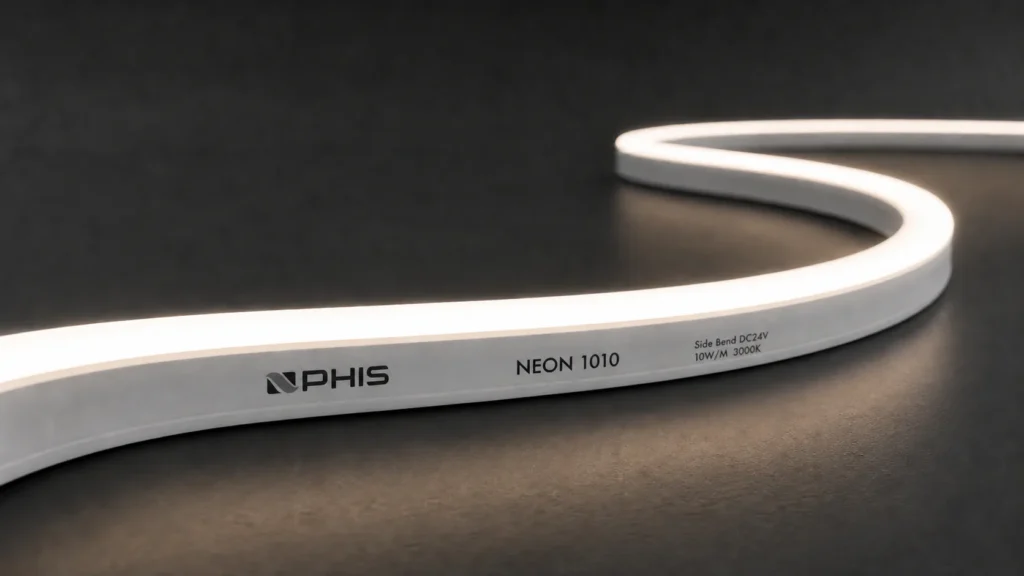
Silicone neon flex for architectural lighting creates continuous lines of light around curves, facades, interiors, and public spaces. It supports dot-free diffusion, multiple bending directions, outdoor protection, and static or dynamic control. However, the correct result still depends on the optical profile, bend direction, IP assembly, color specification, run length, power design, and installation details.
One recurring question we receive from European contractors is why some outdoor neon flex turns yellow, cracks, or develops dark sections after only one winter. In most cases, the cause is not the housing material alone — it is the bend direction, a wet connector, an excessive run length, or a field-cut end that was never properly re-sealed.
This guide explains how we review silicone neon flex for architectural lighting from the factory and project-support side. It is written for architects, lighting designers, contractors, wholesalers, and project buyers who need to turn a design concept into a product that can be manufactured, installed, controlled, and maintained.
Table of Contents
Quick Answer: Why Architects Specify Silicone Neon Flex
Architects use silicone neon flex because a flexible, diffused profile can create a cleaner line than exposed LED tape — and can follow forms that rigid linear fixtures cannot. Silicone materials support design freedom and resistance to UV, heat, and environmental exposure. The actual performance, however, must be verified for the finished product and its installation.
| Design Need | What Silicone Neon Flex Can Provide | What the Specifier Must Still Confirm |
|---|---|---|
| Continuous, dot-free lines | A diffused flexible optical profile | LED pitch, profile depth, viewing distance, and dimming level |
| Curved architecture | Top-bend, side-bend, or multi-directional options | Emitting face, bending plane, and minimum bending radius |
| Outdoor use | UV- and water-resistant constructions are available | Complete IP assembly, test conditions, connectors, and end caps |
| Dynamic lighting | RGB, RGBW, DMX512, or SPI options may be available | Protocol, pixel or segment length, controller, and power layout |
| Project customization | Profile, cut length, cable, mounting, and packaging options | Approved drawing, sample, accessories, and installation method |
The important phrase is “can provide.” A silicone housing does not automatically make every neon flex dot-free, IP68, color-consistent, or suitable for every curve. The system must be specified and verified as a whole.
Why Architects Choose Factory-Engineered Silicone Neon Flex
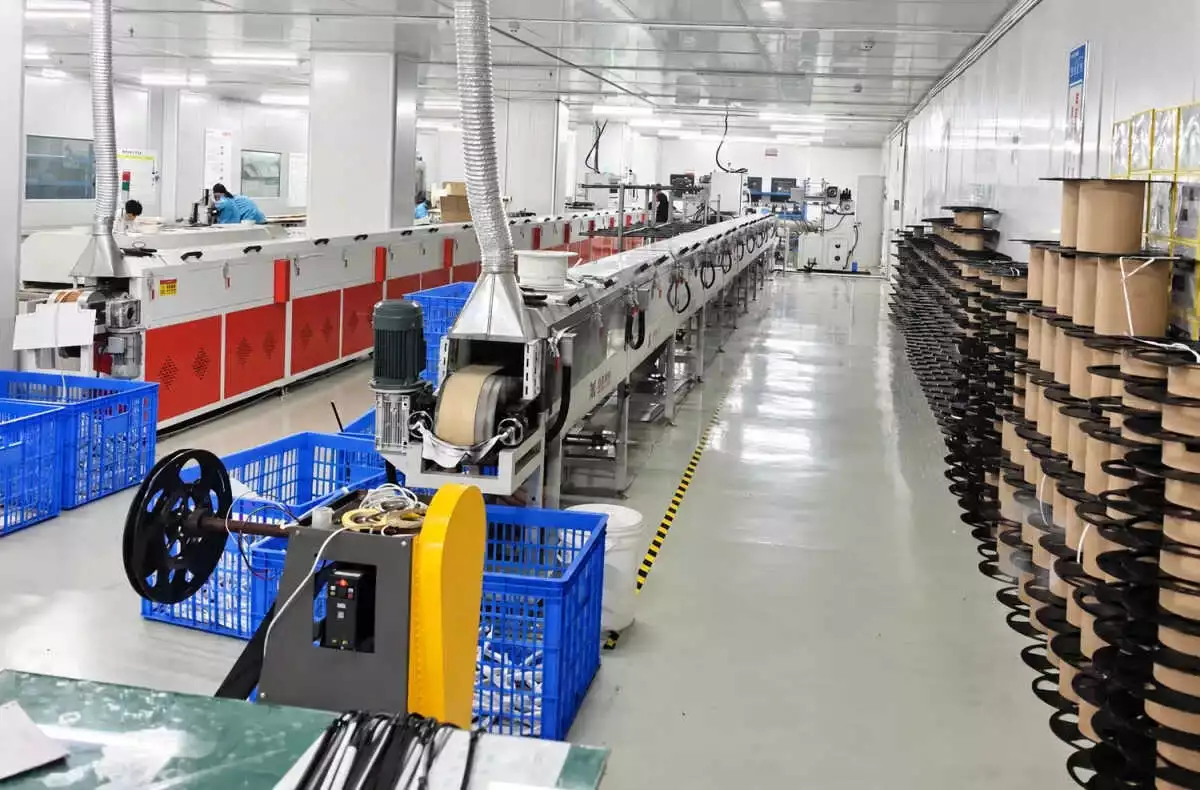
At NPHIS LED (Shanghai Leimei Optoelectronics Technology Co., Ltd.), we have been manufacturing silicone LED neon flex since 2012 — 12 years of continuous production, OEM/ODM development, and direct project support.
In that time, we have shipped to 50+ countries. Our customers include distributors, importers, facade contractors, hospitality lighting designers, retail brands, and public infrastructure project buyers.
Here is what we have learned from that experience:
Factory engineering matters more than the product name.
A “silicone neon flex” from a trading company that outsources production to three different factories will not deliver the same batch consistency, bend tolerance, or IP integrity as a product manufactured on a controlled extrusion line with documented QC steps. The difference shows up on site — in color variation across reels, in connectors that fail after six months, and in profiles that crack when bent to the radius the drawing requires.
What our direct-manufacturing model provides:
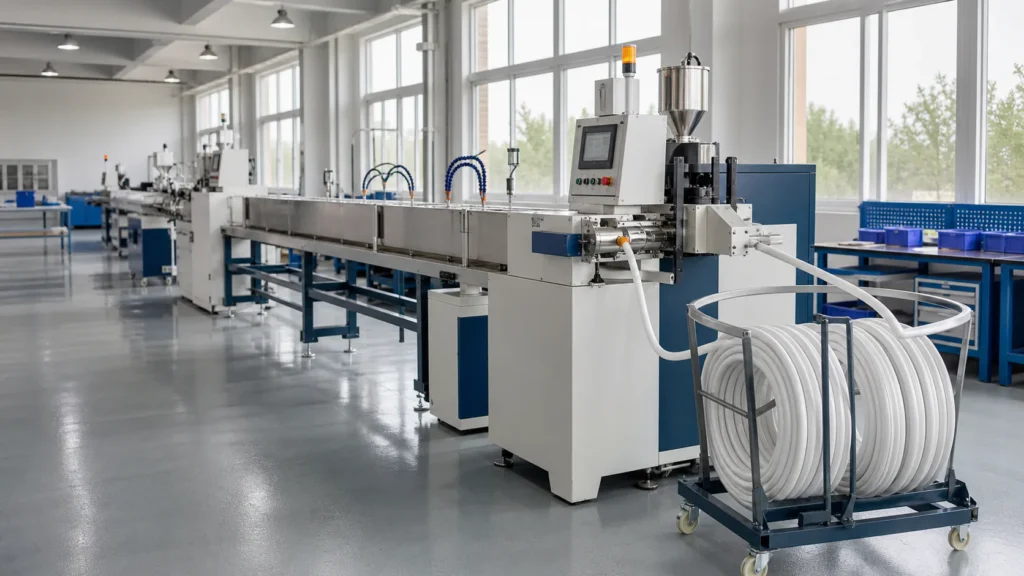
- Profile consistency: Our silicone extrusion lines are calibrated per profile. Cross-section dimensions are checked per batch, not per shipment.
- OEM/ODM support: We develop custom profiles, cable outlet positions, accessory sets, and packaging for project-specific requirements. Drawings are reviewed before production, not after.
- Project-specific labeling and packaging: Long facade runs are packed in installation sequence with batch numbers, CCT, and section references on every reel.
- Pre-shipment QC: Every order goes through illuminated aging, color check, and electrical test before dispatch.
- Direct technical support: Our project team reviews drawings, flags specification conflicts, and recommends the correct profile before a sample or quotation is prepared.
If you are sourcing custom silicone neon flex for a commercial building, hotel, retail chain, or public space project, the factory’s engineering capability — not just its price list — determines the outcome.
Start With the Project Conditions, Not the Product Name
When a buyer asks only for “architectural neon flex,” the request is not ready for production. We first need to understand where the line of light will sit and how the building will use it.
Start with seven questions before selecting any profile:
- Is the installation indoors, outdoors, or underwater?
- Is it a facade, roofline, interior curve, bridge, handrail, signage edge, or recessed detail?
- From what distance and angle will people see the light?
- Is the path straight, curved in one plane, or curved in several directions?
- Will the product face rain, UV, freezing weather, heat, salt air, cleaning chemicals, or standing water?
- Does the design need fixed white, tunable white, RGBW scenes, or pixel effects?
- Where can installers place — and later service — drivers, controllers, connectors, and power-injection points?
These conditions decide the profile, optics, voltage, control method, cable entry, and mounting. A long, straight office ceiling may suit a rigid linear fixture. A curved reception wall or rounded facade edge is a stronger use case for flexible LED lighting for curved architecture.
Getting these answers before contacting a supplier saves weeks of back-and-forth — and prevents costly re-orders when the wrong bend direction or IP rating arrives on site.
Silicone vs PVC: A Short Material Decision Table
Silicone and PVC products are both sold as LED neon flex. The right choice depends on the environment, expected service life, required curve, budget, and evidence supplied with the product.
| Decision Factor | Silicone Neon Flex | PVC Neon Flex | Project Question |
|---|---|---|---|
| UV and appearance | Commonly selected for outdoor weatherability; silicone formulations resist UV degradation | Performance varies by PVC formulation and stabilizers; yellowing risk in direct UV exposure | Is there a relevant UV or aging test report for the quoted model? |
| Cold-weather flexibility | Often selected where wider environmental tolerance is needed; remains flexible at low temperatures | Some constructions can stiffen or crack in cold conditions | What is the rated operating and bending temperature for the project's climate? |
| Complex curves | More flexible profiles and 3D options may be available; smaller minimum bend radius | Often used for simpler bends or cost-sensitive work | What bending plane and radius does the architectural drawing require? |
| Outdoor assembly | IP67 or IP68 constructions may be available through integral co-extrusion | Outdoor constructions also exist; verify the complete assembly rating | Does the IP rating cover the cable, connector, cut end, and installation method? |
| Project-life cost | Initial cost may be higher; lower total cost when access equipment and downtime are included | Initial cost may be lower; higher replacement and labor cost over 3–5 years in outdoor use | What will access equipment, labor, downtime, and replacement sections cost over the project life? |
Dow describes optical silicone materials for lighting as resistant to degradation from UV, heat, and environmental extremes (Dow Optical Materials for LED Lighting). That supports the material-selection logic — but it is not a performance certificate for a specific product. Always evaluate the quoted model and its test documentation.
For a full material comparison, read our Silicone vs PVC LED Neon Flex guide.
What Actually Creates Dot-Free Architectural Light?
The words “silicone diffuser” do not guarantee a flawless line. Dot-free performance comes from the complete optical system — not from the housing material alone.
LED Density and Internal Optical Design
The distance between LEDs affects how easily point sources appear through the diffuser. But density is only one factor.
The optical cavity depth, diffuser opacity, silicone diffusion grade, LED beam angle, and operating brightness all influence uniformity. A shallow profile can expose hotspots even with a high LED count. A deeper profile with a milky silicone body gives light more room to mix before it exits the emitting face.
The only reliable check: request an illuminated sample at the real dimming level, and photograph it from the planned viewing distance — not from several meters away.
Profile Size, Beam Direction, and Viewing Distance
A narrow profile fits a small architectural detail but leaves less optical mixing distance. A deeper profile may produce a softer line but requires more installation space.
The emitting face also matters. A top-emitting profile and a side-emitting profile create very different results on the same curve. Corners, transitions, feed cables, and aluminum channels should all be reviewed on the cross-section drawing before the order is placed.
The U.S. Department of Energy notes that LED performance depends on more than the LED device — fixture design, power-supply efficiency, light distribution, color quality, and dimming all affect the delivered result (U.S. DOE, LED Basics). This is why we do not approve a neon flex specification from wattage alone.
CCT, CRI, Output, and Color Consistency
For white architectural light, confirm all of the following before production:
| Parameter | Why It Matters | How to Specify |
|---|---|---|
| CCT (Correlated Color Temperature) | Warm vs cool tone; brand consistency across zones and reels | State exact value: 2700K / 3000K / 4000K / 6500K, or tunable range |
| CRI (Color Rendering Index) | Affects how architectural materials and finishes appear under the light | Minimum Ra80 for general use; Ra90+ for hospitality and retail |
| Lumen output (lm/m) | Determines visibility at the design viewing distance | Confirm with supplier based on profile and wattage; request test data |
| Power (W/m) | Drives power supply sizing and voltage drop calculation | Confirm per-meter wattage; calculate total load per circuit |
| Color tolerance / batch consistency | Visible color shift between reels ruins long facade runs | Request SDCM ≤3 or 3-step MacAdam ellipse for premium projects |
| RGB/RGBW white quality | Mixed white from RGB LEDs looks different from a dedicated white channel | Specify whether a dedicated W channel is required for white scenes, and which CCT |
DOE describes CCT as a condensed description of color appearance and CRI as one measure of color fidelity (U.S. DOE, Understanding LED Color-Tunable Products). Both are useful, but neither replaces a visual mock-up of the actual material, wall finish, and dimming scene.
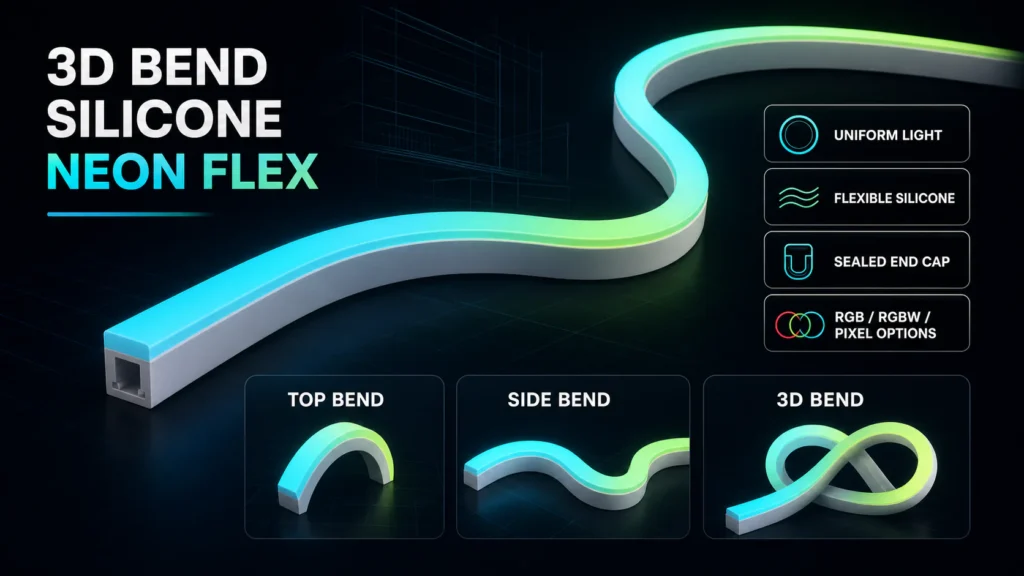
Choosing Top Bend, Side Bend, or 3D Bend
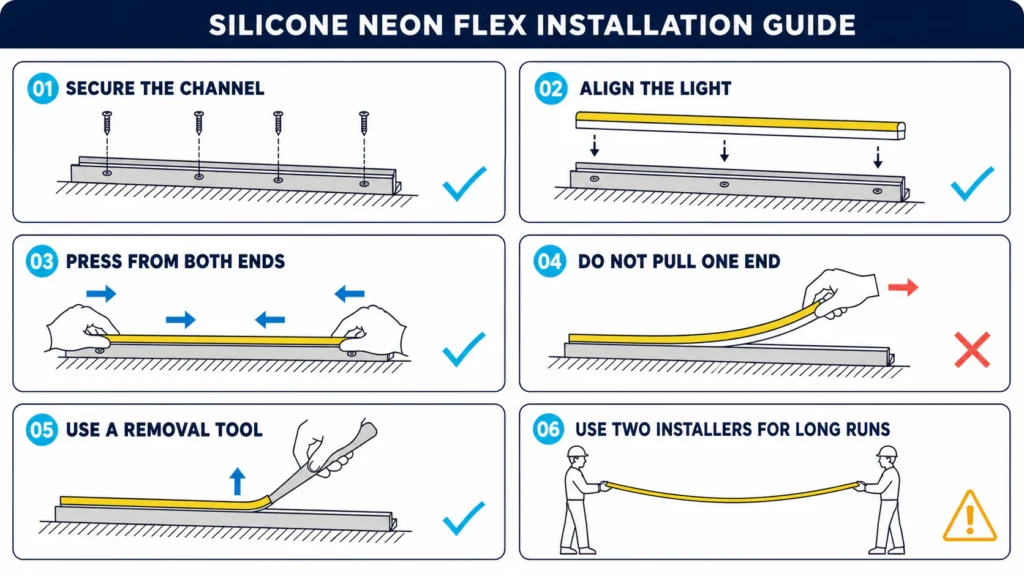
This is the single most common specification error we see. Ordering the wrong bend direction means the product physically cannot follow the building geometry — and no amount of clips or channels will fix it on site.
The bending name alone is not enough. Suppliers sometimes use “top bend,” “vertical bend,” and “horizontal bend” differently. Always confirm the emitting face and the allowed bending plane on a cross-section drawing.
| Bend Type | Typical Architectural Use | Main Risk to Check |
|---|---|---|
| Top bend | Rooflines, flat wall paths, step edges, and arches that bend in the profile's permitted vertical plane | Forcing the product sideways can damage the PCB or create dark sections; wavy appearance on flat walls if wrong type is used |
| Side bend | Horizontal curves, storefront outlines, logo borders, channel letter edges, and rounded wall details | The emitting face may point in the wrong direction if the profile is selected by name only; must confirm light-emit direction relative to mounting surface |
| 3D / multi-directional bend | Columns, compound curves, sculptural forms, arched facades, and complex transitions | Confirm minimum radius, torsion limits, mounting support, and feed direction; requires physical sample approval before bulk production |
The safest workflow:
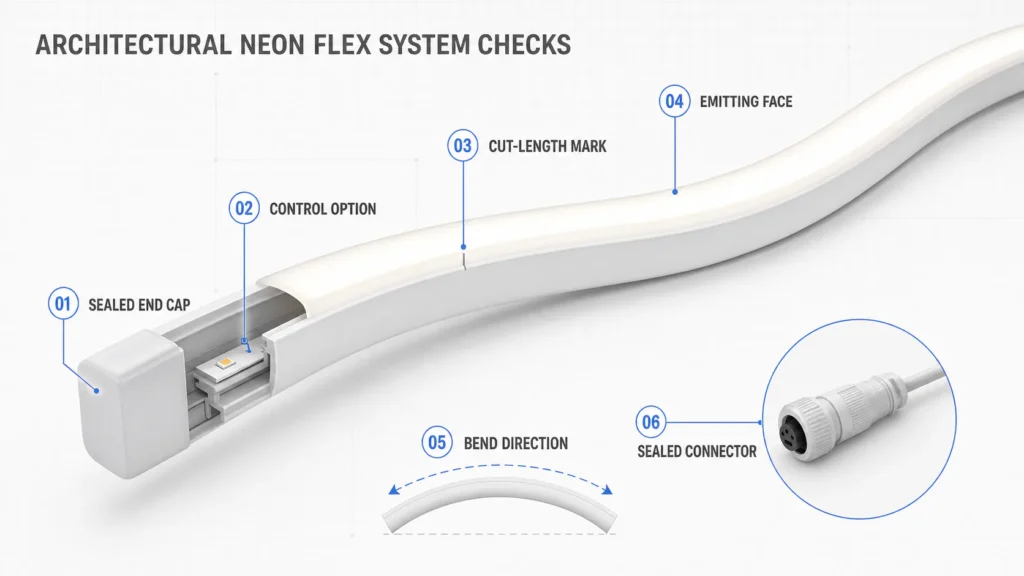
- Mark the light-emitting face on the drawing
- Mark every bend and change of direction
- Add the manufacturer’s minimum bend radius
- Identify straight cuts, factory-formed connections, and cable exits
- Approve a physical sample or a full-size corner mock-up before bulk order
For more detail, see the NPHIS guides to side bend silicone LED neon flex and 3D bend silicone neon flex for complex architectural designs.
Outdoor Reliability Is More Than an IP68 Label
“IP68” is the most misunderstood specification in outdoor LED neon flex procurement. We see it used as a blanket guarantee of outdoor suitability — and that misunderstanding causes real project failures.
An IP code describes enclosure protection against access, solid objects, and water under defined test conditions. IEC 60529 is the international standard. That classification is important. It is not a promise that every installed system will survive every outdoor condition.
IP67 vs IP68 and the Actual Exposure
Do not select IP67 or IP68 from the higher number alone. Define the actual exposure first:
- Rain and wind-driven water
- Temporary water contact at a connector or end cap
- Standing water around a cable entry point
- Continuous or repeated submersion
- Pressure from cleaning equipment
- Freeze-thaw cycles
- Salt air or chemical exposure
For IP68 outdoor neon flex, request the manufacturer’s test conditions for the complete quoted assembly. IP68 conditions depend on the agreement and product specification — the depth, duration, cable entry method, and end treatment all matter.
For most building facade applications, IP67 is sufficient. IP68 is relevant for pool edges, water features, underground conduit runs, and installations where the product will be continuously submerged.
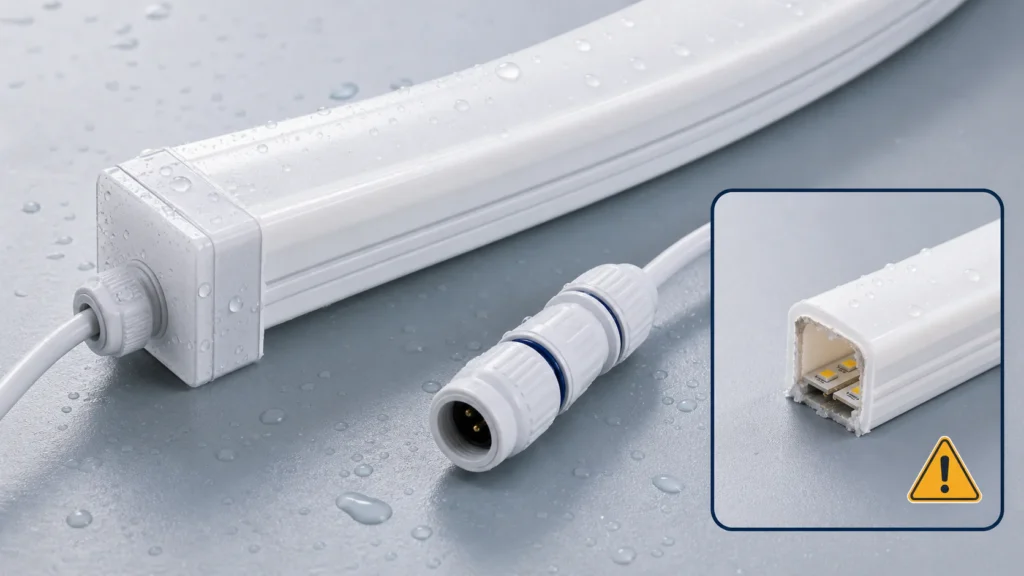
Connectors, End Caps, and Cable Entry
Many outdoor failures begin at a cut end or cable entry — not through the extruded body.
Factory-sealed lengths reduce field variables. But installers still need correct connectors, cable routing, drainage, strain relief, and the specified sealing process. A connector placed at a water-collection point will fail regardless of the strip’s IP rating.
Field cutting changes the protection condition. If a contractor must cut and re-seal on site, the method needs written instructions and trained installers. The original IP rating of the strip body does not transfer to an unsealed field cut.
UV, Temperature, and Corrosion Evidence
An IP rating tells you about water ingress. It tells you nothing about UV degradation, thermal cycling, salt corrosion, or long-term aging. For outdoor architectural projects, request the following from any outdoor silicone neon flex supplier:
| Evidence Type | What to Ask For | Why It Matters |
|---|---|---|
| UV resistance test | UV aging chamber test report with hours, irradiance level, and before/after color or appearance data | Confirms anti-yellowing silicone neon flex claim is backed by model-specific data |
| Operating temperature range | Minimum and maximum rated operating temperature for the specific silicone grade used | Critical for cold-climate projects and high-ambient-temperature facades |
| Waterproof test method | Test depth, duration, and whether end caps and connectors are included in the test assembly | IP68 outdoor neon flex claims must specify the rated submersion depth and duration |
| Salt spray / corrosion resistance | Salt fog test report (ASTM B117 or equivalent) for coastal and marine projects | Relevant for seaside hotels, marinas, bridge lighting, and coastal public spaces |
| Aging / lumen maintenance | LM-80 or equivalent lumen depreciation data; L70 hours if available | Supports lifecycle cost calculation and warranty claims |
| Warranty scope and exclusions | Written warranty document specifying what is covered, what voids the warranty, and who is responsible for labor and access costs | Protects contractor and end client on multi-year projects |
Do not convert a general material advantage into an unsupported statement such as “never yellows” or “works at any temperature.” Use the model-specific datasheet and test report.
For a deeper facade checklist, read Outdoor LED Neon Flex for Facade Lighting.
5 Mistakes Contractors Make When Buying Silicone Neon Flex
After 12 years of manufacturing and shipping to 50+ countries, these are the five specification errors we see most often — and each one is avoidable.
Mistake 1: Choosing IP68 Without Checking the Connectors
A contractor specifies IP68 on the drawing. The strip body passes the test. But the connectors are standard push-fit type with no independent IP rating. Water enters at the first joint after six months.
The fix: Confirm the IP rating of the end caps, connectors, and cable entry points — not just the strip body. Ask for the test report for the complete assembly.
Mistake 2: Ordering the Wrong Bending Direction
A side-bend profile arrives on site. The drawing shows a roofline that curves up and down. The product cannot follow the geometry without stressing the PCB.
The fix: Mark the emitting face and every bend direction on the drawing before ordering. Confirm the permitted bending plane with the manufacturer’s cross-section drawing.
Mistake 3: Ignoring Voltage Drop on Long Runs
A 50 m run is wired from one end. The far end is visibly dimmer than the feed end. The client rejects the installation.
The fix: Calculate voltage drop per run before production. Confirm the maximum feed length for the selected W/m rating and cable size. Plan power injection points on the drawing, not on site.
Mistake 4: Skipping Sample Approval
A project orders 800 m of warm white neon flex based on a product photo. The delivered CCT is 3500K. The design specified 2700K. Re-production adds six weeks and full material cost.
The fix: Always approve an illuminated sample at the specified CCT, dimming level, and viewing distance before bulk production. For large projects, request a full-size corner mock-up.
Mistake 5: Buying Only by Price Per Meter
A contractor saves 15% on the unit price by switching to a lower-cost supplier. The product yellows in year 2. Replacement requires scaffolding, full re-installation, and a new batch that does not match the remaining original sections.
The fix: Calculate total installed cost — product + accessories + installation labor + access equipment + maintenance visits + replacement downtime. The cheapest meter price is rarely the lowest project cost.
Color, Control, and Power Planning for Commercial Buildings
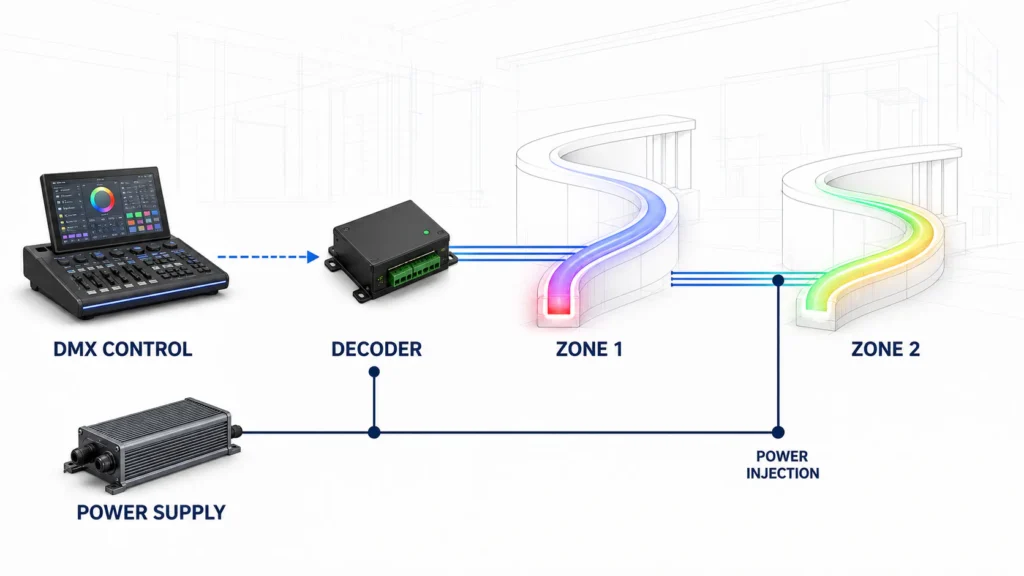
Architectural linear lighting solutions are not complete until the control and power paths are planned. A beautiful product sample can still fail on site when voltage drop, addressing, cable distance, or inaccessible drivers are ignored.
| Desired Project Effect | Recommended Direction | Confirm Before Production |
|---|---|---|
| Hotel daily outline | Fixed or tunable white | CCT, color fidelity, dimming method (0–10V / DALI / PWM), and scene level |
| Shopping-mall events | RGBW zones or DMX control | Controller, zones, addressing, cable routes, and white-channel CCT |
| Dynamic media facade | DMX512 or SPI pixel product | Pixel or segment length, protocol, refresh needs, mapping, and power injection |
| Long static outline | Project-specific constant-voltage system | Maximum feed length, voltage drop, cable size, driver location, and injection points |
| Outdoor public space | Outdoor-rated power and sealed connections | Service access, drainage, surge strategy, local code, and replacement sections |
DMX512 can carry up to 512 control channels in one universe (Microchip, DMX-512 Protocol). A large RGBW or pixel facade may therefore need several universes, nodes, decoders, or segmented power feeds. The protocol and channel map should be approved before manufacturing labels and cable sections are finalized.
If the project requires dynamic scenes, review our DMX512 RGBW silicone neon flex options and confirm the controller, pixel pitch, section length, and power layout before production.
Application and Specification Matrix
The same product should not be copied across every building detail. Use the application to set the specification.
| Application | Likely Bend | Protection Focus | Color / Control | Main Engineering Risk |
|---|---|---|---|---|
| Building outline | Top or side bend | UV, end sealing, drainage | White, RGB, or RGBW | Wrong bending plane ordered |
| Shopping-mall facade | Side or 3D bend | Rain, access, cable entry | RGBW or DMX scenes | Addressing and power injection not planned |
| Hotel exterior | Top or project-specific profile | Weathering and batch consistency | Warm or tunable white | Visible CCT variation between reels |
| Bridge / public space | Drawing-based selection | Salt, vibration, surge, maintenance | Static or controlled color | Difficult replacement access; no surge protection |
| Interior curved surface | Side or 3D bend | Heat, glare, mounting | High-CRI white | Hotspots at close viewing distance; channel shadows |
| Signage / brand outline | Small approved profile | Corners, cut ends, cable exit | Brand color, RGB, or RGBW | Dark corners; inconsistent brand color across batches |
This matrix is a starting point. The final choice still needs the product drawing, electrical plan, installation detail, and local compliance review.
The Lifecycle Cost for Contractors and Wholesalers
The lowest price per meter is not always the lowest project cost. Use this formula:
Total installed cost = product cost + accessories + installation labor + access equipment + maintenance visits + replacement downtime
A material saving can disappear if a contractor must rent a lift, close a storefront, remove channels, or replace several sections to match an older color batch.
Before comparing two quotations, ask:
- Is the product supplied in factory-sealed project lengths?
- Can one failed section be replaced without removing the full line?
- Are drivers and connectors accessible for maintenance?
- Will spare pieces come from the same production batch?
- Who is responsible for field sealing and its warranty?
- Does the quote include channels, clips, cables, connectors, drivers, controllers, and testing?
For wholesale silicone neon flex buyers and distributors: clear labels, bend drawings, cut-length rules, and installation instructions reduce avoidable after-sales work — and protect your relationship with the end contractor.
The economic case for silicone is strongest when the installation is at height, access is difficult, the project is high-visibility, and the client expects a 5+ year maintenance-free appearance.
Architectural Neon Flex Specification and RFQ Checklist
A useful RFQ should allow the supplier to check the full system — not only quote a price per meter. An incomplete RFQ results in a generic quote that cannot be compared across suppliers, and often leads to the wrong product being produced.
| Information Required | Details / Format |
|---|---|
| Architectural drawing with every light line marked | PDF or DWG showing where neon flex is installed on the building |
| Indoor / outdoor / underwater environment and known exposure | Location, climate, UV index, coastal or non-coastal, temperature range |
| Total quantity plus each individual section length | Total meters + individual run lengths between power injection points |
| Profile size, emitting face, and available installation space | Width × height (mm); top-emit or side-emit; channel or clip mounting |
| Top bend, side bend, 3D bend, or a drawing if uncertain | Confirm from the architectural drawing — not from the product name |
| CCT, color fidelity, lumen target, or RGB/RGBW effect | Exact CCT (K), minimum CRI, target lm/m or W/m, SDCM tolerance |
| Required IP rating and the location of every joint and cable exit | IP67 or IP68; where connectors and end caps are located on the drawing |
| Voltage, power-supply location, cable distance, and power-injection plan | 12V or 24V; power supply location; mid-run injection requirements |
| Control method | Static / dimming / PWM / DMX512 / SPI / 0–10V / DALI / unknown |
| Destination market, certification, and project-submittal requirements | CE / RoHS / UL / ETL / other; destination country and compliance standard |
| Mounting channel, clips, end caps, connectors, and cable requirements | Whether accessories are required; channel material and finish preference |
| Sample, mock-up, first-article, labeling, and packaging requirements | Whether a pre-production sample or lit mock-up is required before bulk order |
If some answers are unknown, mark them as unknown. A drawing with honest gaps is more useful than an RFQ filled with guessed specifications.
📩 Send Your Project Brief to NPHIS
Send your project drawing, installation environment, required length, and lighting effect. Our engineers will recommend the suitable silicone neon flex profile before quotation.
→ Email: ted@nphis-led.com
→ WhatsApp: +86 182 1724 1063
We respond within 24 hours on business days.
What a Reliable Silicone LED Neon Strip Manufacturer Should Verify
Production and material consistency
- Profile dimensions, emitting face, surface finish, and extrusion consistency — checked per batch
- LED and PCB assembly condition — SMT placement accuracy and solder joint inspection before extrusion
- Electrical function and rated-power check — continuity and polarity verified before the PCB enters the extrusion line
Optical and color quality
- Illuminated aging test — powered-on burn-in to identify early failures before shipment
- Color consistency across production sections — binning process and SDCM tolerance control; batch test records available on request
- Lumen output verification — integrating sphere measurement for lumen and CCT data on request
Mechanical and environmental testing
- Bending and handling inspection — based on the approved profile and minimum radius
- Sealed end, cable entry, and connector process — submersion test for sealed assemblies; end cap adhesion verified
- Pull and tensile test — cable and connector pull-out force tested to rated specification
Control and system verification
- Control response for RGB, RGBW, DMX, or SPI products — address assignment, channel response, and pixel mapping verified before shipment
- Polarity and wiring labeling — all cables labeled; wiring sequence documented per project
Packaging and traceability
- Section labels with batch number, CCT, wattage, and project reference on every reel
- Reels packed in installation sequence for long facade runs to maintain color consistency
The supplier should also state which checks are routine production controls and which require an optional third-party or project-specific test report.
NPHIS supports configurable silicone LED neon flex for architectural, facade, signage, hospitality, retail, and dynamic-lighting projects. Review the Silicone LED Neon Flex collection and send the project conditions before selecting a profile.
FAQs
❓️ Is silicone neon flex suitable for outdoor architectural lighting?
Yes, when the selected model and complete assembly are rated for the actual environment. Confirm UV evidence, operating temperature, IP test conditions, factory-sealed ends, connectors, cable entry, drainage, and mounting. The word “silicone” alone does not prove that every finished product is suitable for long-term outdoor use. Always evaluate the model-specific datasheet and test report.
❓️ Does IP68 mean neon flex can be installed anywhere outdoors?
No. IP68 is an enclosure-protection classification under stated test conditions — not a universal installation guarantee. Ask for the test depth, duration, assembly configuration, and report for the quoted model. Also review joints, cable entries, field cuts, standing water, temperature cycling, and maintenance access. For most facade applications, IP67 is sufficient.
❓️ What makes silicone neon flex look dot-free?
Dot-free light depends on LED pitch, distance from the LEDs to the emitting surface, diffuser geometry, silicone diffusion grade, beam pattern, operating brightness, viewing angle, and viewing distance. There is no single specification that guarantees dot-free appearance. Approve an illuminated sample or full-size mock-up at the planned dimming level — not only from several meters away.
❓️ How do I choose between top bend, side bend, and 3D bend?
Mark the emitting face and every curve on the architectural drawing, then compare them with the manufacturer’s cross-section and permitted bending plane. Use top bend for up/down curves and straight wall runs. Use side bend for left/right horizontal curves and storefront outlines. Use a 3D profile only when the drawing requires compound curves in multiple planes — and confirm the minimum radius and torsion limits with a physical sample before bulk production.
❓️ Is silicone neon flex worth the higher initial cost?
It can be when the project needs complex curves, outdoor durability, controlled diffusion, or expensive installation access. Compare total installed cost — including accessories, labor, access equipment, maintenance visits, downtime, and replacement sections. Do not decide from the price per meter alone. For short-term indoor displays or fully sheltered interior applications, PVC may be the more cost-effective choice.
❓️ When should an architectural project use DMX512 RGBW neon flex?
Use DMX512 RGBW when the project needs repeatable scenes, zone control, building-management-system integration, a dedicated white channel, or coordinated dynamic effects across a large facade. Confirm channel mapping, pixel or segment length, controller type, decoder, universe count, signal route, power injection points, and service access before production begins. Specifying the strip without the control plan is the most common cause of DMX installation failures.
Conclusion: Specify the System, Not Just the Neon Flex
Silicone neon flex for architectural lighting should be specified as a complete system — not as a product name on a purchase order.
Four principles summarize everything in this guide:
- Optical result — Dot-free appearance, output, CCT, color quality, and viewing distance. Confirm all four before ordering.
- Mechanical path — Profile, emitting face, bend plane, minimum radius, and mounting. Confirmed from the architectural drawing.
- Environmental protection — IP assembly, UV evidence, cable entry, drainage, and temperature range. The IP number applies to the strip body; the full system must be sealed to the same standard.
- Electrical system — Voltage, feed length, driver access, control protocol, and replacement sections. Designed before production begins, not after installation.
That approach gives designers more control and gives contractors fewer surprises on site.
Ready to Specify Your Project?
Browse our full range: → Silicone LED Neon Flex Collection — NPHIS
Send your project drawing, installation environment, required length, and lighting effect. Our engineers will recommend the suitable silicone neon flex profile before quotation. → Submit Your Project Brief
Request a pre-production sample: → Get a Free Sample
Need a custom profile or OEM/ODM specification? → Contact the NPHIS Technical Team
References and Authority Sources
- IEC, IEC 60529 — Degrees of Protection Provided by Enclosures (IP Code): https://webstore.iec.ch/en/publication/2449
- IEC Electropedia, Degree of protection of enclosure: https://ieclib17.iec.ch/iev/iev.nsf/display?ievref=426-04-02
- U.S. Department of Energy, LED Basics: https://www.energy.gov/cmei/ssl/led-basics
- U.S. Department of Energy, Understanding LED Color-Tunable Products: https://www.energy.gov/cmei/ssl/understanding-led-color-tunable-products
- Dow, Optical Materials for LED Lighting: https://www.dow.com/en-us/product-technology/pt-optical-materials/pg-optical-materials-lighting.html
- Microchip, DMX-512 Protocol: https://onlinedocs.microchip.com/oxy/GUID-19E32404-10A3-4F82-A4B0-9332290B918C-en-US-1/GUID-E3A73BEC-FD66-4B46-A7F8-8D84A734DF4A.html
- ASTM B117, Standard Practice for Operating Salt Spray (Fog) Apparatus: https://www.astm.org/b0117-19.html
WHY I WRITE THIS
About my business
Our company’s main products include LED flexible light strips, rigid light strips, and linear light fixtures, all of which are manufactured in our own factory or in factories we have been cooperating with for many years.
Our services
Our products are primarily mid-to-high-end, exported to Europe and America. We accept OEM & ODM small-batch orders, and also provide sourcing services in China to help our international clients solve problems. Please contact us if you need our assistance with sourcing.
Contact Profile
Name Ted Lau
Brand Name NPHIS
Country China
Model B2B Wholesale only
Email ted@nphis-led.com
Related Posts
Explore essential insights on material durability, IP ratings, and installation for our Silicone LED Neon Flex. Designed for lighting professionals, this guide helps you make informed purchasing decisions for commercial and architectural applications.
Client Endorsements
Here,we proudly display the brands we have partnered with.






Request a free quote
If you have questions or suggestions,please leave us a message,we will reply you as soon as we can!