
Over the past 12 months, our engineering team reviewed more than 65 architectural inquiries where suspended flat neon strips twisted in mid-air and left ugly dark shadows on atrium ceilings. If your lighting profile hangs in open space and remains visible from multiple angles, an omnidirectional neon tube is the only way to guarantee uniform, shadow-free illumination.
Based on over 10 years of LED extrusion experience at NPHIS LED, we wrote this factory-level guide for lighting designers, electrical contractors, and project buyers covering 360 Neon Flex architectural lighting. Whether you are sourcing 360 round LED neon flex for a multi-story atrium or drafting tender documents, you will find anti-sag suspension rules, voltage drop calculations, and a copy-paste specification template below.
Understanding Round vs Flat Neon Flex in Architectural Design
A 360 degree LED neon flex is a cylindrical silicone lighting tube that emits smooth, dot-free light around its entire circumference. Unlike flat strips that only glow from one face, this round profile delivers true omnidirectional illumination.
Inside the round silicone jacket, back-to-back high-density SMD LED PCBs (typically 120×2 or 168×2 LEDs per meter) sit inside an optical-grade diffusion core that scatters light evenly before it exits the outer skin.
As a result, you see zero LED hotspots even at close viewing distances of 0.5 meters. Furthermore, operating at a safe 24V DC voltage makes the 360° neon tube a shatterproof replacement for fragile 15,000V glass neon tubes.
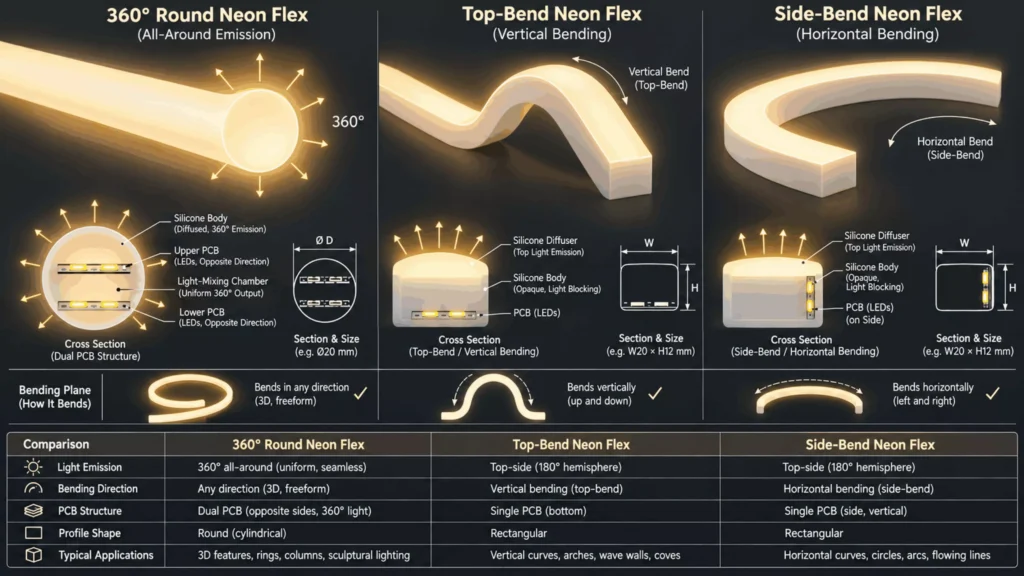
How Does a 360° Neon Tube Compare to Other Linear Lights?
When evaluating round vs flat neon flex, cheap rope lights, or glass tubes, contractors must look closely at internal structures and optical outputs. Here is how our D-Series round neon flex compares against traditional alternatives based on NPHIS laboratory benchmarks:
| Feature / Metric | 360° Silicone Neon Flex | Flat Neon (Top/Side Bend) | Traditional Glass Neon | Commercial Rope Light |
|---|---|---|---|---|
| Beam Angle | 360° Omnidirectional | 120° to 160° Directional | 360° Omnidirectional | 360° (Spotty / Dotted) |
| Operating Voltage | 24V DC (Safe Low Voltage) | 12V / 24V DC | 3,000V – 15,000V AC | 120V / 230V AC or 24V DC |
| Luminous Flux | 760 – 1,540 lm/m (NPHIS Lab) | 400 – 950 lm/m | 250 – 500 lm/m | 150 – 300 lm/m |
| Outer Material | UV-Resistant Silicone | Silicone or PVC | Fragile Glass Tube | Clear PVC (Yellows fast) |
| Min. Bend Diameter | 80 mm – 150 mm (By Diameter) | 50 mm – 100 mm | Custom Heat-Bent Only | 60 mm |
| Lifespan (L70) | > 50,000 Hours | > 50,000 Hours | 10,000 – 15,000 Hours | 8,000 – 15,000 Hours |
When Should You Choose 360° Neon Flex (And When Not To)?
You should specify round neon flex only when the light tube itself is a visible design element viewed from two or more directions. If you hide it inside a narrow ceiling cove, you waste nearly 50% of its light output against the back wall.
3 Scenarios Where 360° Round Neon Excels
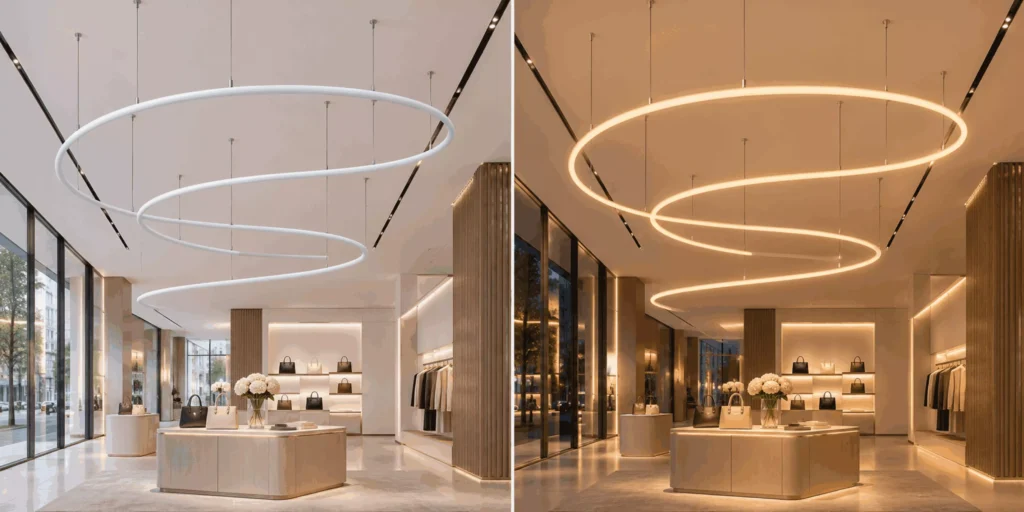
- Suspended Atrium Chandeliers: Visitors see the light line from below, from balconies, and across open floors.
- Freestanding 3D Art Sculptures: The tube spirals around metal frames where flat strips would show their dark backing.
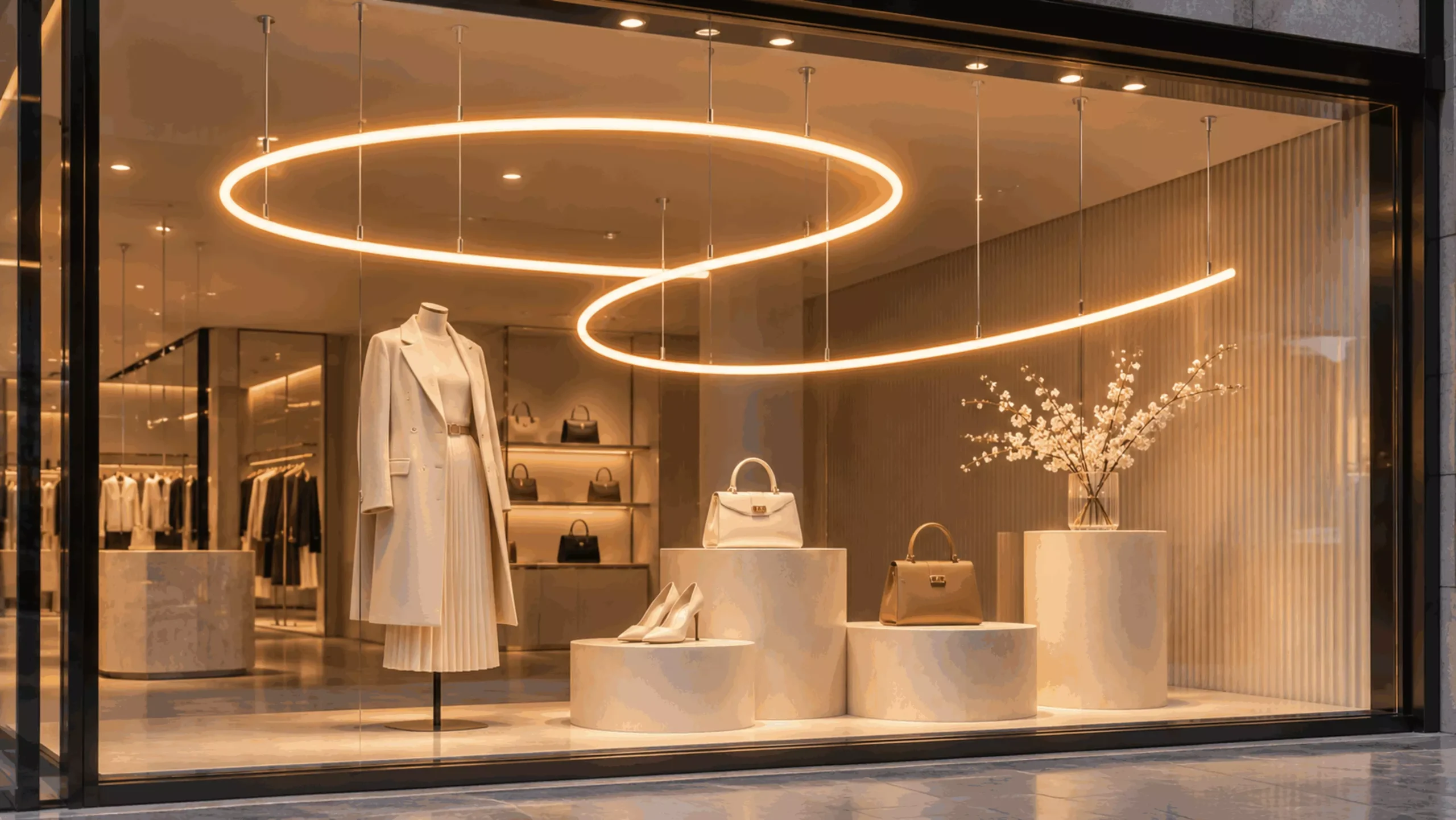
- Glass Curtain Walls & Retail Windows: One round tube illuminates both the indoor sales floor and the exterior sidewalk simultaneously.
When You Should Avoid It
Do not use round neon flex for recessed floor grooves or flush wall grazing. For single-surface contour runs, a standard top bend LED neon flex costs 25% to 35% less and directs 100% of its lumens forward.
Also, remember that “360° emission” does not mean “unlimited 360° twisting.” Because there is a double-sided PCB inside, twisting the tube like a corkscrew can crack the solder joints. If your route bends tightly across two axes on a flat wall, check our 3D LED neon flex configurations first.
Selecting Diameter and Applications for Architectural Projects
When planning 360 neon flex architectural lighting, matching the tube diameter to the viewing distance is critical. A 16 mm tube looks sharp in a boutique window, but it disappears visually when hung 12 meters high in a shopping mall.
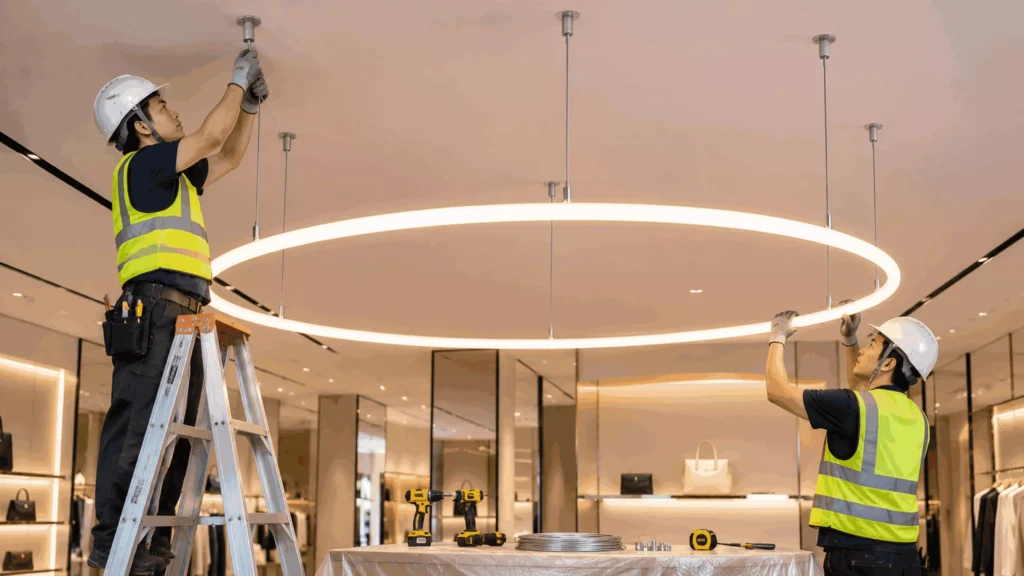
How to Select Diameter by Viewing Distance
| Diameter Range (Model Series) | Recommended Viewing Distance | Typical Architectural Applications |
|---|---|---|
| Ø16 mm – Ø20 mm (D16–D20) | Under 3 meters | Tight curves, retail window displays, and close-up decorative features |
| Ø22 mm – Ø25 mm (D22–D25) | 3 to 8 meters | Hotel lobbies, suspended atrium pendants, and medium-scale chandeliers |
| Ø30 mm – Ø50 mm (D30–D50) | Over 8 meters (up to 30+ m) | Large building facades, high ceilings over 8 meters, and outdoor plazas |
For the full electrical and optical parameter matrix across all ten smooth and woven models (D16 to D50), please visit our product page.
1. Atrium Suspended Waves & Pendants
In large commercial atriums, designers suspend round neon with aircraft cables to create floating light ribbons.
- Recommended Models: D22 (Ø22 mm) or D25 (Ø25 mm) smooth profile in 3000K warm white.
- Pro Tip: Insert the tube into rigid polycarbonate (PC) clear tubes for straight vertical drops, or use stainless steel wire slings spaced every 400 mm for organic waves.
2. Retail Displays & Woven Textured Pendants
High-end fashion stores and hotel lounges care just as much about how a fixture looks when turned off during the day.
- Recommended Models: NPHIS D16 Woven (Ø16 mm) or D22 Woven (Ø22 mm).
- Pro Tip: The braided fabric sleeve softens surface glare to 620–1,120 lm/m (NPHIS Catalog P46 test data), giving suspended decorative fixtures a warm, residential textile feel.
3. Architectural Columns, Bridges & Sculptural Frames
Wrapping exterior pillars or pedestrian bridge railings requires weatherproofing and visual boldness from 30+ meters away.
- Recommended Models: D30 (Ø30 mm), D40 (Ø40 mm), or D50 (Ø50 mm) in IP67 silicone LED neon flex.
- Pro Tip: Larger diameters increase the visual footprint without increasing wattage—all three run at a stable 20 W/m on 24V DC.
4. Dynamic Media Facades & Entertainment Venues
When nightclubs, theme parks, or building facades demand chasing color waves, static white is not enough.
- Recommended Setup: Custom SPI addressable or DMX512 RGB/RGBW D22 round neon. If your project involves flat facade channels alongside suspended tubes, you can pair them on the same controller with our DMX512 RGBW neon flex.

Why Material Choice Dictates Outdoor Lifespan
Driving a sealed silicone tube above 22 W/m traps heat and accelerates lumen depreciation. Equally important is the outer jacket chemistry: cheap round tubes made of PVC turn yellow and crack within 18 to 24 months under direct sunlight.
In contrast, our platinum-cured silicone jacket tolerates temperatures from −40°C to +80°C and resists UV yellowing for over 10 years. For a deeper chemical breakdown, read our lab comparison on silicone vs PVC LED flexible neon lights.
Furthermore, every NPHIS D-Series profile carries an IP67 ingress protection rating verified under International Electrotechnical Commission (IEC 60529 IP Code) standards. To ensure consistent white tones across large building facades, we bin all LEDs within a 3-step MacAdam ellipse (SDCM ≤ 3) in line with Illuminating Engineering Society (IES TM-30 / ANSI C78.377) chromaticity guidelines.
Suspended LED Neon Flex Installation: Anti-Sagging, Voltage Drop & Sealing
Understanding how to hang round neon flex in mid-air is very different from screwing flat channels onto concrete. Follow these four suspended LED neon flex installation rules from our factory floor to prevent site callbacks.
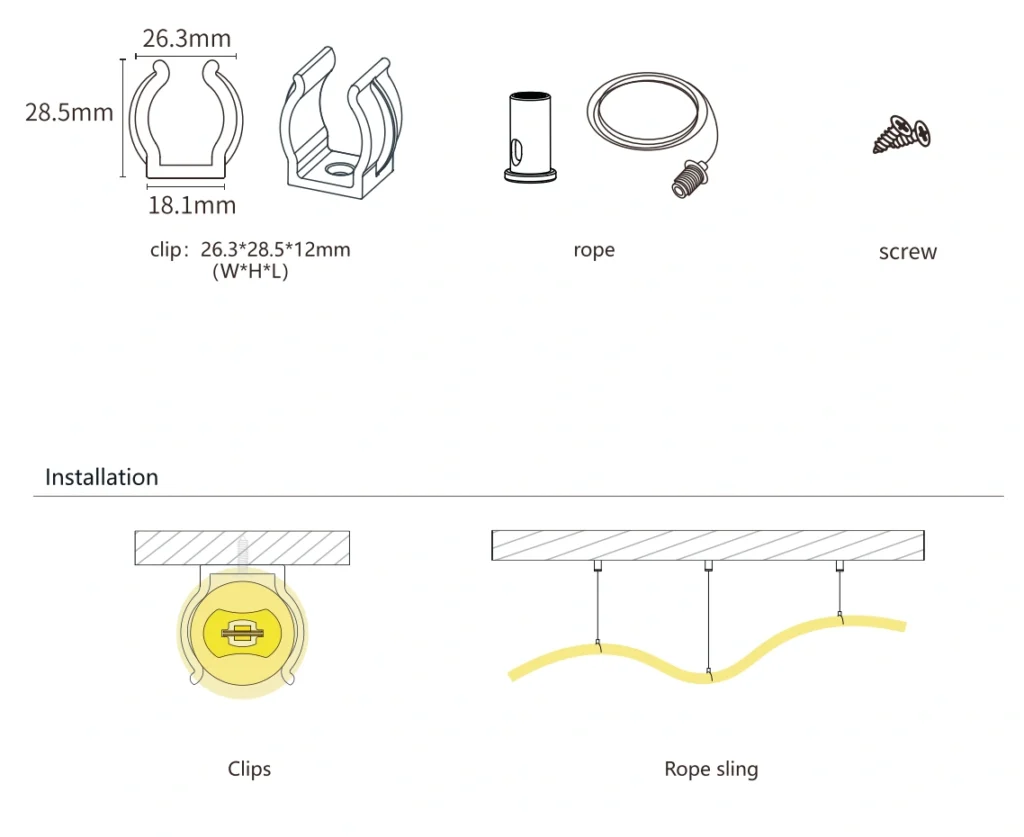
1. Prevent Mid-Span Sagging
Silicone is flexible and heavy—a 5-meter roll of D22 weighs roughly 1.9 kg. If you suspend it horizontally with clips placed 1.5 meters apart, gravity will pull the tube into an unsightly sag.
- Free-Hanging Curves: Place U-shaped transparent PC clips (26.3 × 28.5 × 12 mm for D22) or stainless steel wire slings every 350 mm to 500 mm.
- Dead-Straight Spans: Slide the neon inside a clear UV-stabilized polycarbonate rigid sleeve, or tension a 2 mm stainless steel aircraft cable directly along the spine of the tube.
2. Respect the Bending Direction Mark
Inside the round tube sits a flat PCB. You must bend the tube perpendicular to the PCB plane (following the printed cut/bend line on the silicone surface). Bending against the PCB edge forces copper traces to buckle, causing dead sections within weeks.
3. Calculate Voltage Drop Before Cutting
Although our catalog nominal roll length is 5 meters (5,015 mm total assembly length with 200 mm lead wire), a 20 W/m strip draws 0.83 A/m at 24V DC.
Over a 5-meter single-end feed, total current reaches 4.16 A, creating a tail-end voltage drop of roughly 2.1 V. For runs longer than 5 meters, feed power from both ends or inject power every 5 meters using dedicated 16 AWG / 18 AWG T-splitters.
4. Specify Factory-Molded End Caps
Field-glued end caps fail in 30% of outdoor installations due to thermal expansion. Whenever possible, send us your exact cut schedule so we can supply factory-vulcanized wrapped or uniform-width end caps with straight or side cable exits.
How to Write a 360 Neon Flex Specification for Tender Documents
Lighting specifiers often struggle when contractors substitute cheap PVC rope lights during tender bidding. Copy and paste the 360 neon flex specification clause below into your project schedule to lock in engineering quality:
CSI Specification Template – Linear 360° Omnidirectional LED Luminaire:
- Luminaire Type: Flexible 360-degree omnidirectional cylindrical LED neon luminaire (Reference: NPHIS D-Series D16 / D22 / D30 or approved equal).
- Housing Material: 100% optical-grade extruded silicone, UV-stabilized, flame-retardant, operating temperature −40°C to +80°C. PVC jackets are strictly prohibited.
- Optical & Electrical: 24V DC constant voltage input, power consumption 16 W/m – 22 W/m, delivered lumen output ≥ 1,250 lm/m (smooth white), dot-free 360° emission, CRI Ra ≥ 90, SDCM ≤ 3.
- Protection & Compliance: Factory-sealed IP67 rating with molded straight/side cable exits. CE, RoHS, and UL/ETL compliant components. Supplied with IES photometric files and shop drawings.
Real Project Case Snapshots from NPHIS
Case 1: Luxury Shopping Mall Atrium – Dubai, UAE (2025)
- Design Challenge: The lighting consultant needed 180 meters of suspended spiral light rings across a 4-story atrium with zero visible dark backs from upper floor escalators.
- NPHIS Solution: Custom-cut D22 Smooth (Ø22 mm) in 3000K (CRI ≥ 90, 20 W/m, 1,310 lm/m) paired with clear PC U-clips and 1.5 mm aircraft suspension wires spaced every 400 mm.
- Result: Installed in 4 nights with pre-molded dual-end power feeds. Zero sag and uniform 360-degree glow across all viewing balconies.
Case 2: Waterfront Pedestrian Bridge & Art Plaza – Melbourne, Australia (2026)
- Design Challenge: An interactive public sculpture required weatherproof, salt-mist-resistant 3D light loops with synchronized color waves.
- NPHIS Solution: 120 meters of custom D25 Addressable DMX512 RGBW 360° Neon Flex (IP67 factory-molded ends) integrated with an Art-Net controller. For similar facade control setups, check our guide on DMX LED neon flex for facade and entertainment lighting.
- Result: Survived high coastal humidity and UV exposure with zero water ingress or pixel signal failure after 10 months of continuous operation.
Specify Your 360° Architectural Lighting Project
Explore the complete D16–D50 diameter matrix, cutting intervals, and accessory drawings on our 360 round LED neon flex product page. When your layout is ready, contact our engineering team with your CAD drawings or BOQ for technical review and project support.
References & Industry Standards Cited
- NPHIS LED Neon Flex Catalog 2026–2027 (Pages 38–48): D-Series 360° Round Silicone Neon Flex Integrating Sphere Test Reports (D16–D50).
- International Electrotechnical Commission (IEC): IEC 60529 Degrees of Protection Provided by Enclosures (IP67 Code Testing). https://www.iec.ch/ip-ratings
- Illuminating Engineering Society (IES): ANSI/IES TM-30 & ANSI C78.377 Specifications for the Chromaticity of Solid-State Lighting Products. https://www.ies.org/standards/
FAQs
❓️ What is the difference between a 360° round neon tube and flat neon flex?
A 360 degree LED neon flex has a circular cross-section that emits light equally in all directions (360°), making it ideal for suspended and sculptural fixtures. Flat neon flex (top bend or side bend) has a rectangular profile that emits light from only one surface (120°–160°) and is designed for recessed coves or flat wall mounting.
❓️ Can you bend round neon flex in any direction?
No, 360° refers to the light emission angle, not unlimited mechanical twisting. While the round silicone tube is flexible, it houses an internal PCB that bends safely along its designated plane (minimum bend diameter 80 mm to 150 mm depending on outer diameter). Always align curves with the printed guide mark on the tube.
❓️ Can 360° neon tubes be cut to custom lengths on site?
Yes, our 24V DC round neon profiles can be cut along the printed scissor marks (requiring neutral-cure silicone sealant and waterproof end caps to preserve IP67 protection); please see the product page for exact cutting intervals by diameter.
❓️ What is the maximum single-run length for 24V round neon flex?
For a standard 24V DC configuration consuming 16 W/m to 22 W/m, the maximum recommended single-end power feed is 5 meters. If your continuous design line reaches 10 meters, power the tube from both ends to avoid brightness drop.
❓️ How do you keep suspended round neon flex from sagging?
For curved suspended shapes, install stainless steel suspension cables or transparent polycarbonate clips every 350 mm to 500 mm. For straight horizontal or vertical architectural lines, insert the silicone neon tube inside a rigid clear polycarbonate tube or tension it along an aircraft wire rope.
❓️ How do I choose the right diameter for my project?
Select Ø16–20 mm for close viewing under 3 meters, Ø22–25 mm for medium-scale atrium pendants (3–8 meters), and Ø30–50 mm for high ceilings or facades over 8 meters; compare full model specifications on the product page.
Can’t find the answer you are looking for?
Write us a questionand we will be happy to answer it