

To import silicone neon flex from China without costly post-shipment disputes, you must lock down extrusion construction, single-bin LED matching, and customs paperwork before wiring your deposit. Every week, our team in Shanghai reviews photos from frustrated overseas buyers: reels that turned amber after one summer, or two cuts of “the same” white that visibly clash on a building facade.
Since 2012, we have manufactured and exported linear lighting for importers, distributors, and sign shops. Across hundreds of shipments, buyer complaints almost always trace back to three root causes:
- Premature yellowing: Low-grade material or fake silicone that degrades under outdoor UV exposure. (See our technical breakdown on silicone vs. PVC LED flexible neon lights for material test details.)
- Inconsistent binning: Noticeable color temperature shifts between reels that ruin continuous facade installations.
- Hidden MOQ traps: Middlemen quoting low unit prices, then adding surprise minimum order fees at production. At our factory, standard models start at 1 meter per SKU and custom runs at USD 1,000 across our wholesale LED neon flex range.
This checklist covers every technical spec, sample test, packaging rule, and customs step you need to verify before your order leaves the factory floor.
Table of Contents

Pre-Deposit Spec Audit
You can prevent 90% of import quality disputes by auditing four core specifications on your proforma invoice before paying a deposit. Never accept a generic quotation that only lists wattage, color temperature, and a vague “waterproof” label.
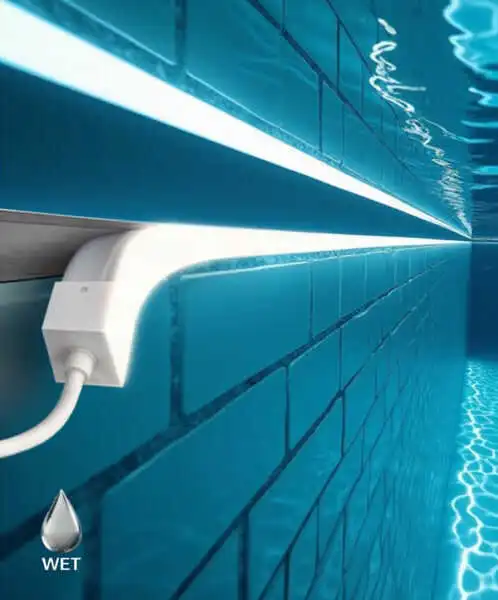
Waterproof Ratings (IP65, IP67, and IP68) and Potted vs. Sleeved Construction
Always ask the factory to specify both the IP rating and the exact extrusion method on your spec sheet. Many online listings advertise IP68 potted vs sleeved neon flex as if they are identical, but a hollow silicone sleeve will eventually take in water through capillary action when submerged.
| IP Rating | Protection Level | Construction Method | Best-Fit Application |
|---|---|---|---|
| IP65 | Dust-tight, water jets | Silicone sleeve or surface coating | Covered outdoor eaves, indoor wet areas |
| IP67 | Temporary immersion | Integrated silicone co-extrusion | Building facades, outdoor signage, landscapes |
| IP68 | Continuous submersion | Fully encapsulated (solid potted silicone) | Swimming pools, fountains, underwater fixtures |
For true continuous-submersion projects, insist on solid co-extruded or fully potted construction and molded injection end caps rather than hand-glued caps. You can see how different profiles perform in real environments in our guide to silicone neon flex for architectural lighting.
Bending Direction, Minimum Bend Radius, and Cutting Intervals
Confirm the bending orientation with your engineering team before requesting a quote, because top-bend and side-bend profiles use completely different internal PCB orientations. Ordering the wrong bend direction will twist the internal copper tracks and crack the solder joints during installation.
- Top-bend (top view): Bends upward and downward along the illuminated face. Our standard minimum bending radius for top-bend profiles is 50mm.
- Side-bend (side view): Bends left and right perpendicular to the glowing surface, ideal for channel letters and logos. Our standard minimum bending radius for side-bend profiles is 25mm.
- Cutting intervals: There is no single universal cut length. Cutting intervals vary by LED density, voltage, and PCB design. Always require the factory to print clear scissor marks on the silicone jacket and state the exact cutting unit in millimeters on the drawing before production.

Silicone Neon Flex Binning (SDCM) and Single-Bin Lock
Specify a strict silicone neon flex binning SDCM requirement on your purchase contract and mandate that your entire purchase order comes from a single LED bin code. Color consistency is measured in SDCM (Standard Deviation of Color Matching), also known as MacAdam ellipse steps—a standard clearly explained in ERCO’s technical guide to MacAdam ellipses.
If a factory mixes leftover LED reels from two different bins on a 500-meter order, your client will see warm and cool patches side by side on the wall. Write “Single Bin Only — Target SDCM ≤5 Steps” directly into the purchase order terms, and ask the factory to keep your bin code on file for future reorders.
Mandatory Factory Documents to Request Before Paying Deposit
Require the supplier to send four technical documents alongside your proforma invoice so your engineering team can verify photometry and component longevity:
- Product Spec Sheet & Mechanical Drawing: Confirming profile cross-section dimensions, wattage per meter, voltage drop limits, and cutting marks.
- IES Photometric Files: Essential if your buyers are lighting designers or architectural contractors running DIALux simulations.
- LM-80 Test Report: Verifying the lumen maintenance data of the raw LED packages inside the strip.
- Batch Integrating Sphere Test Report: Proving the actual CRI, CCT, Duv, and lumen output of the pre-production sample.

Sample Approval Checklist
Testing a physical sample before bulk production is the cheapest insurance policy in international lighting procurement. At NPHIS LED, we provide a free 1-meter sample for standard models (buyers only cover courier freight), and any paid custom sample fees are credited back against your bulk order.
When your sample parcel arrives, run these seven checks in your workshop and record the results:
| Inspection Item | Workshop Test Method | Pass Standard (Factory Benchmark) |
|---|---|---|
| Jacket Material & Thermal Resistance | Check material odor (no pungent PVC smell) and verify thermal rating sheet | Pure silicone rated for -40°C to +120°C working temperature |
| Minimum Bend Radius | Wrap sample around a fixed cylinder gauge and power on for 24 hours | No dark spots, PCB lifting, or cracking at 50mm (top-bend) or 25mm (side-bend) |
| Cut-Line Accuracy | Cut along three printed scissor marks and test both segments with a power supply | Clean copper solder pads exposed; all remaining LEDs light up normally |
| Waterproof End-Cap Seal | Submerge the sealed end-cap and cable entry point in water for 24 hours | Zero moisture ingress, condensation, or bubbles inside the housing |
| Color Consistency (SDCM) | Light up two sample segments side by side against a matte white board | Uniform white appearance; integrating sphere report matches target bin (5 SDCM) |
| Voltage Drop & Brightness | Power a full run length and measure tail voltage with a digital multimeter | Tail-end brightness uniform; voltage drop within 5-10% |
| Outdoor Lifespan & Warranty Terms | Verify written warranty agreement and UV aging documentation | 5+ years outdoor lifespan; 3-year warranty for standard items (up to 5 years for custom products) |
Packaging and Reel Handling
Improper reel winding and weak export cartons damage more LED neon flex during transit than actual manufacturing defects. Silicone is soft and elastic, which means excessive tension on a flimsy plastic spool will stretch the internal PCB and break micro-solder joints before the container ever reaches your warehouse.

When reviewing your supplier’s packing specification, enforce these four rules:
- Reel winding tension: The strip must be wound loosely on a reinforced hub diameter larger than the minimum bend radius (≥100mm hub diameter recommended) so the inner loops are never pinched.
- Anti-static and moisture barrier: Silicone carries static electricity easily and attracts cardboard dust. Each reel should be sealed inside an anti-static bag with a silica gel desiccant pack.
- Carton crush strength: Specify 5-ply corrugated export master cartons with internal cardboard dividers so stacked reels do not crush the bottom layer during ocean transit.
- Palletization & labeling: For LCL and air shipments, require fumigation-free export pallets wrapped in stretch film with corner protectors. If you need custom barcode stickers, distributor part numbers, or branded boxes (available at a USD 1,000 OEM private-label MOQ), review our guide on private label silicone LED neon flex OEM packaging.

Shipping and Customs
Factor both manufacturing lead time and transit time into your project schedule before choosing a shipping mode. Our standard factory lead time is 5–7 business days for regular items and 15–20 business days for custom extrusions.
Sea Freight vs. Air Freight vs. Express Courier
Choose your transport mode based on chargeable weight and project deadlines:
| Shipping Mode | Typical Door-to-Door Transit Time | Best Order Volume | Cost & Handling Notes |
|---|---|---|---|
| Express Courier (DHL / FedEx / UPS) | 5-6 days | Samples & urgent orders (< 100 kg) | Fastest customs clearance; highest per-meter freight cost |
| Air Freight (Airport to Airport / Door) | 10-12 days | Medium commercial projects (100–500 kg) | Balances speed and cost for tight contractor deadlines |
| Sea Freight (LCL / FCL) | 25-40 days | Bulk distributor stock (> 500 kg / 2+ CBM) | Lowest landed cost per meter; requires early inventory planning |
Incoterms: FOB Shanghai vs. DDP
If you already work with an experienced freight forwarder and customs broker, buying on FOB Shanghai terms gives you full transparency over ocean rates, marine insurance, and local port charges. If you run a sign shop or regional distributorship without an in-house import license, ask whether DDP (Delivered Duty Paid) air or sea service is available for your destination country—just be sure to require a separate breakdown of unit product price vs. logistics fees.
Neon Flex HS Code Verification
Using the wrong neon flex HS code on your commercial invoice can trigger customs holds or unexpected tariff assessments. LED neon flex and linear LED lighting strips are typically classified under Heading 9405 (such as 9405.42 for other electric luminaires and lighting fittings with LED light sources, or related subheadings depending on whether power supplies and controllers are pre-assembled).
Because tariff descriptions and duty rates vary by jurisdiction and assembly level, always cross-check the exact 8- to 10-digit code on the USITC Harmonized Tariff Schedule (HTS) database or your local customs portal, and have your licensed customs broker confirm the code in writing before your factory issues the final packing list and Bill of Lading.
Compliance Certificate Package (EU & North America)
Never let a shipment sail before inspecting the exact compliance certificates tied to the factory’s model numbers:
- European Union: You must hold valid CE (LVD / EMC) and RoHS test reports and a signed Declaration of Conformity. At NPHIS LED, our silicone neon flex products carry CE and RoHS certifications for rapid EU customs clearance.
- North America: Many commercial projects require UL or ETL listing [ confirm specific project listing requirements before ordering]. Always verify the file number directly on the certifying body’s online directory rather than trusting a logo printed on a PDF brochure.
Red Flags at the Quote Stage
You can usually spot an unreliable supplier or an undisclosed trading middleman before placing a sample order by watching for five warning signs during the quotation stage:
- Refusal to state extrusion method: Quoting “IP68” at an unusually low price without confirming whether the body is solid potted silicone or a hollow sleeve.
- No SDCM commitment: Claiming “pure white, no color difference” verbally while refusing to write an SDCM step limit or single-bin guarantee on the proforma invoice.
- Vague warranty paperwork: Promising 5+ years of warranty in an email without defining failure rates, UV yellowing thresholds, or replacement shipping terms.
- Mismatched certificate names: Sending CE or RoHS certificates issued to an unrelated company name.
- Evasive factory audit answers: Declining a quick 10-minute live video call from the extrusion line and aging test room.
For a complete step-by-step audit score sheet before wiring funds, read our dedicated guide on how to evaluate a silicone LED neon flex manufacturer in China.
Next Steps for Your Import Order
Once you have verified your target specifications and customs requirements against this checklist, you can move from planning to sampling through three direct paths on our site:
- Browse Standard Profiles & Bend Directions: Explore our complete wholesale LED neon flex range to filter models by top-bend, side-bend, 3D bend, and cutting intervals—starting from just 1 meter per SKU for standard specifications.
- Custom Architectural & Facade Engineering: Visit our silicone neon flex project solutions page if your project requires custom mold extrusion, IP68 underwater potting, or DMX/SPI pixel control (custom and OEM orders start at USD 1,000).
- Request Your Free 1-Meter Sample Kit: Contact our Shanghai engineering team with your target CCT, IP rating, and run length. We will prepare a free 1-meter sample (freight collect) along with the matching spec sheet, IES file, and CE/RoHS certificate package within 5–7 business days.
FAQs
❓️ How long does it take to ship silicone neon flex from China?
Production lead time at our Shanghai factory is 5–7 business days for standard models and 15–20 business days for custom or OEM orders. After dispatch, transit takes approximately 5-6 days by express courier, 10-12 days by air freight, and 25-40 days by ocean freight depending on your destination port and customs clearance speed.
❓️ What does IP68 actually mean for silicone LED neon flex?
True IP68 means the neon flex is engineered for continuous underwater submersion rather than temporary rain or splashing. To achieve genuine IP68 protection, the LED strip must be fully encapsulated (solid potted) in silicone with factory-molded injection end caps. Always verify whether a supplier’s “IP68” quote refers to solid potting or a hollow IP67 sleeve.
❓️ Why do two reels of the same white silicone neon flex look different?
Visible color differences between reels of the same nominal CCT (such as 3000K or 4000K) happen when a supplier mixes LEDs from different chromaticity bins or uses loose MacAdam ellipse tolerances. To prevent mismatched facades, require a strict SDCM tolerance and specify “single-bin fulfillment across the entire purchase order” on your contract.
❓️ What should I check first when testing a silicone neon flex sample?
Test four physical parameters first: confirm the jacket is 100% pure odorless silicone rated for -40°C to +120°C, bend the strip to its rated minimum radius (50mm top-bend or 25mm side-bend) to check for dark spots, cut at a printed scissor mark to verify clean solder pads, and submerge the end cap in water to test the seal.
❓️ Which certificates are required to import LED neon flex into the US and EU?
For the European Union, importers need CE (LVD and EMC) and RoHS compliance certificates alongside a Declaration of Conformity—both of which NPHIS LED provides as standard. For the United States and Canada, commercial installations typically require UL or ETL listing [待确认], plus FCC compliance if drivers or controllers are included.
❓️How do I confirm the right HS code for silicone LED neon flex?
Silicone LED neon flex generally falls under Harmonized System heading 9405 (commonly subheading 9405.42 for LED electric luminaires and lighting fittings). Because duty rates depend on whether the strip is imported on bulk reels or as a finished kit with power supplies, send the factory’s spec sheet to your licensed customs broker and verify the final 10-digit code on USITC HTS before shipping.
WHY I WRITE THIS
About my business
Our company’s main products include LED flexible light strips, rigid light strips, and linear light fixtures, all of which are manufactured in our own factory or in factories we have been cooperating with for many years.
Our services
Our products are primarily mid-to-high-end, exported to Europe and America. We accept OEM & ODM small-batch orders, and also provide sourcing services in China to help our international clients solve problems. Please contact us if you need our assistance with sourcing.
Contact Profile
Name Ted Lau
Brand Name NPHIS
Country China
Model B2B Wholesale only
Email ted@nphis-led.com
Related Posts
Explore essential insights on material durability, IP ratings, and installation for our Silicone LED Neon Flex. Designed for lighting professionals, this guide helps you make informed purchasing decisions for commercial and architectural applications.



Client Endorsements
Here,we proudly display the brands we have partnered with.






Request a free quote
If you have questions or suggestions,please leave us a message,we will reply you as soon as we can!