
Most of our wholesale partners already know why they buy RGB silicone LED neon flex — the flexibility, the anti-yellowing performance, the clean dot-free light line. So we won’t waste your time repeating that.
Instead, let’s talk about what actually goes wrong after the container arrives.
Last year alone, our pre-sales team received complaints from no fewer than 20 contractors around the world. Almost none were about silicone quality. They were about voltage drop, batch color mismatch, water ingress at field-cut ends, and camera flicker.
Today, I’m sharing the factory SOPs we use at NPHIS to prevent these four failures — before your goods even leave our production line.
Table of Contents
The Hidden Killer of Commercial Projects: Managing Voltage Drop in Long Runs
Here’s a real case. In early 2025, a US contractor bought 300 meters of 24V RGB neon flex elsewhere for a shopping mall ceiling. By meter 8 of each run, red looked orange. The white mix turned pinkish. The whole batch got blamed — but the product was fine. The power feeding plan wasn’t.
Why RGB Suffers More Than Single Color
Voltage drop hits RGB harder than white strips. The three channels (R/G/B) have different forward voltages. As voltage sags along the run, the channels dim unevenly. The result: visible color shifting at the far end, not just brightness loss.
24V vs. 48V: Our Factory Recommendation
| Spec | 24V RGB Neon Flex | 48V RGB Neon Flex |
|---|---|---|
| Max single-end run | 5–8 m | 10–15 m |
| Max dual-end run | 10–15 m | 20–30 m |
| Color shift risk | Moderate | Low |
| Best for | Signage, short accents | Facades, long coves |
Dual-End Feeding: The 5-Minute Fix
For any run beyond the single-end limit, we specify dual-end power feeding — injecting power at both ends of the strip. Voltage sag then peaks in the middle, cutting the effective drop by roughly 75%.
At NPHIS, every bulk order over 10m per run ships with a wiring diagram customized to your project layout. It costs us an hour of engineering time. It saves you a job-site disaster.
Color Consistency Across Batches: Why SDCM Matters for Wholesalers
A German distributor once told me: “Batch 1 sold perfectly. Batch 2 arrived, my client installed both in one lobby — and the greens didn’t match under camera.”
This is the classic binning problem, and for wholesalers it’s a reputation killer.
What Actually Causes Batch Drift
- LED chip makers produce dies across multiple color bins; low-cost factories mix bins to cut cost.
- Phosphor and silicone diffusion layers vary between extrusion runs.
- RGB chips have wavelength tolerances — a 3nm shift in green is visible to the naked eye.
How NPHIS Locks Batch-to-Batch Consistency
- Single-bin purchasing: we lock one wavelength bin per project code, not per PO.
- Integrating sphere testing on every production lot, with data archived for 5 years.
- SDCM < 3 guaranteed on white-mix output (per the tighter end of ANSI C78.377 chromaticity standards).
- Golden sample retention: your first-order sample is sealed and used as the visual reference for every reorder.
So when your batch 5 arrives eighteen months later, it matches batch 1. That’s not luck — it’s traceability.

On-Site Cutting vs. Factory Pre-Injection: Preventing Water Ingress
Here’s a number from our own warranty records: around 90% of outdoor neon flex failures we’ve analyzed started at a field-cut end — not in the strip body.
Why On-Site Sealing Fails So Often
Contractors are under time pressure. On a cold, dusty rooftop, they cut the strip, apply generic glue, cap the end, and move on. The problems:
- Most adhesives don’t chemically bond to extruded silicone.
- Curing takes 24 hours; installers rarely wait.
- Capillary action pulls moisture along the copper conductors — the strip dies 5 meters from the visible entry point.
The Factory Pre-Injection Alternative
Factory pre-injected connectors are molded and vulcanized onto the strip under controlled pressure and temperature, creating a homogeneous silicone-to-silicone seal. In our lab, pre-injected ends survive 30 days of IP68 submersion cycling; field-sealed samples average leakage within 7–10 days.
Our recommendation to every importer:
- Send us your cut-length schedule (e.g., 46 × 3.2m, 20 × 7.5m).
- We deliver pre-cut, pre-injected, pre-tested segments, labeled per zone.
- Your installer only plugs and mounts. Zero on-site cutting. Zero warranty gray areas.
Yes, it adds 2–3 days of lead time. It removes years of callback risk.
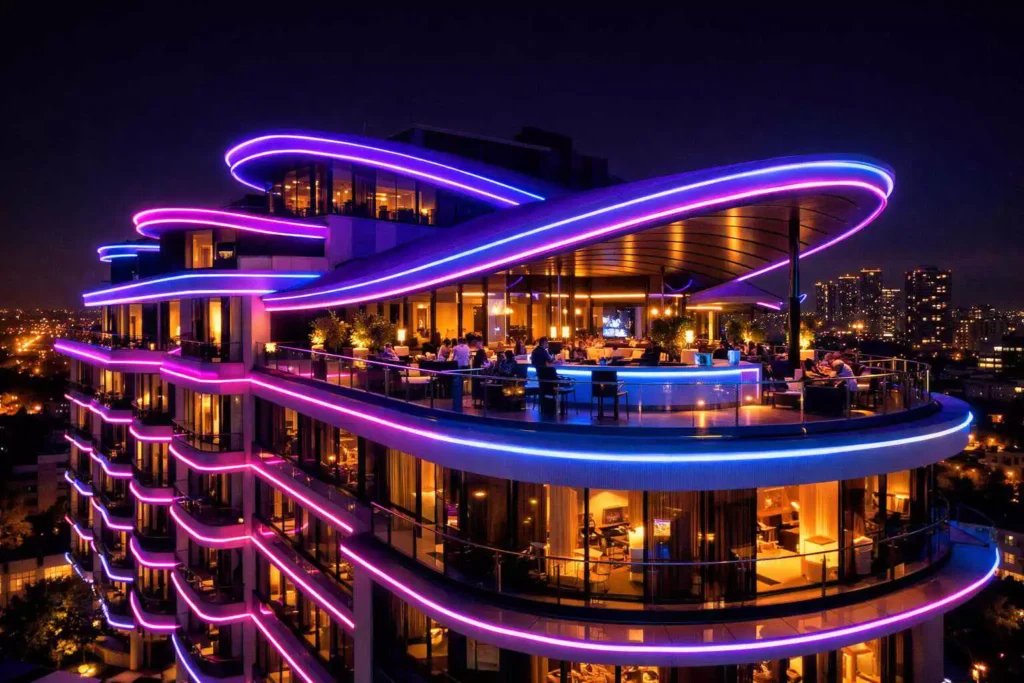
Seamless Control: Avoiding Flickering in Entertainment Lighting
If your client’s project involves cameras — hotels hosting events, TV studios, nightclubs full of smartphones — flicker is the complaint you’ll get in week one.
The PWM Frequency Problem
Cheap RGB controllers dim at 200–500Hz PWM. Invisible to the eye, but a rolling-shutter camera catches ugly banding instantly. For camera-ready commercial decorative lighting solutions, we specify drivers and decoders running at ≥ 2kHz, ideally 4–8kHz — in line with IEEE 1789 recommendations on flicker risk reduction.
Before shipping entertainment projects, our QC films every controller-strip pairing with a 240fps slow-motion camera. If banding appears, the pairing doesn’t ship.
DMX512: Pixel Control Without the Headaches
For dynamic facades and stage installations, our RGB LED neon flex range integrates directly with standard DMX512 architecture. For projects that need tunable whites on top of color — think hotel exteriors switching from festive RGB to warm 2700K on weekdays — the 4-channel RGB LED neon strips with built-in DMX512 ICs gives your programmer per-segment addressability without external decoders cluttering the ceiling void.
As a DMX512 RGBW neon flex supplier, we pre-write the DMX addresses at the factory according to your fixture map. Your integrator plugs in and patches — no ladder work re-addressing 200 segments on site.
A Checklist for Importers: What to Confirm Before Your Next Bulk Order
Price is the last question, not the first. Here’s what we’d ask if we were in your chair:
- Voltage plan: “Based on my run lengths, do you recommend 24V or 48V, and where are the feed points?”
- Binning policy: “Do you lock one LED bin per project code? Can I see integrating sphere reports?”
- SDCM guarantee: “Is SDCM < 3 written into the sales contract?”
- Pre-injection service: “Can you cut and seal to my exact length schedule?”
- PWM frequency: “What is the dimming frequency of your recommended controller — with test footage?”
- DMX pre-addressing: “Will segments arrive pre-addressed to my fixture map?”
- Warranty terms: “Does the 5-year warranty cover factory-sealed ends explicitly?”
- Reorder traceability: “How do you match my golden sample two years from now?”
If a supplier hesitates on more than two of these, that’s your answer.
Conclusion: Build on a Factory That Solves Problems Before They Ship
Color-changing commercial decoration projects don’t fail because silicone is bad. They fail on voltage planning, bin control, field cutting, and cheap PWM — all preventable at the factory stage.
At NPHIS LED, we’ve built these safeguards into our standard production workflow for over ten years. Send us your project drawings or your next bulk RFQ, and our engineering team will return a free voltage-drop layout, cut-length plan, and controller pairing recommendation within 48 hours.
👉 Contact NPHIS LED for a project evaluation — deal directly with the factory, not a middleman.
FAQs
❓️ What is the maximum run length for RGB silicone LED neon flex without color shift?
For 24V, keep single-end runs under 8m; with dual-end feeding, up to 15m. For 48V versions, dual-end feeding supports 20–30m with negligible color shift.
❓️ Why does my second batch of neon flex look different from the first?
Usually because the factory mixed LED bins between production runs. Insist on single-bin lock per project code and SDCM < 3 written into your contract.
❓️ Can RGB silicone neon flex be cut on-site?
Technically yes, but roughly 90% of outdoor failures originate at field-sealed cut ends. Ordering factory pre-injected custom lengths is the reliable solution for outdoor and wet-location projects.
❓️ What PWM frequency prevents flicker on camera?
At least 2kHz; 4–8kHz is ideal for TV studios and event venues, consistent with IEEE 1789 flicker guidance.
❓️ What's the difference between RGB and DMX512 RGBW neon flex?
Standard RGB changes color as one zone via a controller. DMX512 RGBW adds a dedicated white channel and per-segment addressability, enabling chases, gradients, and tunable white scenes.
❓️ What is the typical MOQ and lead time for custom-length pre-injected neon flex?
At NPHIS, custom orders typically start at 200–500 meters, with 10–15 working days production plus 2–3 days for pre-injection and labeling.
❓️ Does dual-end power feeding require two power supplies?
Not necessarily. One adequately sized PSU can feed both ends via a looped cable, though separate PSUs simplify wiring on very long facades.
❓️ How do I verify a supplier's color consistency claims?
Request integrating sphere test reports per lot, confirm golden-sample retention policy, and order samples from two different production dates before committing.
Can’t find the asnwer you are looking for?
Write us a questionand we will be happy to answer it
References / Sources
- ANSI C78.377 — Chromaticity specifications for SSL products (American National Standards Institute / NEMA): https://www.nema.org
- IEEE Std 1789-2015 — Recommended practices for modulating current in LEDs to mitigate flicker: https://standards.ieee.org/ieee/1789/4479/
- U.S. Department of Energy — SSL flicker and color consistency research: https://www.energy.gov/eere/ssl/solid-state-lighting
- DMX512-A Standard (ESTA/ANSI E1.11): https://tsp.esta.org