


Last month, a contractor in Dubai sent us photos of 400 meters of “IP68” neon flex peeling apart at the seams after just six weeks poolside. He’d bought it cheap, no test reports, just a nice PDF with a CE logo pasted on. This is exactly why LED neon flex certifications matter. In our factory, we’ve reviewed hundreds of these failure cases, and nearly every one traces back to fake specs and skipped testing. So today, we’re pulling back the curtain on how real certification, testing, and quality control actually work.
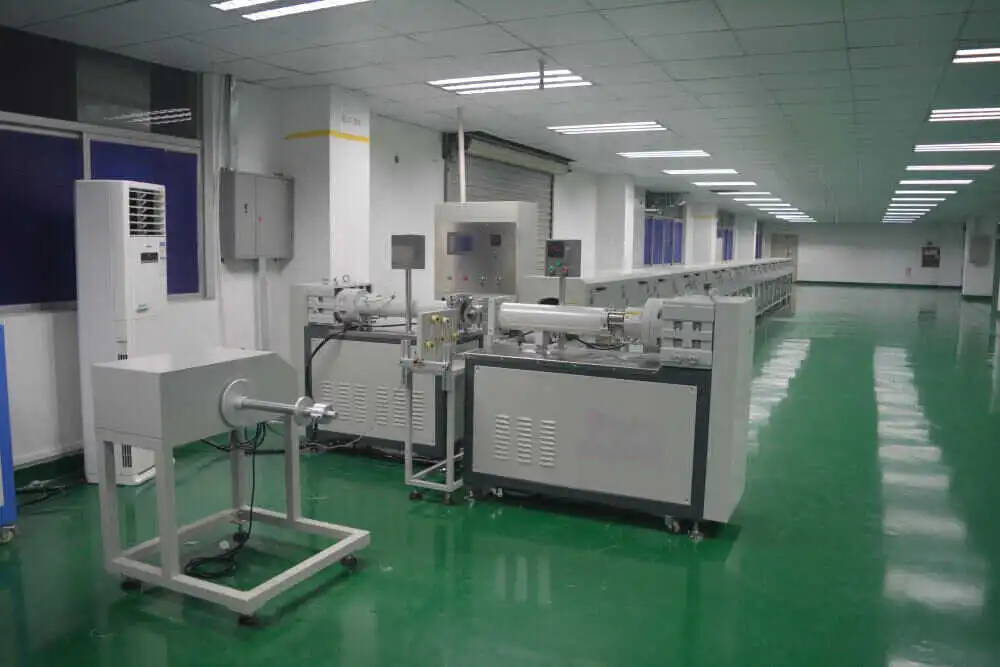
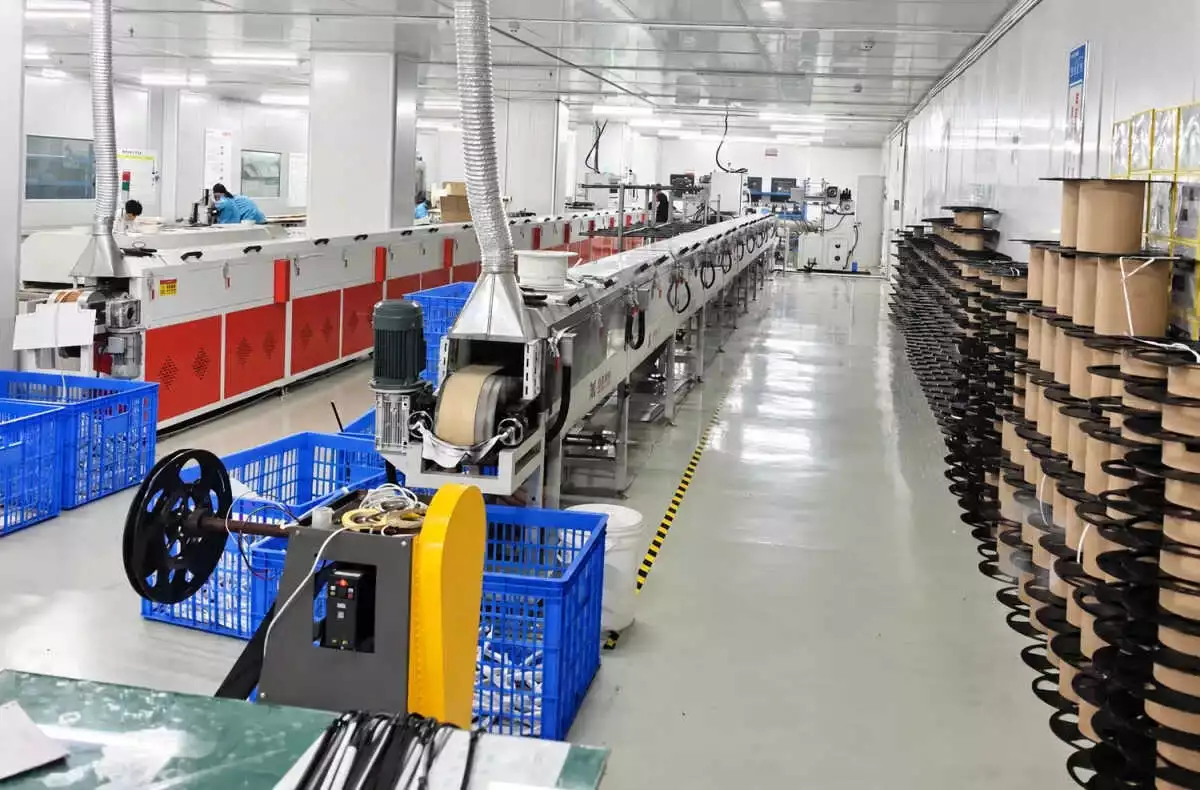
We’re not going to give you textbook definitions. We’re going to show you what happens on our extrusion lines, inside our submersion tanks, and in front of our integrating spheres, so you know exactly what to demand from any supplier.
Table of Contents
Why Authentic Certifications Matter More Than Price
We get it, price wins deals. But in our 10+ years shipping globally, we’ve watched buyers lose far more money chasing the cheapest quote. Here’s why real certificates beat a low unit price every time.
Project safety comes first. Neon flex runs on live electrical current, often outdoors, often near water. A product that fails LVD safety testing isn’t just a warranty problem, it’s a fire and shock risk on your client’s building.
Customs will stop uncertified goods. We’ve seen full containers held at EU and US ports because the paperwork didn’t match the product. CE and RoHS compliant LED neon clears customs smoothly. Fake documents get flagged, and you eat the demurrage fees.
Re-installation is the silent budget killer. Ripping failed neon flex out of a hotel façade and re-installing correct material can cost 5–10× the original material price in labor and scaffolding.
Bottom line: a genuine certificate isn’t a cost. It’s insurance.
Core LED Neon Flex Certifications Explained (CE & RoHS)
Two certifications form the foundation of nearly every export order we ship. Let’s break down what they actually cover, from a manufacturing standpoint.
CE Certification: Your Passport to Europe
CE isn’t a single test. For our neon flex, it means we prove compliance with two EU directives at once.
- LVD (Low Voltage Directive 2014/35/EU): This covers electrical safety, insulation, creepage distances on the PCB, and the integrity of our silicone housing. We design the copper traces and encapsulation specifically to pass this. See the official EU Low Voltage Directive page for the legal scope.
- EMC (Electromagnetic Compatibility 2014/30/EU): This ensures our strips don’t emit interference that disrupts nearby electronics, critical for airports, hospitals, and broadcast environments.
In practice, our engineers test raw samples off the line, then a notified lab issues the report. Only after both LVD and EMC pass do we affix the CE mark.
RoHS Compliance: Safe for the Environment and Users
RoHS restricts hazardous substances like lead, mercury, and cadmium. For CE and RoHS compliant LED neon, this shapes how we source materials.
- Eco-friendly silicone: Our extrusion compound is halogen-free and non-yellowing, so the diffuser stays clear, not that murky amber tint cheap PVC develops.
- Lead-free soldering: Our SMT lines use lead-free solder paste, verified batch-by-batch.
This is where silicone neon flex factory standards separate real manufacturers from re-labelers. You can’t fake RoHS at the material level, it’s baked into procurement.
Quick reference table (mobile-friendly, paste into Elementor HTML widget):
| Certification | What It Covers | Primary Market |
|---|---|---|
| CE (LVD + EMC) | Electrical safety & interference | European Union |
| RoHS | Restricted hazardous substances | EU / Global |
| UL / ETL | North American safety listing | USA / Canada |
| REACH | Chemical safety compliance | European Union |
IP Rating and Waterproof Testing: Straight from Our Lab
This is where most cheap neon flex dies. IP ratings follow the IEC 60529 standard (official IEC IP ratings page). Let us walk you through the actual IP67 waterproof testing process on our floor.
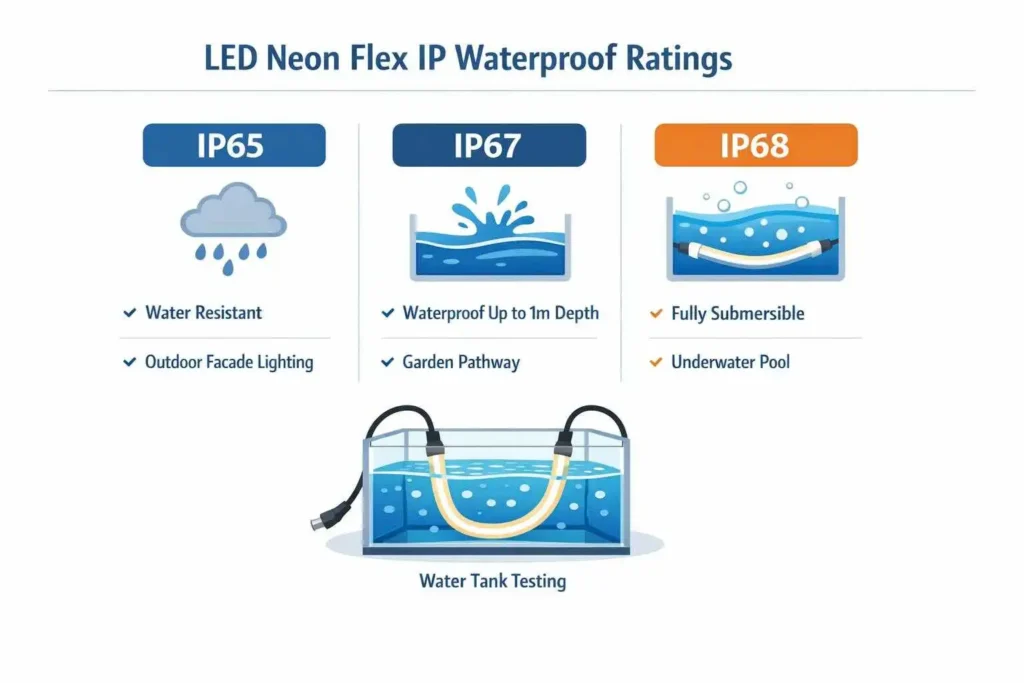
Here’s how a real IP67 test runs in our lab:
- Sealing check: We inspect every silicone end-cap and glue joint before testing, because 90% of leaks start at the terminations.
- Submersion tank: Sample strips go into a water tank, fully submerged at roughly 1 meter depth.
- 24-hour lit soak: We keep the strips powered on during submersion. A dead strip that passes cold means nothing, we need it working live under water pressure.
- Post-test inspection: After removal, we cut samples open to check for internal moisture, fogging, or corrosion on the copper.
Only strips that come out dry and fully lit earn the IP67 label. For continuous underwater use (pools, fountains), we push to IP68 with fully potted encapsulation.
IP rating breakdown (mobile-friendly table):
| Rating | Protection Level | Best Application |
|---|---|---|
| IP65 | Low-pressure water jets | Covered outdoor signage |
| IP67 | Temporary immersion ~1m, 30 min | Façades, garden pathways |
| IP68 | Continuous submersion | Pools, fountains, underwater |
For a deeper dive into ratings by application, see our internal guide: Top 15 Silicone LED Neon Flex Suppliers in China.
Our Rigorous Quality Control (QC) Process Before Shipping
Certification proves a design is compliant. LED neon flex quality control proves every reel you receive is actually good. These are two different things, and honestly, this is where we spend most of our energy.
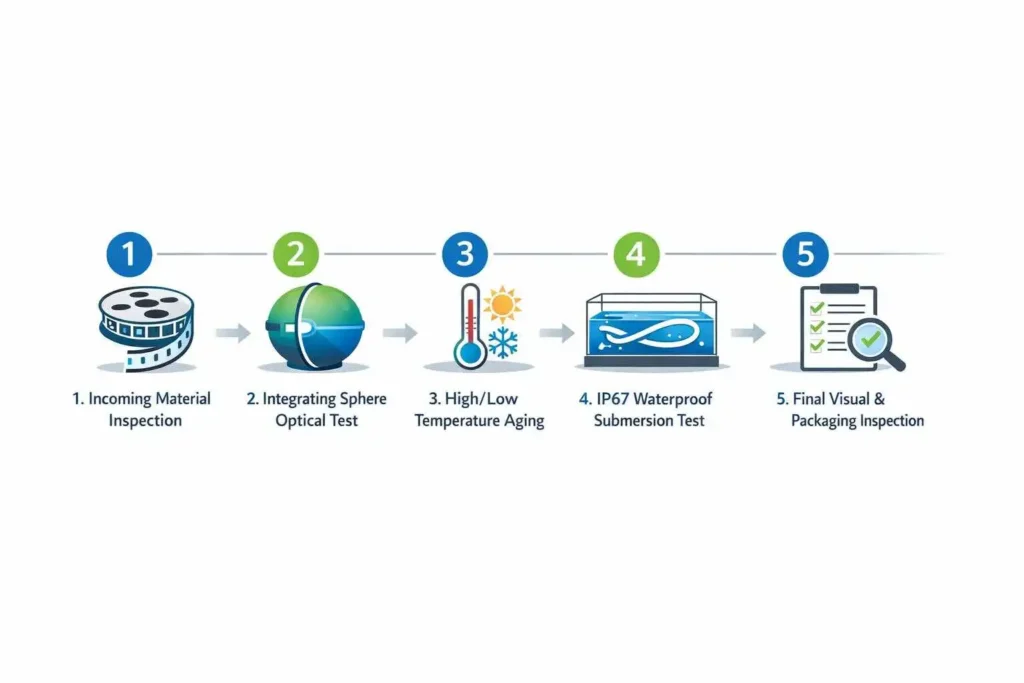
Here’s what every batch goes through before it hits a container:
- Integrating sphere test: We measure lumen output, color temperature, and CRI. This is how we guarantee SDCM < 3, meaning no visible color drift between reels on the same wall.
- High/low temperature cycling: Strips run through hot and cold extremes to simulate desert rooftops and freezing winters. Solder joints that crack under thermal stress fail here, not on your job site.
- UV resistance: Our silicone is UV-stabilized. We aging-test samples so the housing won’t yellow or crack after months in direct sun, a core part of our silicone neon flex factory standards.
- 24-hour aging burn-in: Every batch runs powered for 24 hours to catch early “dead LED” failures before shipment.
We’d rather fail a reel in-house than let it fail in your client’s lobby.
How B2B Buyers Can Verify Supplier Certificates
Because fake documents are everywhere, here’s the practical checklist we recommend to our own buyers. Real LED neon flex certifications can always be traced.
Spotting a fake certificate:
- ✅ Check the report number. Genuine reports from labs like TÜV, SGS, or Intertek carry a unique reference number.
- ✅ Verify the product photo matches. Certificates list a specific model. If the photo shows a different profile than what you’re buying, walk away.
- ✅ Confirm the applicant name. A real factory’s name (not a random trading shell) should appear as the applicant.
- ✅ Cross-check with the lab directly. Reputable labs let you verify report authenticity by number. SGS and Intertek both offer verification channels.
- ✅ Watch for “CE” that means “China Export.” The spacing on a genuine EU CE mark follows a specific proportion. Ask for the underlying LVD/EMC test reports, not just the mark.
Practical tip: Ask any supplier for the full test report PDF, not just the one-page certificate. If they can only send a logo, that’s a red flag.
For NPHIS, we welcome buyers to request full third-party reports and even schedule live video factory walkthroughs, our compliance is verifiable, not just claimed.
Conclusion
After a decade of manufacturing, our lesson is simple: real certification is the cheapest insurance you’ll ever buy for a lighting project. The buyer who lost that Dubai poolside job didn’t save money, he paid twice. Genuine CE and RoHS documents, a properly run IP67 waterproof testing process, and batch-by-batch quality control are what keep your projects safe, compliant, and off the customs hold list.
If you’re sourcing product you can actually trust, explore our fully tested, LED neon flex certifications-backed silicone neon flex range, engineered to real global standards and available for white-label supply. Send us your spec sheet, and we’ll return full third-party test reports with your sample.
👉 Ready to verify quality yourself? Request a free sample and full certification package from our team.
Sources & References
FAQs
❓️ What certifications should LED neon flex have for the EU and US markets?
For the EU, you need CE (covering LVD + EMC) and RoHS, plus REACH for chemical compliance. For North America, look for UL or ETL listing. NPHIS supplies CE and RoHS as standard, with UL/ETL available on request.
❓️ What's the difference between IP67 and IP68 neon flex?
IP67 handles temporary immersion (around 1m for 30 minutes), ideal for façades and outdoor signage. IP68 is built for continuous submersion, like pools and fountains, using full silicone potting.
❓️ How can I tell if a supplier's CE certificate is fake?
Check the report number, confirm the model photo matches your product, verify the applicant is a real factory, and cross-check the report directly with the testing lab (SGS, TÜV, Intertek). Always request the full test report, not just the logo page.
❓️ Does RoHS compliance affect the neon flex color quality?
Yes, indirectly. RoHS-compliant, UV-stabilized silicone resists yellowing, so the light stays clean and true. Cheap non-compliant PVC often turns amber within months.
❓️ What is SDCM and why does it matter?
SDCM measures color consistency. An SDCM < 3 (our standard) means the human eye can’t detect color differences between reels, essential for seamless architectural installations.
❓️ Can NPHIS provide OEM/white-label certified products?
Yes. We offer full white-label manufacturing with your brand on packaging, plus unbranded spec sheets and certification documents for your resale.
❓️ Will uncertified neon flex get stopped at customs?
It can be. Missing or mismatched CE/RoHS documentation frequently triggers holds at EU and US ports, leading to delays and demurrage fees. Proper certification clears customs smoothly.
❓️ What is the typical MOQ and lead time for certified custom neon flex?
Standard catalog products start at 100 meters; custom silicone neon flex is typically 200–500 meters. Bulk orders usually ship within 10–15 working days, with samples in 5–7 days.
WHY I WRITE THIS
About my business
Our company’s main products include LED flexible light strips, rigid light strips, and linear light fixtures, all of which are manufactured in our own factory or in factories we have been cooperating with for many years.
Our services
Our products are primarily mid-to-high-end, exported to Europe and America. We accept OEM & ODM small-batch orders, and also provide sourcing services in China to help our international clients solve problems. Please contact us if you need our assistance with sourcing.
Contact Profile
Name Ted Lau
Brand Name NPHIS
Country China
Model B2B Wholesale only
Email ted@nphis-led.com
Related Posts
Explore essential insights on material durability, IP ratings, and installation for our Silicone LED Neon Flex. Designed for lighting professionals, this guide helps you make informed purchasing decisions for commercial and architectural applications.

Request a free quote
If you have questions or suggestions,please leave us a message,we will reply you as soon as we can!