
Когда покупатель спрашивает нас о “50 метрах неоновой вывески с эффектом чеканки”, наш первый вопрос никогда не касается цены за метр.
Вместо этого мы задаём более сложный вопрос: смогут ли эти 50 метров надёжно воспроизводить задуманную анимацию после того, как их разделят на стены, буквы, полы или участки фасада?
Вот в чём основное различие. Стандартный неоновый RGB-светильник превращает весь подключенный к нему участок в одну цветовую зону. Адресуемая светодиодная неоновая гибкая лента, Однако, это разделяет линию на управляемые пиксели. Каждый пиксель может одновременно отображать разный цвет и яркость. Именно это делает возможными эффекты погони, перелива, градиента, отображения и интерактивные эффекты.
Но будьте осторожны. Добавление адресуемых микросхем не гарантирует автоматическое создание надежной системы подсветки пикселей.
Эффект, шаг пикселя, протокол, контроллер, распределение питания, направление передачи данных, разъемы, физический профиль и план технического обслуживания должны быть спроектированы совместно. В противном случае образец может идеально работать на нашем заводском стенде, но выйти из строя после того, как установщик разместит его по всему зданию.
Основываясь на многолетнем опыте производства светодиодных неоновых гибких панелей в NPHIS, это руководство показывает импортерам, подрядчикам, системным интеграторам и производителям осветительного оборудования, как перейти от креативной концепции к образцу для тестирования, заводским приемочным испытаниям (FAT) и контролируемому оптовому заказу.
Оглавление
Адресуемая светодиодная неоновая гибкая вывеска: определение для покупателя за 60 секунд
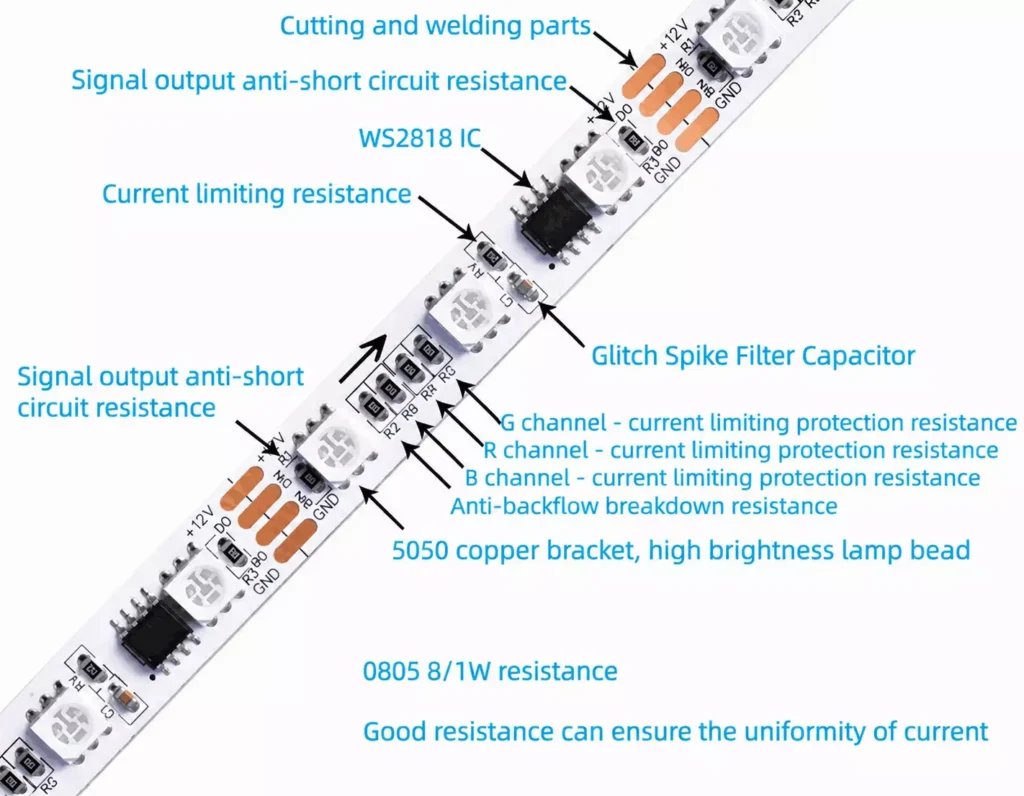
Адресуемый светодиодный неоновый гибкий кабель сочетает в себе рассеивающий свет гибкий силиконовый профиль со светодиодами и цифровыми управляющими микросхемами.
Каждый управляемый участок называется пиксель. В зависимости от изделия, пиксель может содержать один светодиод или группу светодиодов.
Это различие имеет большее значение, чем думает большинство покупателей.
Например, “60 светодиодов на метр” не всегда означает “60 пикселей на метр”. Если шесть светодиодов используют одну микросхему, то изделие будет иметь только десять управляемых пикселей на метр.
Адресуемая неоновая подсветка может создавать:
- Эффекты погони и плавного движения
- Скользящие градиенты
- Последовательная анимация бренда
- Многозонное управление цветом
- Сцены, синхронизированные с музыкой
- Шаблоны, отображаемые на пиксели
- Интерактивное освещение, срабатывающее от датчиков
Поэтому, прежде чем сравнивать цены, подтвердите следующие пять определений:
| Срок | Что должен подтвердить покупатель |
|---|---|
| плотность светодиодов | Физическое количество светодиодов на метр |
| Плотность пикселей | Независимо управляемые секции на метр |
| шаг пикселя | Расстояние между управляемыми пикселями |
| Режущий блок | Наименьший участок, который можно физически отрезать. |
| Формат канала | RGB, RGBW или другая поддерживаемая конфигурация |
Помните: самая низкая цена за метр не означает самую низкую стоимость проекта. Неправильный шаг пикселей, протокол или тип режущего блока могут увеличить количество контроллеров, объем работ по программированию, длину кабельных трасс и количество отходов при монтаже.
Начните с эффекта, а не с длины катушки.
Для составления коммерческого предложения необходима полная длина. Однако одной лишь длины недостаточно, чтобы понять, что должна делать система.
Полезное техническое задание начинается с определения желаемого результата:
- Анимация должна двигаться слева направо?
- Следует ли следовать контуру по часовой стрелке?
- Должны ли отдельные секции одновременно давать одинаковый эффект?
- Это просто погоня или спланированное видео?
- Реагирует ли оно на музыку, присутствие людей или другой датчик?
- Будет ли оно управляться от пульта управления освещением?
- Требуется ли для этого отдельное запланированное воспроизведение?
- Требуется ли также чистый архитектурный белый цвет?
Рассмотрим два проекта по 50 метров. Первый — это потолок торгового помещения, на котором воспроизводится медленно повторяющийся градиент. Второй — это набор нерегулярных линий, которые реагируют на музыку в реальном времени.
Одинаковая длина. Совершенно разные требования к плотности пикселей, контроллеру, программированию и распределению данных.
Поэтому, прежде чем выбирать продукт, составьте простую схему эффектов:
| Сцена | Визуальное поведение | Курок | Метод воспроизведения |
|---|---|---|---|
| Ежедневный режим | Статические фирменные цвета | Расписание | Автономный контроллер |
| Режим приветствия | Движение к входу | Датчик или команда | Интерактивный ввод |
| Режим событий | Синхронизированная многозонная анимация | Оператор | Консоль или медиасервер |
| Режим закрытия | Последовательность медленного затемнения | Расписание | Автономный контроллер |
Это помогает заводу понять коммерческое назначение установки, а не только ее электрическую нагрузку.
Шаг пикселя: как он меняет анимацию и спецификацию материалов.
Шаг пикселя определяет визуальное разрешение подсвеченной линии.
A более короткий шаг Это позволяет получить больше управляемых точек на метр. В результате получаются более плавные градиенты и более точное движение. Однако это также увеличивает общее количество пикселей, пропускную способность контроллера, сложность построения карты, время программирования и стоимость.
A более длинный шаг Уменьшает количество контролируемых точек. Подходит для крупных контуров, рассматриваемых издалека. Но вблизи движение может выглядеть явно сегментированным.
| Тип проекта | Приоритет пиксельного дизайна |
|---|---|
| Функция просмотра товаров в розничной сети крупным планом | Плавное движение, менее заметная сегментация |
| Анимированные вывески | Точное перемещение вокруг букв и углов. |
| Особенности отеля/ресторана | Сбалансированное разрешение, простое управление сценами. |
| Сценическая установка | Скорость отклика и синхронизация |
| Интерактивная скульптура | Гибкое сопоставление данных, управление в реальном времени. |
| Контур крупного здания | Прозрачность, надежность, управляемый масштаб |
Перед предоставлением коммерческого предложения запросите у поставщика подтверждение следующих параметров: количество светодиодов на метр, количество пикселей на метр, количество светодиодов на пиксель, шаг пикселя, тип режущего блока, формат RGB/RGBW, модель микросхемы, направление передачи данных, совместимость с контроллером, количество пикселей на выходе и рекомендуемая длина секции.
SPI против DMX512: какая архитектура подходит для вашего проекта?
Как продукты, использующие протоколы SPI, так и DMX512, позволяют создавать адресные эффекты. Однако ни один из протоколов не подходит автоматически для каждого проекта.
Решение должно основываться на архитектуре вашей системы:
| Фактор принятия решения | SPI-адресуемый неон | Адресуемая неоновая подсветка DMX512 |
|---|---|---|
| Источник управления | Совместимый контроллер пикселей | DMX-контроллер, консоль или шлюз |
| совместимость микросхем | Контроллер должен поддерживать выбранную микросхему. | Адресация и режим канала должны совпадать. |
| Распределение данных | Ближайшие пиксельные выходы или преобразователи | Интегрируется с профессиональной DMX/сетевой инфраструктурой. |
| Плотность пикселей | Поддерживает детальную настройку пикселей. | Зависит от продукта и способа адресации. |
| Ввод в эксплуатацию | Настройка микросхемы, порядок пикселей и направление должны совпадать. | Адрес, порядок каналов, вселенная должны совпадать. |
| Неудачное поведение | Зависит от архитектуры с одним/резервным хранилищем данных. | Зависит от микросхемы и параллельной/последовательной архитектуры. |
| Типичный приоритет | Гибкие пиксельные эффекты, выбор контроллера | Профессиональная интеграция систем освещения |
Не следует полагаться на чрезмерно упрощенные правила, такие как:
- “SPI предназначен только для небольших проектов”.”
- “DMX всегда может работать на сотнях метров”.”
- “Один неисправный пиксель DMX никогда не повлияет на другой”.”
- “Любой SPI-контроллер может управлять любым SPI-устройством”.”
В действительности, пропускная способность контроллера, расстояние передачи данных и характер отказов зависят от конкретной модели. Сам протокол DMX512 определяется... Стандарт ANSI E1.11 поддерживается организацией ESTA. — но способы его реализации в каждом конкретном продукте различаются.
Для получения рекомендаций по конкретному проекту, пришлите нам модель вашего контроллера, программное обеспечение, количество пикселей, длину кабеля и схему расположения элементов.
Для получения более подробной информации см. наш Руководство по использованию светодиодных неоновых гибких светодиодов DMX для фасадного и развлекательного освещения. и Страница товара DMX512 RGBW Silicone LED Neon Flex.
Buyer Concern → NPHIS Engineering Solution
A professional supplier converts buyer concerns into engineering decisions. Here is how we do it at NPHIS:
| Buyer Concern | Engineering Response |
|---|---|
| Will a 50-meter effect run continuously? | Divide into calculated power and data zones — never one uncontrolled electrical run |
| Will the animation run backward? | Mark input, output and data direction on pixel map, labels and drawing |
| Will outdoor joints leak? | Define factory-cut sections, cable outlets, connector type, sealing method, field-joint policy |
| What if one pixel fails? | Confirm IC transmission architecture; demonstrate failure behavior during sample testing |
| SPI or DMX512? | Compare controller, pixel count, signal distribution, software and maintenance |
| Cut sections to my drawing? | Create a section schedule that respects the product's cutting unit |
| How to replace a failed section? | Define connector access, section boundaries and spare parts before installation |
| Match my existing controller? | Verify protocol, IC, color order, output capacity and electrical interface |
| Approve before 500 meters? | Representative prototype + documented Factory Acceptance Test (FAT) |
| Repeat orders match batch 1? | Record the approved configuration and production controls |
У вас есть еще какие-либо вопросы к нам?
Не стесняйтесь обращаться к нам с дополнительными вопросами или за информацией.
Three Problems That Cause Most Pixel-Neon Project Failures
Many failures blamed on “bad neon” actually begin before installation. Three areas deserve special attention.
1. Voltage Drop and Power Distribution
Voltage drop happens when current travels through conductors with resistance. As distance and current increase, the voltage at the far end decreases.
Typical symptoms:
- Reduced brightness and color shift
- Inconsistent white
- Flicker under high-output scenes
- Unstable pixels
- Overloaded connectors or cables
Important: a larger power supply alone does нет fix voltage drop along an undersized conductor.
The correct engineering process:
- Confirm the product’s verified power consumption
- Record every section length
- Calculate the load per power zone
- Select conductor size and cable route
- Calculate voltage drop
- Define power-injection points
- Keep the PSU within a safe loading margin
- Measure voltage under a demanding test scene
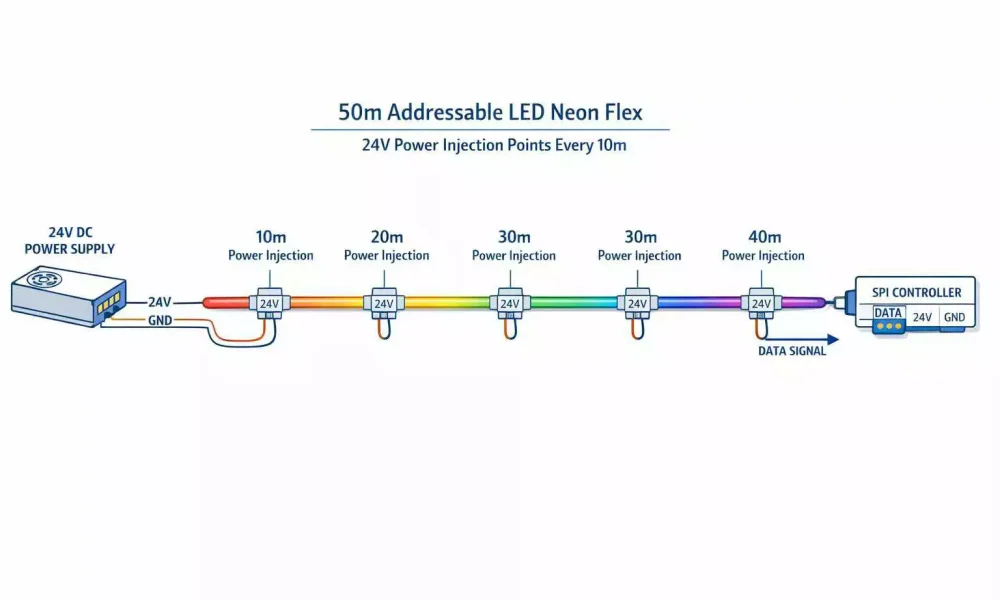
A 50-meter visual effect may look continuous. Electrically, however, it must be divided into controlled sections.
Also, beware of universal claims like “inject power every 10 meters.” The correct interval depends on voltage, watts per meter, wire size, connector rating, and allowable voltage variation. For the full calculation method, see our Long Run LED Strip Voltage Drop guide.
2. Signal, Addressing and Data-Direction Problems
Signal problems often look like product defects:
- Random flashing or frozen pixels
- Incorrect colors or reversed animation
- The first section working while later sections fail
- Effects losing sync after restart
Common causes include: wrong IC selected in the controller, incorrect RGB/RGBW channel order, data connected backward, excessive device distance, poor grounding, interference, wrong addressing, exceeded output capacity, or a pixel map that does not match the installed layout.
The solution is a documented signal plan — not trial and error on site. The drawing should show: controller location, output number, data direction, section start/end, pixel range, address or universe, converters, cable route, power zone, and maintenance access.
3. Waterproofing, Connectors and Field Joints
An IP rating on the product body does not prove the installed system is protected. IP ratings follow the IEC 60529 standard, and the rating only applies to the assembly that was actually tested.
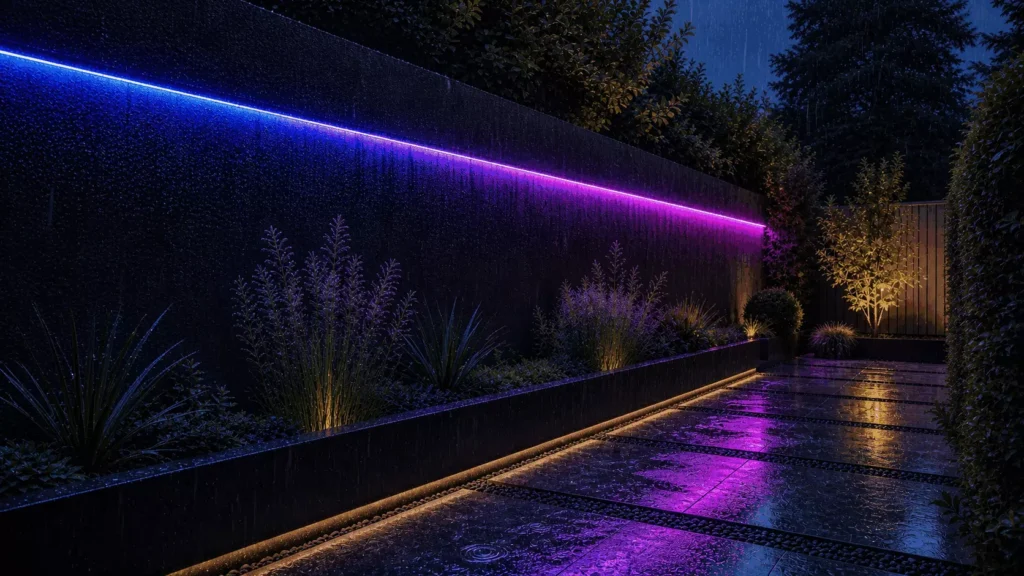
Outdoor reliability also depends on: cable-entry construction, end caps, connectors, factory and field joints, installation orientation, drainage, mechanical stress, correct sealant curing, and installer workmanship.
For permanent outdoor projects, decide before production whether sections will be:
- Cut and sealed at the factory
- Connected with project-specific waterproof connectors
- Joined on site under a documented process
- Supplied with pre-assembled spare sections
Ask your supplier exactly which assembly the IP evidence covers. A report for the neon body may not cover every customized connector or field joint.
Controller Architecture and Pixel Mapping
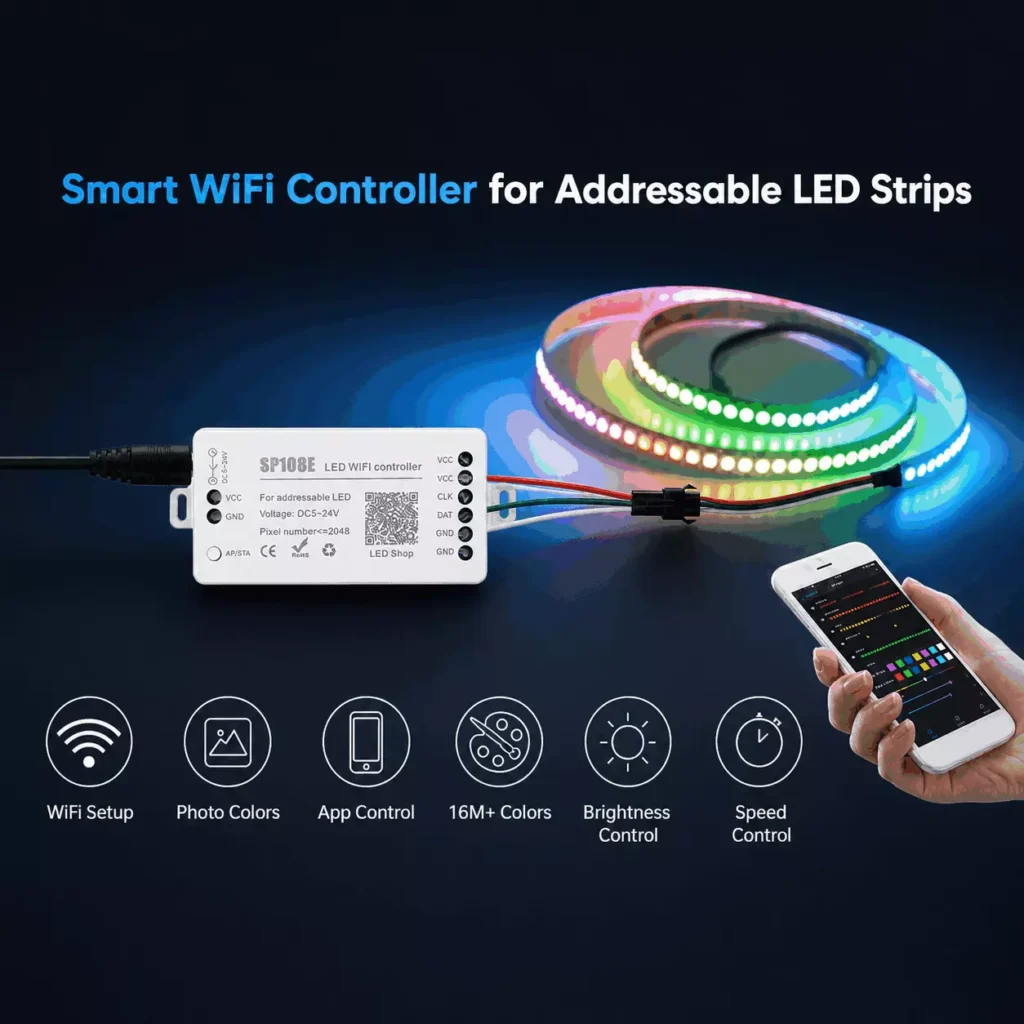
The controller does not simply “make the neon change color.” It translates content into instructions for defined pixels.
Before choosing a controller, confirm: supported IC or DMX mode, RGB/RGBW channel order, pixels per output, total pixel capacity, number of outputs, network input, standalone playback, real-time input, software compatibility, synchronization, restart behavior, and remote management.
A pixel map connects the digital content to the physical installation. For each neon section, record:
| Field | Цель |
|---|---|
| Section ID | Matches drawing, product label and packaging |
| Start / end point | Defines physical orientation |
| Data direction | Prevents reversed effects |
| Section length | Supports production and installation |
| Pixel quantity | Supports controller allocation |
| Pixel range | Connects physical line to content |
| Controller output | Identifies the signal source |
| Power zone | Identifies the electrical supply |
| Connector location | Supports installation and maintenance |
Crucially, the factory, programmer, and installer must all use the same revision of this document.
Power Distribution and Signal Distribution
Plan power and data as two related but separate systems:
| Power-Distribution Questions | Signal-Distribution Questions |
|---|---|
| What is the verified load per section? | Which protocol and IC are used? |
| Where are the power supplies located? | Where is the controller located? |
| What conductor size is required? | How far is the first pixel from the controller? |
| Where is power injected? | Is a gateway, repeater or converter required? |
| What is the voltage at the far end? | What is the data direction? |
| Are connectors within current limits? | How are pixels and outputs mapped? |
| Can a PSU be replaced after installation? | What happens after signal loss or restart? |
The finished engineering package should include both diagrams.
Choose the Physical Neon Profile
The correct control system cannot compensate for the wrong physical profile.
Confirm: bending direction (top-bend, side-bend, 3D or round), cross-section dimensions, minimum bending radius, cutting unit, cable outlet direction, connector dimensions, mounting channel, joint visibility, maximum factory-assembled length, indoor/outdoor use, maintenance access, and spare-section strategy.
Some quick rules:
- Для signage, the cutting unit must fit the letter geometry.
- Для curved architecture, the bending direction must match the drawing.
- Для suspended installations, the viewing angle and visible back surface matter.
Browse the available profiles in our Коллекция силиконовых светодиодных неоновых гибких кабелей. Always confirm final dimensions against the selected product’s current datasheet.
Prototype Before Bulk Production
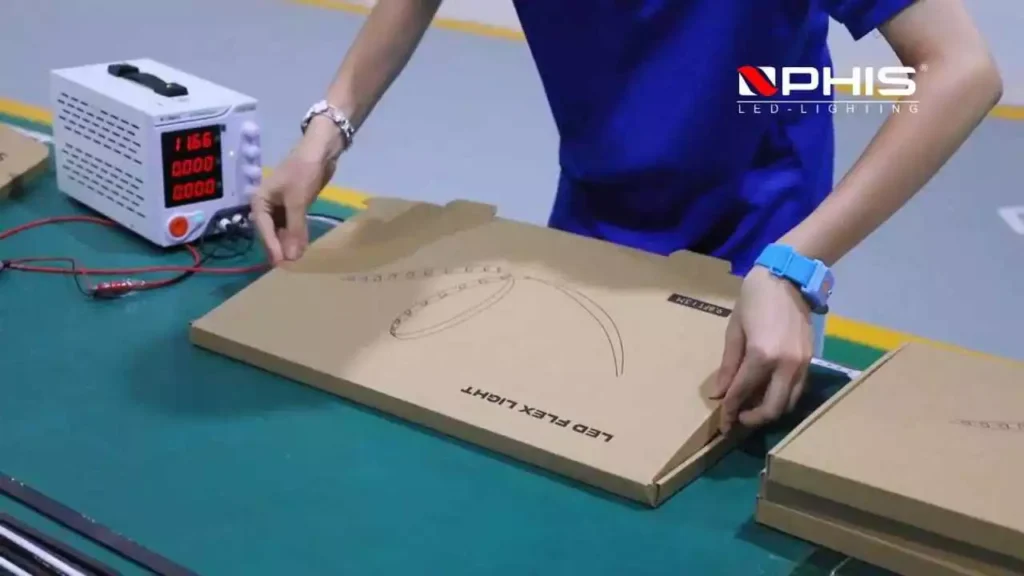
A valid prototype must reproduce the project’s most difficult condition. A short piece running only a factory demo mode proves nothing about a large installation.
The prototype should use: the proposed neon model, proposed pixel pitch, final (or equivalent) controller, representative cable distance, intended connectors, actual animation, realistic section geometry, and the proposed mounting and outdoor assembly.
The prototype should answer:
- Is the animation smooth enough at the viewing distance?
- Is the direction correct?
- Are pixels visible through the diffuser?
- Is the channel order correct?
- Does the controller restart correctly?
- Do multiple sections stay synchronized?
- Can a section be disconnected and replaced?
- Does the sealing process match the installation?
Then approve the sample in writing. Record the product code, IC, pixel pitch, profile, color format, cable outlet, connector, and controller settings.
Factory Acceptance Test (FAT)
Before bulk shipment, the FAT verifies the agreed configuration and system behavior.
Product checks
Profile and dimensions, bending direction, section lengths, cable outlets, connectors, data-direction labels, surface appearance, continuous illumination, joint appearance, and packaging by installation zone.
Electrical and control checks
Input voltage, operating current under the agreed test condition, voltage at defined points, pixel order, RGB/RGBW channel order, addressing, animation direction, output synchronization, restart behavior, response after signal loss, approved scene files, and camera-flicker checks where required.
Outdoor assembly checks
End-cap and cable-entry inspection, connector assembly, curing records, ingress testing per the project specification, and identification of field joints excluded from factory testing.
Handover documents
Pixel map, section schedule, controller-output schedule, address schedule, wiring diagram, power-distribution diagram, datasheets, approved effect file, section labels, spare-parts list, installation notes, and the FAT record.
At NPHIS, every batch is tested and thermally aged before shipment, with color consistency held to SDCM < 3. Exact measured values are always more persuasive than a generic “100% tested” claim.
Application Decision Matrix
| Приложение | Main Priority | Key Buyer Question |
|---|---|---|
| Анимированные вывески | Sectioning and direction around letters | How will the animation continue between separate letters? |
| Retail display | Close-view smoothness, simple operation | Can store staff change scenes without reprogramming? |
| Hospitality feature | Ambience, white quality, event scenes | Is RGBW required for usable white light? |
| Stage and event | Synchronization, fast replacement | Can damaged sections be exchanged between shows? |
| Схема здания | Distribution and maintenance access | Where will controllers and PSUs be serviced? |
| Media façade | Mapping, network scale, content workflow | Who creates and approves the pixel map? |
| Interactive installation | Input compatibility and latency | Which sensor or software triggers the effect? |
| Sculpture | Geometry, viewing angle, custom sections | How does the physical curve match the digital map? |
What a Professional Supplier Should Ask Before Quoting
A reliable engineering discussion includes questions from the supplier. If the only questions are “How many meters?” and “What voltage?”, important risks stay unresolved.
A professional supplier should ask:
- What is the application, and what should the animation do?
- What is the viewing distance?
- How many physical sections are on the drawing, and how long is each?
- Is RGB or RGBW required?
- Is a controller already selected? Which software or console will run it?
- How far is the controller from the first pixel?
- Where can power supplies and gateways be installed?
- Indoor or outdoor? Sections cut and sealed at the factory?
- How will damaged sections be accessed?
- Quantity, prototype requirements, and destination-market certifications?
Equally important: the supplier should openly say what cannot be confirmed until a drawing or sample exists. That honesty is more trustworthy than saying “yes” to everything.
Addressable Neon Flex RFQ Checklist
Send the following for an engineering review:
Project details — company and country; your role (buyer / contractor / integrator); application; indoor or outdoor; installation drawing; delivery date; sample requirement; estimated quantity.
Lighting effect — static and animated scenes; movement direction; RGB or RGBW; pixel-density or viewing-distance requirement; synchronization; interactive or music input; standalone or live control.
Physical sections — total length; length of each section; bend direction; profile-size restriction; cable outlet; connector preference; mounting method; required spares.
Control system — SPI or DMX512 preference; existing controller model; software or console; pixel map if available; controller-to-neon distance; network infrastructure; restart and monitoring needs.
Commercial requirements — trial and bulk quantity; packaging; private label; destination market; certificates or reports; delivery schedule.
Часто задаваемые вопросы
❓️ Will 50 meters of addressable neon work as one continuous animation?
Yes, the visual effect can flow across 50 meters. However, the project must not be treated as one uncontrolled power and data run. It normally needs defined sections, power zones, controller outputs, and mapped pixel ranges.
❓️ How do I prevent the animation from running backward?
Mark the data direction and start point on the drawing, pixel map, product label, and packaging. Then verify the direction during the prototype and the FAT.
❓️ What happens if one pixel fails?
It depends on the IC and transmission architecture. Single-data, backup-data, and parallel-transmission products behave differently. Ask the supplier to demonstrate the failure behavior of the selected model.
❓️ Can NPHIS cut sections according to my drawing?
Yes, subject to the product’s cutting unit and the required sealing and connector method. Send a section schedule with every length and cable direction for engineering review.
❓️ Can the neon match my existing controller?
Compatibility requires more than matching “SPI” or “DMX.” Send the controller model, supported ICs, output capacity, electrical interface, software, and pixel count for verification.
❓️ Should I choose SPI or DMX512?
Choose based on the project architecture: controller, pixel count, signal distribution, software, maintenance plan, and existing lighting infrastructure — not on price alone.
❓️ Can outdoor joints be truly waterproof?
Outdoor reliability depends on the complete assembly — cable entry, end cap, connector, sealant, curing, and field workmanship. Request test evidence that applies to the proposed joint, not only the neon body. IP ratings follow the IEC 60529 standard and only cover the assembly that was actually tested.
❓️ How can I approve the product before a large order?
Approve a representative prototype using the proposed neon, controller, connection method, and effect file. Then define the FAT items and acceptance limits in writing before bulk production begins.
❓️ How do I replace a damaged section after installation?
Divide the installation into identifiable, labeled sections. Preserve access to connectors and prepare labeled spare sections. Never bury every connection behind inaccessible finishes.
❓️ How many pixels can one controller output support?
It depends on the controller, protocol, color channels, frame rate, number of outputs, and the selected product. Always calculate capacity from pixel count — not just meters.
❓️ What is the typical lead time for a custom addressable neon flex order?
Based on our production experience at NPHIS, samples usually take 3–7 days. Bulk orders typically take 10–20 days after sample approval, depending on quantity, customization, and connector assembly work. Confirm the schedule during the engineering review.
Не можете найти нужный ответ?
Напишите нам вопроси мы с удовольствием ответим на него.
Send Drawing → Engineering Review → Sample → Bulk Order
A professional addressable LED neon flex order follows a controlled project path:
| Step | Что происходит |
|---|---|
| 1. Send drawing & effect brief | Provide section lengths, animation direction, application, quantity, environment and controller info |
| 2. Engineering review | Product, pixel pitch, protocol, controller capacity, power zones, data distribution, profile and sealing reviewed together |
| 3. Project proposal | Restates buyer requirements, proposed configuration, customization, wiring concept, sample scope and quantities |
| 4. Prototype & effect approval | Test the most difficult project condition with representative hardware and content |
| 5. Factory acceptance test | Verify lengths, labels, electrical performance, pixel order, effects, connectors, sealing and handover documents |
| 6. Bulk production & project packing | Produce against the approved sample; label sections per drawing; preserve configuration for repeat orders |
Ready for an Engineering Review?
Send your drawing and addressable neon flex requirements to NPHIS via our contact page.
Please include:
- Application and country
- Drawing with section lengths
- Required animation and RGB/RGBW format
- SPI or DMX512 preference
- Existing controller (if any)
- Installation environment
- Quantity, delivery date, and sample requirement
We will then identify the missing engineering decisions до preparing your sample and bulk quotation — so your 50 meters of chasing neon works on the building, not just on the bench.
Список литературы и дополнительные материалы
- ESTA Technical Standards Program – ANSI E1.11 DMX512-A Standard: https://tsp.esta.org/tsp/documents/published_docs.php
- IEC 60529 – Ingress Protection (IP) Ratings, International Electrotechnical Commission: https://www.iec.ch/ip-ratings
- NPHIS – Long Run LED Strip Voltage Drop: Calculate & Avoid It: https://nphis-led.com/industry-blogs/led-strip-voltage-drop/
- NPHIS – DMX LED Neon Flex for Façade & Entertainment Lighting: https://nphis-led.com/industry-blogs/dmx-led-neon-flex-facade-entertainment-lighting/