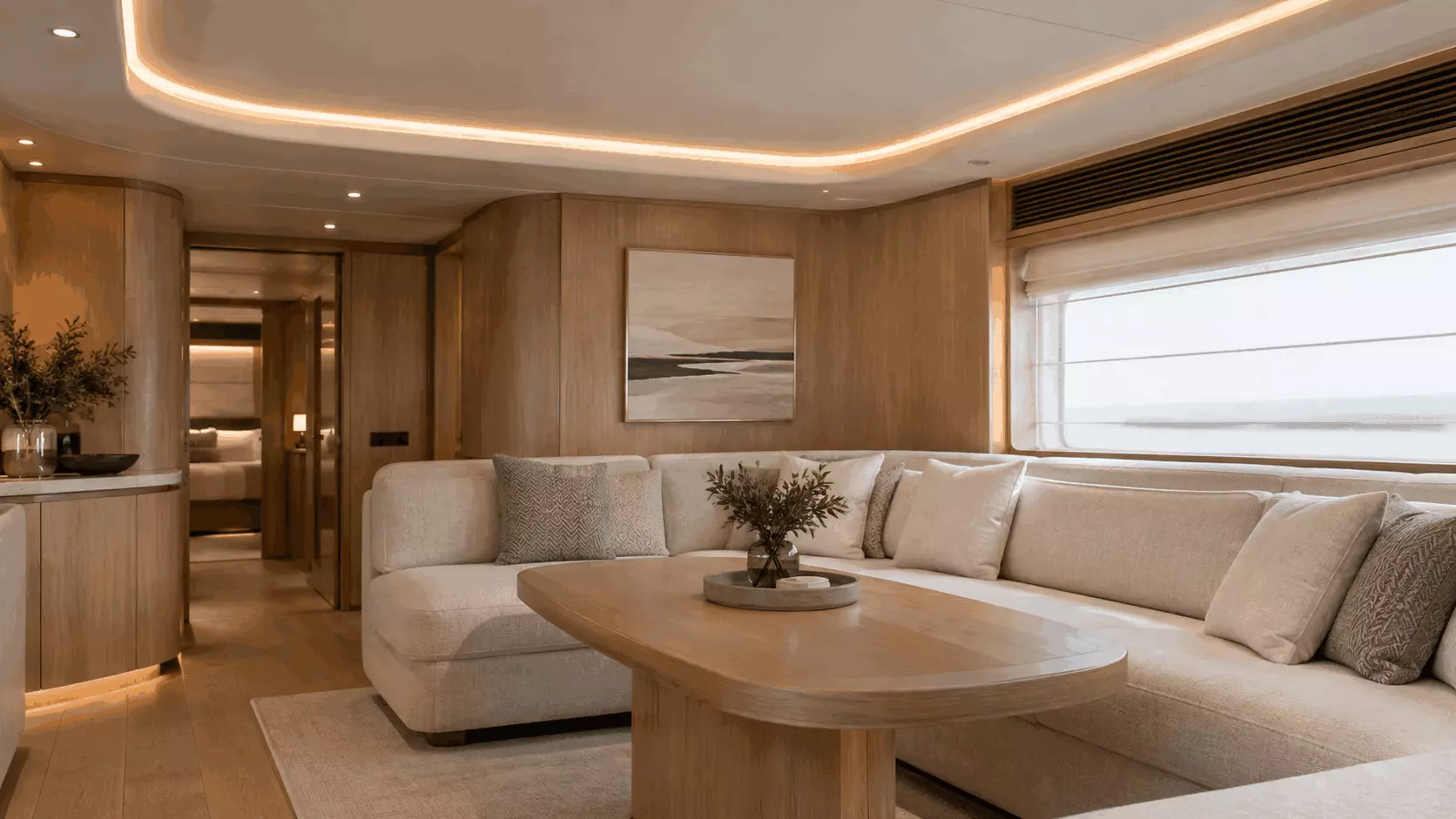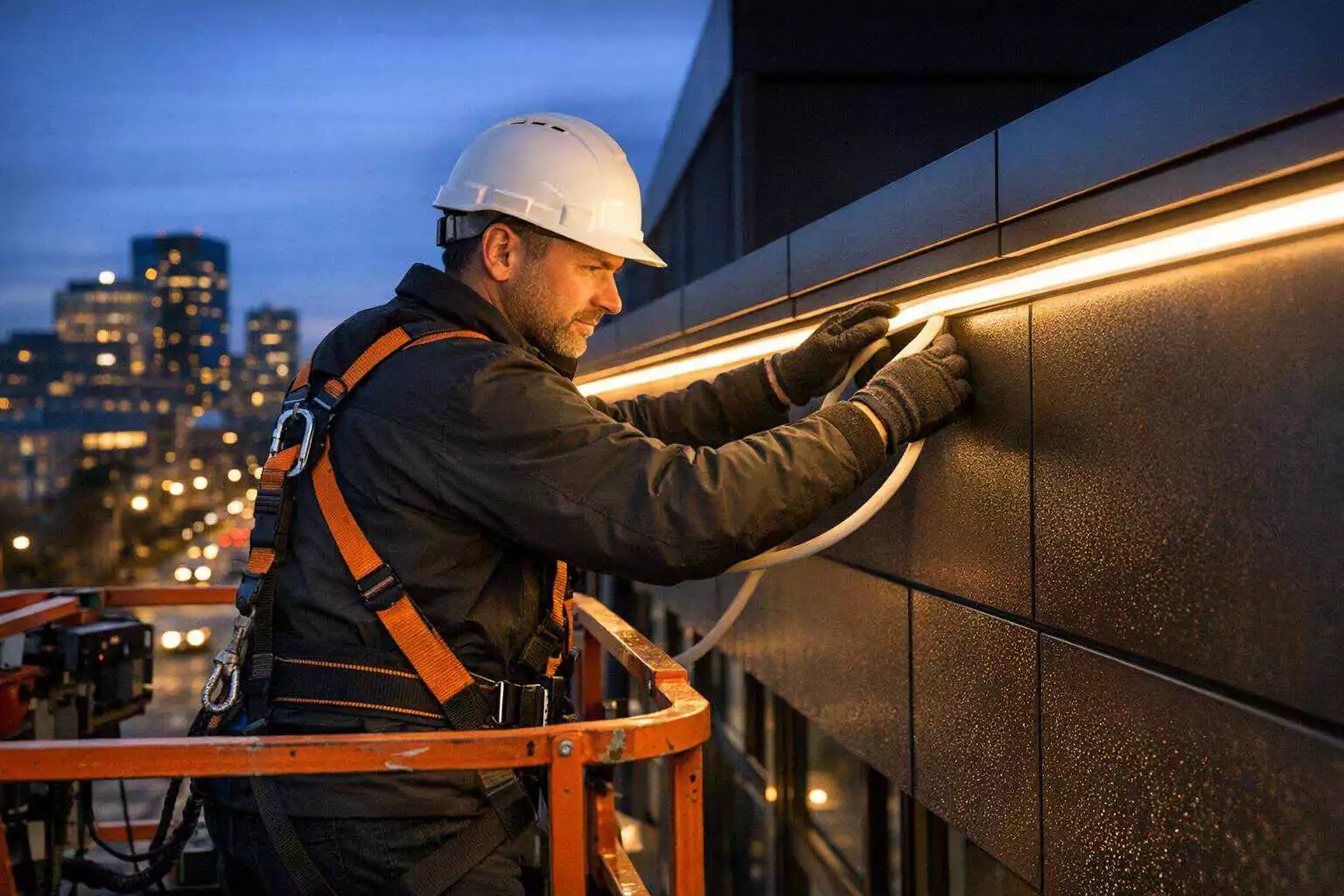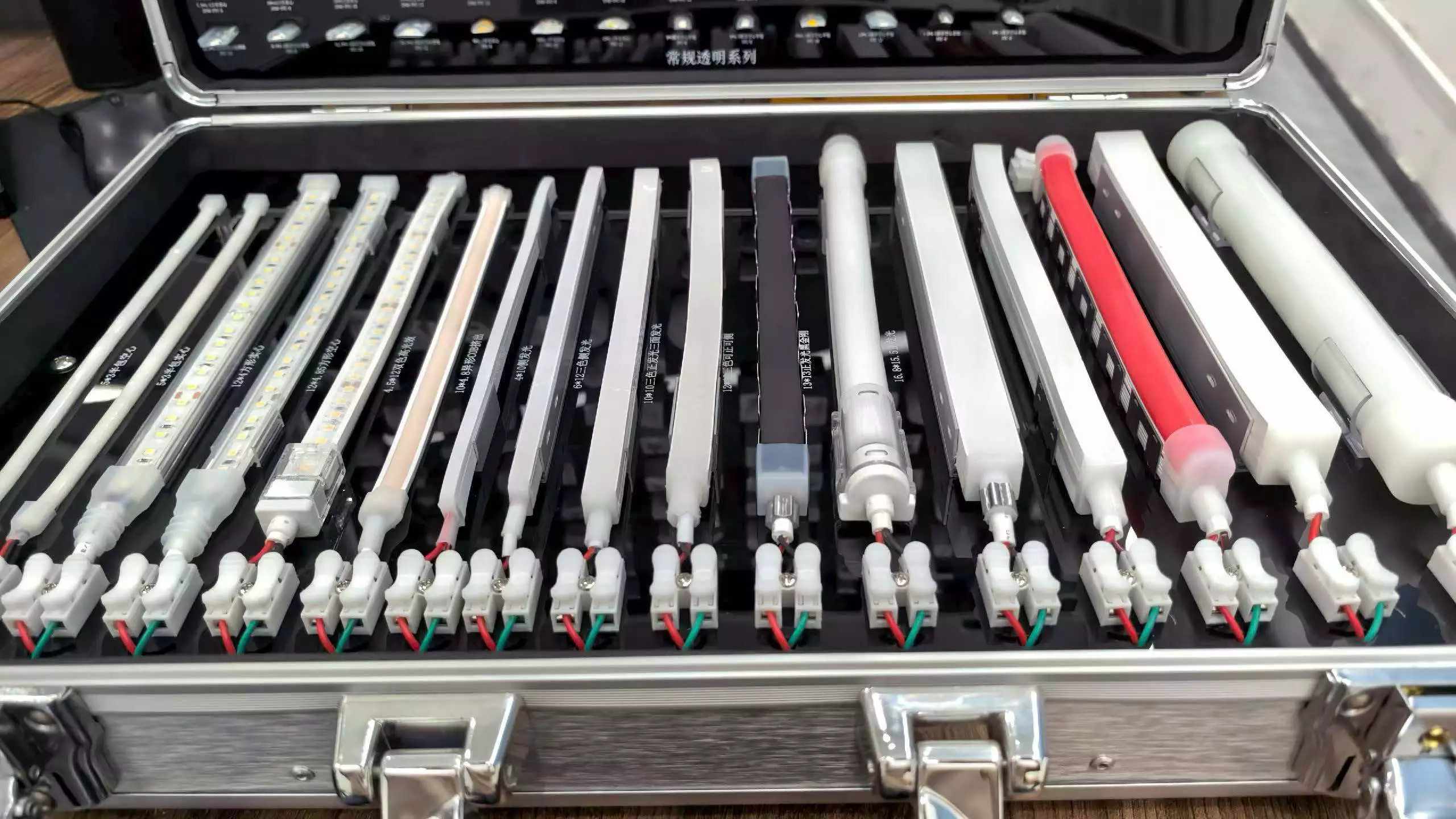

Sometimes, yes. COB LED strip can replace silicone neon flex outdoors only when the finished assembly matches the neon result on four points: how it looks at the real viewing distance, its water and UV protection, whether it can follow the required bend, and how easily a failed section can be replaced. A bare COB strip is a light source. Silicone neon flex is a finished luminaire. Comparing the two as if they were the same kind of product is the most common reason outdoor substitutions fail.
Use this rule of thumb:
- Choose COB in a sealed, concealed channel when the strip is hidden behind a diffuser, the run is mostly straight, and the profile supplies the weather protection.
- Choose silicone neon flex when the line itself is visible, must bend in a defined direction, and has to survive rain, sun and cleaning with no extra housing. See our gamme de néons LED flexibles en silicone.
- Do not decide from a data sheet alone. Approve a side-by-side mockup on site (Section 5).
⚠️Disclosure: NPHIS manufactures silicone neon flex and supplies bandes COB, so we have an interest in this topic. The checks below apply whichever product you buy, and they are written so you can verify our claims against a sample.
Define whether the line is exposed or concealed
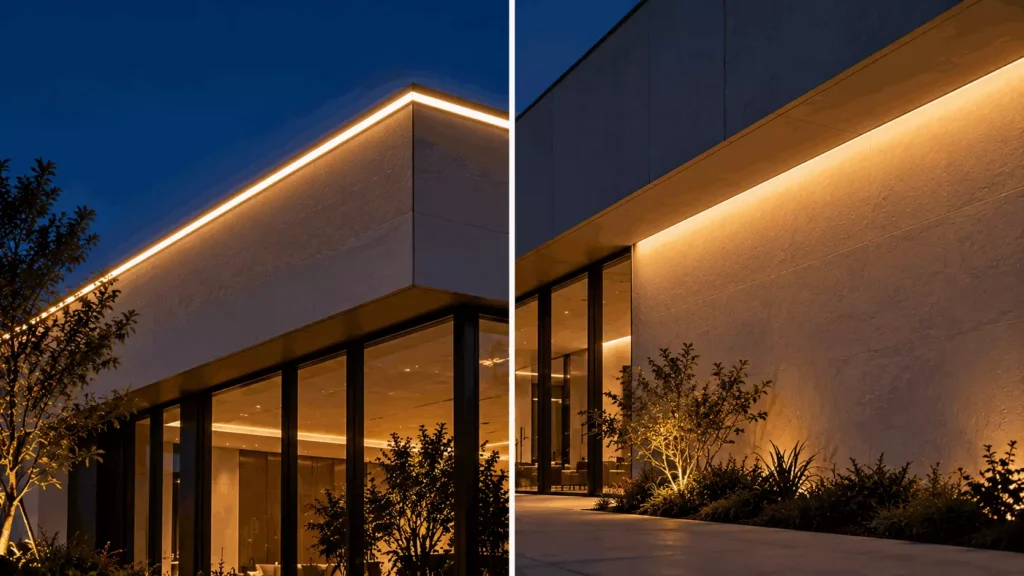
Start with what the viewer actually sees. This one question removes most of the confusion.
| Condition | What the viewer sees | Better starting point |
|---|---|---|
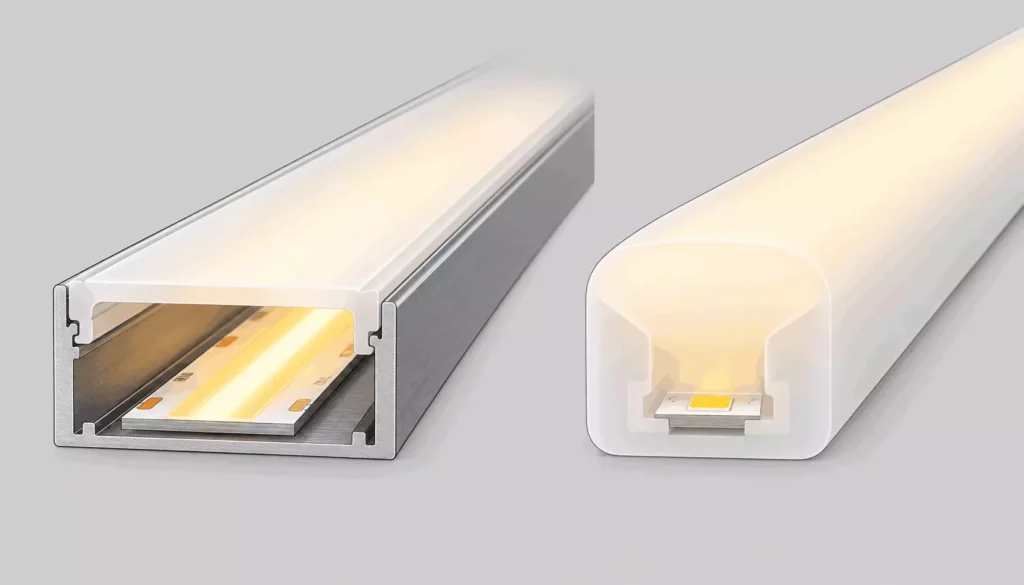
| Exposed linebuilding outline, sign edge, handrail line | The luminous body itself, in daylight and at night | Silicone neon flex, or COB inside a purpose-made diffuser extrusion |
| Concealed linecove, recess, behind a baffle, under a ledge | A wash of light or a glow, not the strip | COB strip or conventional strip in a channel |
| Semi-exposedvisible only at some angles | Both, depending on position | Mock up and check the worst viewing angle |
Two practical tests:
- Daylight test. An unlit exposed line is part of the facade in daytime. Colour, gloss, joints and end caps all show. A concealed strip never has this problem.
- Distance test. COB’s continuous, dot-free output looks smooth at close range. Neon flex gets a similar look from its built-in diffuser. At the distance from which people really view the building, the difference between the two shrinks, so measure that distance rather than assuming it.
If your project is a close-viewing retail display, that is a different decision; see our beginner’s guide to LED strips for retail displays. If you are still choosing between COB and SMD strip, read COB vs SMD LED strips: which is better for your project.
Compare complete optical assemblies, not light sources
A COB strip and a neon flex are not the same level of product, so compare them as installed assemblies.
| Layer | Silicone neon flex | COB strip used outdoors |
|---|---|---|
| Light source | Discrete SMD 2835 LEDs, 120 per metre in the NPHIS neon series, inside the body | Chips under a continuous phosphor layer on a flexible board 1.6 mm thick |
| Optical diffuser | Built into the silicone body | Separate diffuser, lens or extrusion, chosen for the project |
| Weather protection | Silicone body; the NPHIS neon series is rated IP67 | The datasheet lists IP20 to IP68 versions; the bare board is supplied non-waterproof and protection is added by sleeve or silicone filling |
| Ends and joints | Moulded or fitted end caps, cable exits, connectors | Sealed end caps, potting or heat-shrink, chosen per project |
| Mounting | Clips, channels, flexible profiles | Adhesive plus a channel |
The COB strip’s price is only part of the cost. Once you add the diffuser, the housing and the sealing work needed to reach the same protection, the comparison changes. Ask for the complete assembly’s light output, not the bare strip’s. A diffuser can absorb a large share of the light, so a bright bare strip can look dim after it is covered.
What the COB datasheet shows
All models below share Ra above 90, R9 above 60, a 180° beam angle, a 1.6 mm board thickness, 5 m reels, and CE and RoHS marks. The datasheet quotes 80 to 120 lm/W depending on the model.
| Modèle | LEDs/m | Board width (mm) | Voltage (V DC) | Puissance (W/m) | Output (lm/m) | Cut length (mm) |
|---|---|---|---|---|---|---|
| COB-512-24V-10MM | 512 | 10 | 24 | 14 | 1,400 | 62.5 |
| COB-512-12/24V-8MM | 512 | 8 | 12/24 | 10 | 1,000 | 7.8 / 62.5 |
| COB-480-24V-10MM | 480 | 10 | 24 | 12 | 1,200 | 50 |
| COB-480-12/24V-8MM | 480 | 8 | 12/24 | 9 | 900 | 25 / 50 |
| COB-384-12/24V-10MM | 384 | 10 | 12/24 | 10 | 1,000 | 41.66 / 83.33 |
| COB-384-24V-8MM | 384 | 8 | 24 | 8 | 800 | 83.33 |
| COB-240-12/24V-8MM | 240 | 8 | 12/24 | 8 | 800 | 50 / 100 |
| COB-480-12/24V-5MM | 480 | 5 | 12/24 | 7 | 560 | 25 / 50 |
| COB-480-12/24V-4MM | 480 | 4 | 12/24 | 6 | 480 | 25 / 50 |
All models: Ra above 90, R9 above 60, 180° beam angle, 1.6 mm board thickness, 5 m reels, CE and RoHS marks. The 4 mm and 5 mm versions are listed in IP20 and IP67; the wider boards are listed from IP20 up to IP68. Confirm the IP grade per model before ordering.
The 4 mm and 5 mm versions are listed in IP20 and IP67. The wider boards are listed from IP20 up to IP68. Confirm the IP grade per model before ordering. Constant-current versions are also available for longer runs, listed for 5 m and 15 m at 24 V and 30 m at 48 V without visible voltage drop.
What the NPHIS neon catalogue shows
| Profil | Bend direction | LEDs/m | Voltage (V DC) | Output (lm/m) | IP |
|---|---|---|---|---|---|
| 1010 | Courbure supérieure | 120 | 24 | 340–420 | IP67 |
| 1212 | Courbure supérieure | 120 | 24 | 340–430 | IP67 |
| 1616 | Courbure supérieure | 120 | 24 | 330–430 | IP67 |
| 2020 | Courbure supérieure | 120 | 24 | 330–430 | IP67 |
| 0816 | Courbure latérale | 120 | 24 | 210–310 | IP67 |
Single-end supply for up to 20 m with constant-current drive is listed for the neon series. Confirm figures against the latest datasheet for the exact model.
Single-end supply for up to 20 m with constant-current drive is listed for the neon series. Confirm figures against the latest datasheet for the exact model.
Three things stand out when you read the two tables together:
- Bare COB is far brighter per metre than finished neon. Listed COB output runs from 480 to 1,400 lm/m, while the neon profiles list 210 to 430 lm/m. The neon figure already includes its diffuser and sealed body; the COB figure does not.
- Orientation changes output. The side-bend 0816 neon lists lower output than the top-bend profiles, so a figure for one profile does not transfer to another.
- Cut length decides the layout. COB cuts every 7.8 to 100 mm depending on the model, so check that the run length you need lands on a cut point.
Check the bend plane and weather protection
These two checks decide whether a substitution survives its first winter.
Bend plane
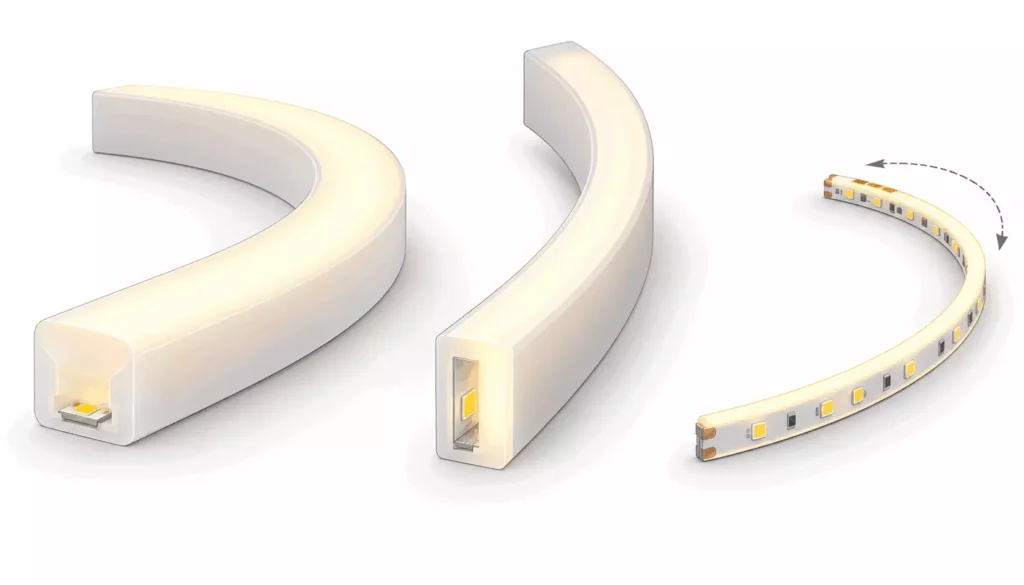
Neon flex is designed around a bend direction. NPHIS offers top-bend, side-bend and round profiles, because a profile that bends easily in one plane resists the other. A flat COB strip also bends in one plane only and does not take a twist. Our LED neon flex installation guide gives a typical minimum bend diameter of about 5 cm for the silicone series and warns that bending against the axis can crack solder joints. Before you swap:
- Mark the bend plane on the drawing for every curve.
- Check that the minimum radius suits the tightest curve.
- Confirm whether any run needs a twist or a 3D path. If it does, a flat strip needs a different solution.
Weather and UV protection
- IP rating is a system rating. IP67 means protection against dust and temporary immersion, as defined in CEI 60529. A bare strip does not earn it, and neither does a sealed strip with open cut ends. Check the rating on the finished assembly including the end caps and cable exit, because those are where water usually gets in.
- Material ageing. Sunlight yellows and hardens some plastics over time. NPHIS neon uses a silicone body described in our catalogue as anti-yellowing, UV resistant and salt-mist resistant; our comparison of silicone and PVC neon flex explains why material matters more than the chip outdoors. If you cover a COB strip with a diffuser, ask the diffuser supplier for the same information and do not assume it.
- Heat. A sealed channel traps heat. Check the power per metre (up to 14 W/m on the COB models above) and the channel’s ability to shed it, especially in direct sun.
- Voltage drop. At 24 V, long runs lose brightness at the far end. Plan injection points, or choose a constant-current version for long continuous lines.
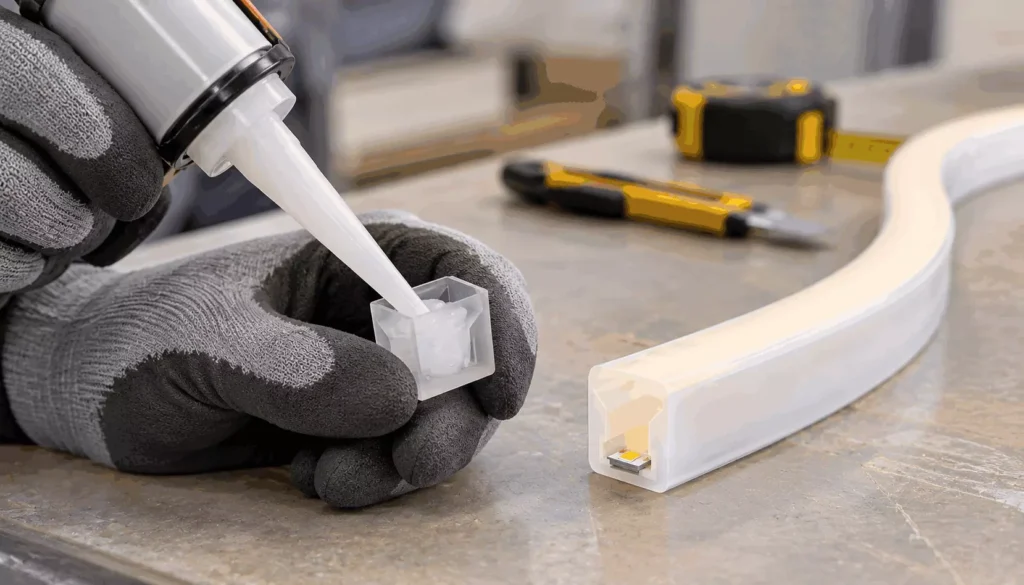
The cut end is the weak point of any outdoor strip. In our after-sales records, roughly 70% of product-failure claims turn out to be installation errors, not defective strips (see the installation guide). That guide recommends neutral-cure silicone in the end cap, because acidic glue corrodes copper pads, and at least 4 hours of curing before power-on. Apply the same discipline to a COB assembly.
Electrical safety also matters on the supply side. Our neon products run from low-voltage DC only, through a certified AC-DC power supply; they must never be connected directly to mains.
Standards and compliance. Ask any supplier for current test reports, and make sure the report covers the model you are buying. The COB datasheet carries CE and RoHS marks. As an example of how to read a report, we hold a RoHS report (HTT202201108CH) and an EMC report (HTT202201108ER) issued by Shenzhen HTT Technology Co., Ltd. in January 2022 for a family of SMD LED light bands. The EMC report states that one tested model (LM2835-138L) represents the others because they share the same circuit. These reports cover SMD light bands, not the COB or neon models above, so check which model was actually tested and which were assumed to be equivalent.
Compare installation and maintenance costs
Compare cost over the installed life, not the strip price.
Installation items to list for each option
- Strip or flex, per metre, at the finished length
- Diffuser, channel or profile, per metre
- End caps, connectors and cable exits, per run
- Sealing materials and labour for every cut and joint
- Power supplies, wiring and any injection points
- Mounting hardware (clips, brackets, fixings)
NPHIS neon ships with matched accessories: end caps, straight, side and bottom cable exits, clips, aluminium profiles and flexible 3D profiles, for surface, recessed, side-recessed and ground-recessed mounting. If you choose COB, make sure you can source an equivalent matched set, because mismatched parts are a frequent cause of failures. The installation guide compares clips and aluminium channels for speed and cost.
Maintenance questions
- Can one failed section be replaced without removing the whole run? On COB, check that the failed length can be cut out at a cut point (7.8 to 100 mm, depending on the model).
- Who can do it, and does it need special sealing skill?
- How is the product cut and rejoined? Cutting at the wrong point or resealing badly ruins the IP rating.
- What does the warranty cover? The COB datasheet shows a 5-year mark. Ask in writing whether it applies outdoors and what it excludes. Warranties often exclude improper installation, unauthorised modification, or operation outside the specified environment.
The lowest purchase price often loses on the second and third service visit. Add an allowance for maintenance access (lifts, scaffolding) when the line sits high on a facade.
For a full facade neon flex purchase from LED neon flex manufacturer, see our outdoor LED neon flex facade lighting design and buying guide.
Approve a side-by-side mockup before you specify
A mockup removes the guesswork that a data sheet cannot.
Build two samples on the same substrate
- Same length, same mounting surface, same power supply
- Same colour temperature, checked against the sample
- Each one finished with the real end caps, cable exits and joints

Then check
- Night view at the real viewing distance and angle. Look for dots, hot spots, uneven colour and shadows at corners.
- Daylight view with the line switched off.
- Bend test on the tightest curve in the drawing.
- Weather test: spray the assembly, including the end caps and joints, and check for ingress afterwards.
- Heat check: run the sample for several hours, measure the surface and channel temperature, and compare against the datasheet.
- Service test: replace one section and time it.
Record and sign off the result on a sample photo sheet, so that the decision is documented for the client.
Materials to prepare
- Datasheets for both models, with exact model codes
- Target viewing distance and the viewing positions
- IP rating, end-cap and joint details for the whole assembly
- Bend, power and accessory lists
- Maintenance route and cost assumptions
Related NPHIS guides
- COB vs SMD LED strips: which is better for your project
- LED strips for retail displays: a beginner’s guide to spotless COB and silicone neon
- Outdoor LED neon flex for facade lighting: design and buying guide
- How to install silicone LED neon flex with clips and channels
- Bandes LED néon flexibles en silicone ou en PVC
- Silicone LED neon flex product page
External reference: IEC 60529, ingress protection (IP) ratings
FAQ
❓️ Can COB LED strip be used outdoors?
Yes, if the finished assembly is protected. The bare COB board is supplied non-waterproof, so it needs a sleeve, silicone filling or a sealed housing, plus sealed ends. Check the IP rating on the finished assembly.
❓️ Is COB strip better than neon flex?
Neither is better in general. COB gives smooth, dot-free light as a source, and neon flex is a ready-made, weather-protected luminaire. The right choice depends on whether the line is exposed or concealed.
❓️ What does IP67 mean for outdoor LED lighting?
It means the enclosure is protected against dust and temporary immersion under the conditions defined in IEC 60529. It applies to the whole finished product, so end caps and cable exits count.
❓️ Can I cut neon flex or COB strip on site?
Only at the marked cut points, and you must reseal the cut end properly. COB cut lengths run from 7.8 to 100 mm depending on the model; neon cutting distances are given per profile in the catalogue.
❓️ How long can a 24 V run be?
hat depends on the product’s power per metre, the wire and the drive type. The NPHIS neon series lists single-end supply up to 20 m with constant-current drive. Constant-current COB versions are listed for 5 m and 15 m at 24 V and 30 m at 48 V. For anything longer, inject power along the line.
Can’t find the answer you are looking for?
Posez-nous une questionet nous serons heureux d'y répondre